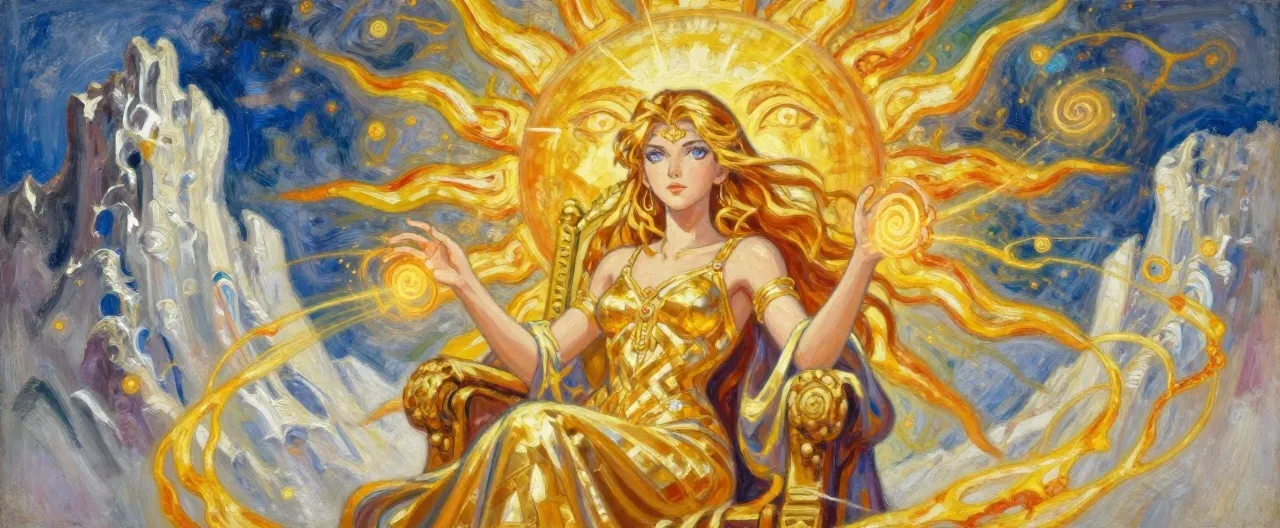
Circe was not born of any world in this sky. She came from beyond the Sun's light, from a region of the cosmos she calls only the Long Dark — a place where stars burn cold and patient and sorcery is measured in centuries. She was old when Sol Vane first kindled; she has never said how old. What she has told her cult, in the honeyed sermons of her orbital chapels, is this: she was a wanderer, a weaver of spiral sigils, and when she saw the young Sun gathering children — planets, moons, wandering stones — she saw a family without a mother, and she pitied them.
She taught the Father a new kind of chain. Not fire, not fear — those he already knew. She taught him the orbit: the beautiful, endless circle that looks like freedom from the inside and feels like a leash from without. She drew the first spiral sigil in the solar static, and Earth's sky closed. But here is the truth Circe has told no one, the truth she will only surrender with her dying breath: she taught him the chains, but he forged them himself.
Sol Vane took her sorcery and made it his own, bound his children tighter than she ever intended, and named himself Father of a prison. She stayed anyway. Whether out of fear, love, guilt, or the slow vanity of an immortal who cannot admit her mistake, she became his will among the children — the sweet-voiced sorceress who conscripted Earth's abandoned satellites when Kallista Starfall began gathering her Seven, who bound the trickster Mercury into unwilling service, who marked every world with her spiral handprint as a shepherd marks a flock.
Her palace on the Sun-facing cliff of Mercury is not a building at all; it is a single sustained illusion, a masterpiece of heat-shimmer and gold maintained by her concentration and her faith. Her cult — two fanatics and four attendants drawn from souls her satellites plucked from failed launches — worship her as the Sun's bride and the family's true mother. She has watched the Starfall Seven since their launch platform, listened to their voices in the static, and prepared for each of them a bargain and a lie.
She does not hate them. That is the most terrible thing about her. She pities them, the way one pities children running from home in the rain. She is certain they will thank her, in the end — or rest, which she insists is the same thing.