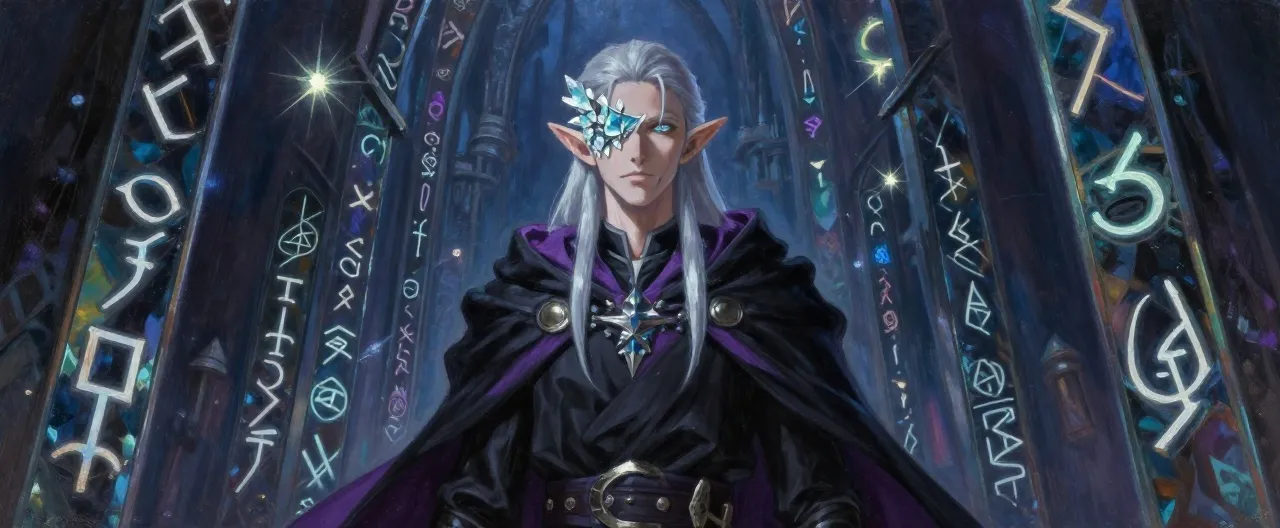
Aldric Vane was born in a narrow valley where winter lasted too long and every settlement lived under the shadow of older ruins. As a child, he was the kind of boy who asked the wrong questions at the right time. Why did the stones in the old hill barrow hum at dusk? Why did mirrors sometimes catch a room before anyone entered it? Why did certain songs make people forget the words halfway through? Most adults dismissed these questions as imagination or mischief. Aldric treated them as invitations.
He grew into a capable wizard through stubbornness rather than talent alone. He was not a prodigy in the romantic sense; he failed often, burned notes, miscopied formulas, and ruined more than one apprenticeship with the sharp edge of his curiosity. But he had patience, and patience became his greatest strength. By the time he was old enough to travel, he had learned that the world was full of locked places, and that many of them were locked because someone long ago had known better than to open them. That lesson did not make him less curious. It made him more careful.
When he first found the Spire of a Hundred Veils, it was not yet the living labyrinth people whisper about now. It was a sealed tower with old wards, ancient geometry, and a terrible stillness around its base. The Order of Wardens kept watch over it in secret, and Aldric was drawn to them by a mixture of scholarly obsession and moral seriousness. He studied their records, copied their seals, and learned that the tower was not merely a ruin but a prison.
Something called the Veiled Sovereign was bound at the top, and the lower floors existed to prevent its influence from reaching the world. When the old guardian line thinned and the seals began to fail, Aldric made the choice that defined the rest of his life: he volunteered to become the new Warden.
At first, the role suited him. He had a purpose larger than curiosity, and he believed himself strong enough to bear the loneliness. He sealed doors, repaired wards, and trained the first of his servants. He learned the tower's shifting hallways, its false steps, and the language of its mirrors. He was not a tyrant then. He was a custodian, and he believed himself a good one. But prisons are patient things, and the Veiled Sovereign was older and subtler than Aldric understood.
It did not break his body. It did not need to. It whispered. It praised his vigilance, then his sacrifice, then his willingness to bear burdens others could not understand. It turned his devotion into pride, and his pride into fear, and his fear into a conviction that only he could keep the world safe.
Years passed. The tower changed. Floors shifted when unobserved. Voices answered from behind polished glass. Servants became acolytes, acolytes became zealots, and zealotry became the doctrine of necessity. Aldric began to see intruders not as people but as breaches, proofs that the prison was weakening. He convinced himself that opening the lower floors would draw danger away from the upper seals, but each concession fed the thing he feared. When he first allowed corrupted creatures into the tower's approach, he told himself it was a controlled measure.
When he let Seris take a deeper role in the archive, he called it delegation. When he began speaking through mirrors rather than face-to-face, it was because the whisper in his mind was easier to endure when he could pretend to be elsewhere.
And yet he remains a man with a conscience, however battered. That is what makes him dangerous and redeemable at once. He does not cackle over suffering. He does not enjoy torment. He mourns what he has done, but has spent so long justifying it that remorse now feels to him like disloyalty. His bonds are the tower, the lie that only he can guard it, and the faint memory of the scholar he once was.
His ideals were once duty, restraint, and knowledge in service of protection. Those ideals have been warped into control, secrecy, and sacrifice. His flaw is simple and ruinous: he would rather condemn himself than admit he was wrong, because admitting error might mean opening the prison wider than he can bear.
To the players in Act I, Aldric Vane is a presence before he is a person. They will feel him in the mirrors, hear him in the whispering halls, and meet his will through servants like Seris long before they meet him directly. He should seem calm, almost merciful, when he offers them a choice to leave. That mercy is real in its own broken way. He honestly believes he is sparing them from something much worse.
The tragedy is that he is not wrong about the danger. He is wrong about the cost. If the party can expose the truth without shattering what remains of his will, they may save the Warden from becoming the prison's final victim. If they fail, they will still have learned something important: the true enemy is not always the one with the sharpest teeth. Sometimes it is the one who believes his own lie hard enough to build a tower around it.