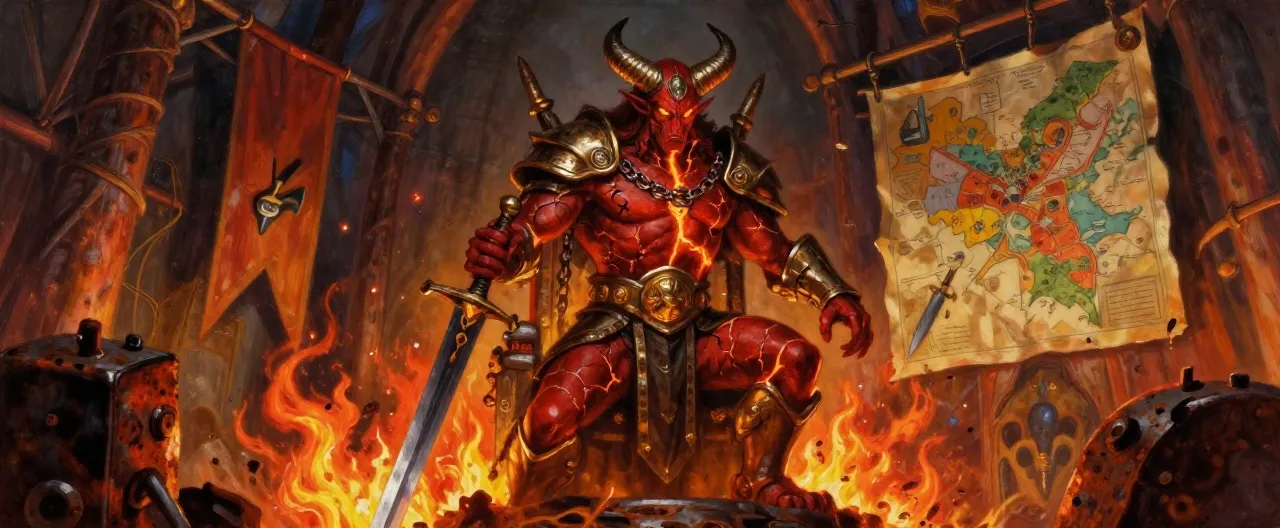
Vorgath's story begins, though he will never admit it, as a mortal soul—a damned man coin-stacked into the legions of Avernus some two thousand years ago. He has no memory of his mortal life beyond a name locked in a soul coin worn against his sternum, and he has decided that the name matters less than what he made of the damnation. As a bearded devil he fought in the Blood War's front lines, where he learned the lesson that defined him: chains break, blades dull, but a contract, precisely worded and witnessed, binds forever.
He taught himself infernal contract law in the trenches, between engagements, reading discarded writs scavenged from battlefields. His ascent was slow and surgical. He served a greater duke of the Brazen Wastes for a century, mapping every flaw in his master's holdings, and then brought a tithe dispute before the infernal courts so precisely argued that the courts awarded him the entire territory. The old duke's armor was melted and reforged into the rusted plates of the Rusted Citadel, which Vorgath raised on the ruins as both fortress and statement: the law had changed in the Brazen Wastes.
Two marshals of the old regime escaped the purge and remain at large in the badlands—a loose end Vorgath has hunted for two centuries. His ambition next turned outward, toward the Material Plane, but infernal incursion requires mortal partners. Kaelthar Vane came to him forty-three years ago: a mortal king drowning in losing wars, kneeling in the ash with an offer of his kingdom's soul tithe. Vorgath drafted the pact personally—banishment trap, soul engine, unending rule in exchange for a thousand souls a season—and believed he had found the ideal client: ruthless, literate in power, and desperate enough to accept hard terms.
For seven years the tithe flowed and Vorgath's influence in the Material Plane grew through embedded agents. Then Vane, having studied the soul engine his patron had gifted him, realized it could run on souls harvested directly, cutting Hell out of the transaction entirely. He stopped paying, sealed the rift with the engine's own power, and stranded Vorgath's agents as soul coins in the wastes. The betrayal did not enrage Vorgath—it refined him.
He spent the following decades doing what he does best: documenting. Every withheld soul is itemized. Every sealed rift is catalogued as breach of covenant. His court's bound pit fiend magistrate, Zhal'kereth, validated the claim, and the debt now stands at forty-three thousand souls plus compounded interest, enforceable the moment mortal hands can place the original contract before an infernal court. This is why the banished party matters. When Vane's banishment trap hurled the heroes into Avernus, Vorgath's spies watched them land in the Brazen Wastes and recognized the opportunity immediately: mortals the Emperor believes dead, carrying the Emperor's hatred, capable of reaching the Emperor's Vault where infernal claws cannot.
He has prepared for their arrival with the patience of two thousand years—key fragments readied, intelligence compiled, the second coin polished and waiting on a table beside a map of a kingdom pinned to the wall with a dagger. He is honest with them from the first audience: he wants Vane judged, he will pay for the privilege, and the wording of any promise they make him will matter forever.
What he does not tell them—what he may never tell them—is that the contract's final page transfers the tithe debt to the mortals who deliver Vane's soul, and that his long game stretches past the campaign's ending, into a gate he means to own, and toward a memory in the Styx that he has spent centuries trying to buy back.