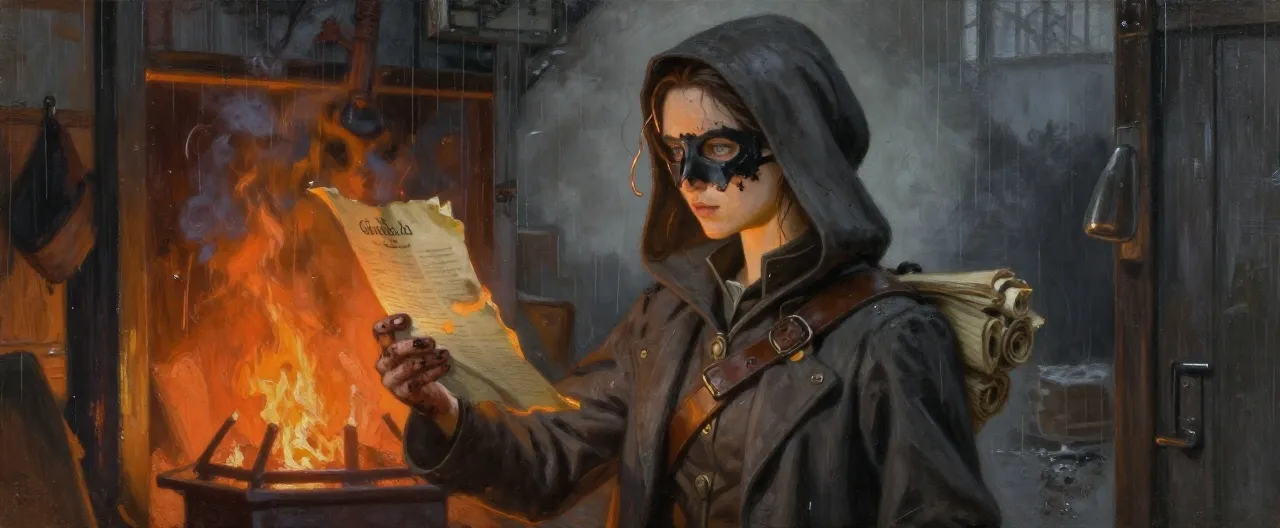
Rohanne Pyke was born in Amberford, the only child of Davram Pyke, an independent wool-broker and a clerk of scrupulous honesty who kept his own small counting office near the south-bank wharves. Her mother died of the winter fever when Rohanne was six, and Davram raised her among ledgers the way other fathers raise daughters among gardens: she learned her letters from invoices, her sums from freight tallies, and her father's one moral law before she learned to ride — keep honest books, whatever else you do.
It was not piety. Davram Pyke believed a clerk's ledger was a kind of covenant: that figures written plainly, checked twice, and never falsified were the only honest power a small man in a guild town would ever hold. Rohanne absorbed this as a faith. At fourteen she was apprenticed into the Amberford Wool Guild's counting room, where her precision made her noticed and her father's independence made her quietly resented.
At nineteen, everything closed. The guild, oversold on bonded wool contracts it could not cover, needed a shortfall hidden. Guildmaster Nathan Pyke — then a rising factor, not yet master — signed a false debt instrument against Davram's office, alleging bonded wool purchased and never paid for. The paper was witnessed, sealed, and flawless, because it was drafted by clerks. Davram was ruinous in a single season: contracts seized at debtor prices, office sold, name struck from the guild rolls.
He entered debtors' holding in the autumn and died there before the thaw, of damp and shame and the particular death that comes to honest men who are told, in writing, that they were never honest at all. His last letter to his daughter contained no accusation. It apologized for the debts and asked her to keep honest books, whatever else she did.
Rohanne kept them. She stayed at the guild, because leaving would have looked like guilt, and because a clerk who stays can read every page. For eleven years she processed pensions, filed bonded contracts, and watched Nathan Pyke rise on the difference between what the guild owned and what its public ledger said. She learned everything a counting room can teach: the guild shorthand cipher used for bonded instruments, the strongroom's habits, the specific weight of Nathan's signature.
She also learned, line by line, the thing she was looking for — that wool was being sold twice against the same debt, and that a buyer signing only in cipher was purchasing those debts through intermediaries at a fraction of their face value.
The contact came two years ago, through her Criminal background channel at the wharves: a sealed letter in guild shorthand, offering what no honest salary could — the means to make the guild's books burn in public. The letters signed themselves the Quiet Hand. Rohanne told herself she was an auditor; the mask, a soot-blackened clerk's half-mask scorched in her father's memory, was a professional instrument, not a disguise. She bought Vincent Todd with a copied debt and a silver piece.
She bought Karl Norton with his daughter's debt, paid quietly, and the receipt shown once. She learned Fire Bolt from a borrowed treatise because a burning page thrown from a distance is cheaper than a lamp, and the trick — Fog Cloud over a burning ledger, her gone before the smoke settles — became the town's rumor: the Cinder Clerk, burning the books of Amberford.
The campaign's tragedy is arithmetic she has not yet done. The cipher-mark on the Quiet Hand's letters matches the buyer's mark on the original false debt that ruined Davram Pyke. Her patron signed her father's ruin, then hired her to widen the ruin's market. She suspects. She has not audited it. She is twenty-nine, precise, courteous, grieving, and dangerous — and her ledger has one entry she cannot yet bring herself to close.