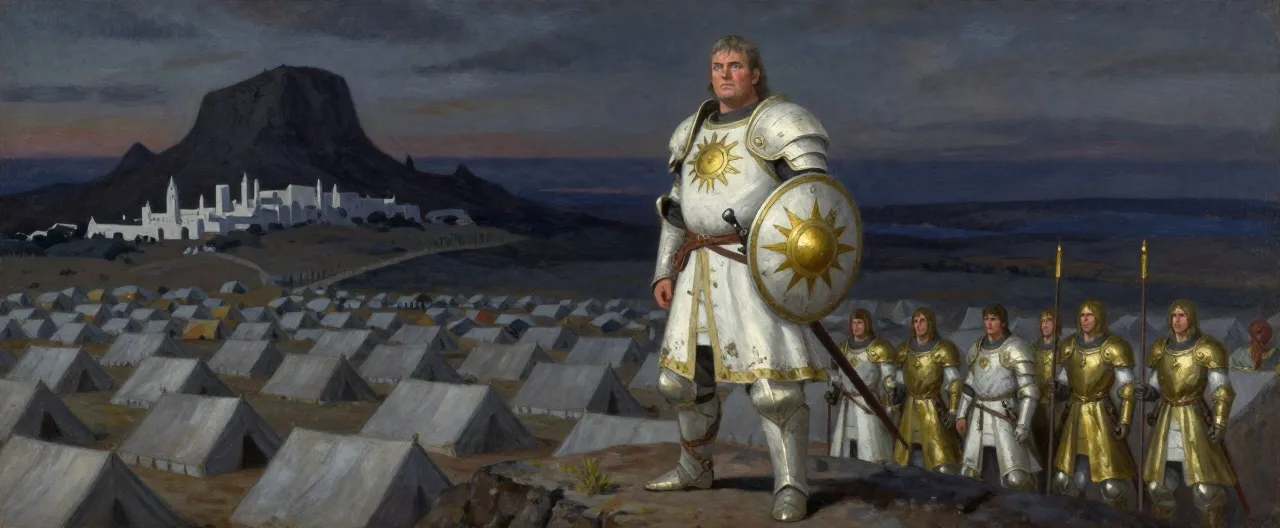
Basel Draper was born in Valleyford, the second son of salt-rakers who worked the pans south of the Verge and expected their boys to inherit a rake and a shortened life. He was a solemn child with a head for lists, and the story the family still tells is that at nine years old he kept a slate of every neighbor who owed them water, and forgave none of the debts — but also never once charged a traveler for a drink.
The Order of the Lamp came through Valleyford the winter he turned twenty-five, escorting a caravan too small and too sick to defend itself, and Basel signed on before the caravan master finished asking for men. His mother wept. His father said a knight's commission was just a longer road to the same grave, and Basel, who had already decided, said nothing, which was how he said everything.
The Order made him the way the road makes stone: slowly, by friction. He was never the strongest blade in a yard and never the boldest; he was the one who was still there at the end of the watch, the one whose reports were filed, whose kit was clean, whose shield was always between the dark and whoever stood behind him. He learned the spearmen's shield-count from a sergeant named Corwin's father, and he learned something more important from a hospitaler called Sister Maud, who ran the waystation infirmary at Dry Hollow and taught every knight who passed through that the Lamp's real weapon was not the sword but the counted name — that a man who knows every pilgrim by name cannot be persuaded that any of them is expendable.
Then came the rot camps. The Ash Rot swept the pilgrim roads in the worst season in living memory, and Basel spent a winter at the relief camps outside Dry Hollow watching the Lamp's best intentions drown in arithmetic. The sick outnumbered the cots. The bread ran short. The relief captain kept immaculate ledgers and counted the rations short every single day, and when Basel confronted him, the man said the words Basel has never stopped hearing: 'The ledgers balance, Sir Draper.
People do not.' Nine pilgrims died on Basel's watch that winter who did not need to. He carried the last one — a girl of eight with salt in her hair — two miles to the infirmary and was too late, and that night he took a knife and scratched a second sun into the paint beneath his shield-disc, one mark for each name he had failed, and made a vow he has never spoken aloud: the day he stops counting is the day he stops being a knight.
He walked with a limp from that winter on — not from any single wound, though the cold iron he took freeing Chain captives in his twenties finished what the frost began, but from the body's habit of holding what the mouth will not. Sister Maud was the only person who ever spoke of it plainly. 'You limp, Sir Draper, because you are carrying nine people on one leg. Put them down. Count them instead.' He has been counting ever since — twelve spears at dusk, every dusk, the way she counted the dead at the camps so that no one was buried unrecorded.
The years after were good ones, as the road measures good. He rose the slow way, without noble blood or chapter patrons, to senior knight and road command. He trained a young man named Corwin Vale, the last soldier he ever called a student, and lost him to a road escort that never reported home. He was given the Headland escort — the post every knight wants and no knight keeps long — twelve spears, a thin picket line against a thousand tents of pilgrims and a badlands full of teeth. And then, a month ago, the letters from Castillo stopped.
He has written four. The first three went the proper channels, through the waystations to the Almonry, and each was answered — warmly, personally, and always by Deacon Abel Warren, whose handwriting Basel has come to know the way a man knows the knock of a debt collector. The answers were perfect. The instructions thinned his escort each time. The fourth letter, half-written, sits in a sealed pouch at his hip, and Basel Draper — lawful, careful, plain Basel Draper — is afraid, and does not know of what, and writes the fear down because writing it down is the only prayer he still trusts.
What he does not know is that he is almost right and entirely wrong about the shape of it. The Order has not abandoned him. The Order has been eaten from inside, the way a lamp is eaten by moths — quietly, from within, by people who light candles and mean them. And the man at the top of that silence has been reading Basel's letters with great interest, because a knight who suspects but cannot prove is the most useful kind of knight there is: one who can be managed, or one who can be blamed.