Corvath the Bell-Toller

Level 3 Undead (custom: Lich, bound) Wizard (School of Necromancy) (School of Necromancy)

Available with DM subscription
Register to save this character forever!

This character will be deleted in 6 days. Create a free account to claim all your generated content.

STR
8 (-1)
DEX
14 (+2)
CON
13 (+1)
INT
17 (+3)
WIS
10
CHA
12 (+1)

Defense

Armor Class 15 (Mage Armor active (13 + DEX +1 from bone-hard flesh))
Hit Points 17 (3d6 + 3 (CON) + 6 (custom Undead Fortitude bonus) +1)
Speed 30 ft.

Proficiencies & Skills

Saving Throws Intelligence, Wisdom
Skills Arcana +5, History +5, Insight +2, Religion +5, Survival +2, Perception +2, Investigation +5

Features

Toll of the Soul-Bell (Custom)

custom Level 1
1/Legendary-scale action; usable once per encounter

As an action, Corvath rings the soul-bell (or, away from the vault, a hand-bell of bell-metal) with a resonant toll. Each creature within 30 feet of the bell (or 20 feet of Corvath, if using the hand-bell) makes a Constitution saving throw (DC 13). On a failure, the creature is Stunned until the end of its next turn and takes 1d6 cold damage; on a success, it takes half damage and is not Stunned. Warmth drains from the area: the ground within 60 feet is coated in unnatural frost for 1 hour.

Bell-Bound Soul (Custom)

custom Level 1

Esmond's binding ties Corvath's soul to the great soul-bell in the Bellfounder's Vault. While the bell stands intact, Corvath regains 5 hit points at the start of his turn if he has at least 1 hit point. If the bell is destroyed (AC 15, 30 HP), he loses this regeneration and his spell save DC drops by 1 until he reattunes. His true phylactery is hidden in Esmond's winter kingdom; he cannot be permanently destroyed while it exists, and he cannot enter that plane himself.

The Portal Key (Custom)

custom Level 1
Special

Corvath carries a bell-metal sigil that opens the Frostgate Hollow portal โ€” one-way, keyed to bell-metal from the soul-bell. A piece chiseled from the great bell (Sleight of Hand DC 13 or Athletics DC 15 to break free) serves the same function. He can open the portal as an action and shove creatures through, sealing it behind them.

Undead Nature (Custom)

species Level 1

Corvath is an Undead. He doesn't need air, food, drink, or sleep. He is immune to poison damage and the Poisoned condition, and cannot be charmed or frightened by non-magical means. His flesh is bone-hard: his unarmored AC is 13.

Network of Bells (Custom)

custom Level 1
Narrative

Corvath's cultists and paid informants across the Rye Meadow country report to him by night, by bell, and by fear. He is rarely surprised in his own hills and knows of any major movement toward the Old Mill or the vault.

Necromancy Savant

class Level 3

Corvath has learned to cast Necromancy spells with unusual efficiency; he halves the gold and time needed to copy Necromancy spells into his spellbook (a wizard school feature, flavored as centuries of study).

Grasp of the Grave (Custom)

custom Level 1
At will

Corvath's touch carries grave-cold. His unarmed strike (reach 5 ft.) deals 1d6 necrotic damage, and the target cannot regain hit points until the start of Corvath's next turn.

Grim Harvest

class Level 3

When Corvath kills a creature with a level 1+ spell, he regains hit points equal to twice the spell level (or 5 ร— the spell level if the spell used a Necromancy slot).

Arcane Recovery

class Level 1
1/Long Rest

During a Short Rest, Corvath recovers expended spell slots with a combined level of up to 3 (e.g., two 1st-level slots and one 2nd-level slot).

Ritual Casting

class Level 1

Corvath can cast a known spell as a ritual if it has the ritual tag and is in his spellbook.

Spellcasting

Intelligence DC 14 +6 to hit Level 1: 4 slots Level 2: 2 slots

Level 3 wizard prepares 6 spells (Intelligence modifier + level); the list above reflects his usual combat load-out. His spellbook also contains Find Familiar, Detect Magic, and Comprehend Languages (rituals only).

Ray of Frost

Cantrip class
Evocation 1 Action 60 feet V, S

A frigid beam of blue-white light streaks to a creature. Ranged spell attack; on hit, 1d8 cold damage and the target's Speed is reduced by 10 feet until the end of your next turn. Cantrip upgrade: +1d8 at levels 5, 11, 17.

Fire Bolt

Cantrip class
Evocation 1 Action 120 feet V, S

Hurls a mote of fire. Ranged spell attack; on hit, 1d10 fire damage. Cantrip upgrade: +1d10 at levels 5, 11, 17.

Minor Illusion

Cantrip class
Illusion 1 Action 30 feet S, M

Creates a sound or an image of an object within range that lasts 1 minute.

Mage Hand

Cantrip class
Conjuration 1 Action 30 feet V, S

A spectral hand appears and can manipulate objects at range for 1 minute.

Magic Missile

Level 1 class
Evocation 1 Action 120 feet V, S

Three darts of magical force each deal 1d4+1 force damage to creatures of your choice; the darts strike automatically.

Shield

Level 1 class
Abjuration 1 Reaction Self V, S

An invisible barrier grants +5 AC until the start of your next turn, including against the triggering attack, and blocks Magic Missile.

Charm Person

Level 1 class
Enchantment 1 Action 30 feet V, S

A humanoid must succeed on a Wisdom save or be Charmed for 1 hour, regarding you as a friendly acquaintance. Corvath uses this to 'hire' the living.

Ray of Sickness

Level 1 class
Necromancy 1 Action 60 feet V, S

Ranged spell attack; on hit, 2d8 poison damage and the target must succeed on a Constitution save or be Poisoned until the end of your next turn.

Web

Level 2 class
Conjuration 1 Action 60 feet V, S, M

Fills a 20-foot cube with difficult-terrain webs for 1 hour; creatures entering or starting their turn there make a Dexterity save or be Restrained (escape DC 14).

Misty Step

Level 2 class
Conjuration 1 Bonus Action Self V

Teleports up to 30 feet to an unoccupied space you can see. Corvath's escape tool of choice.

Behind the character

Character Information

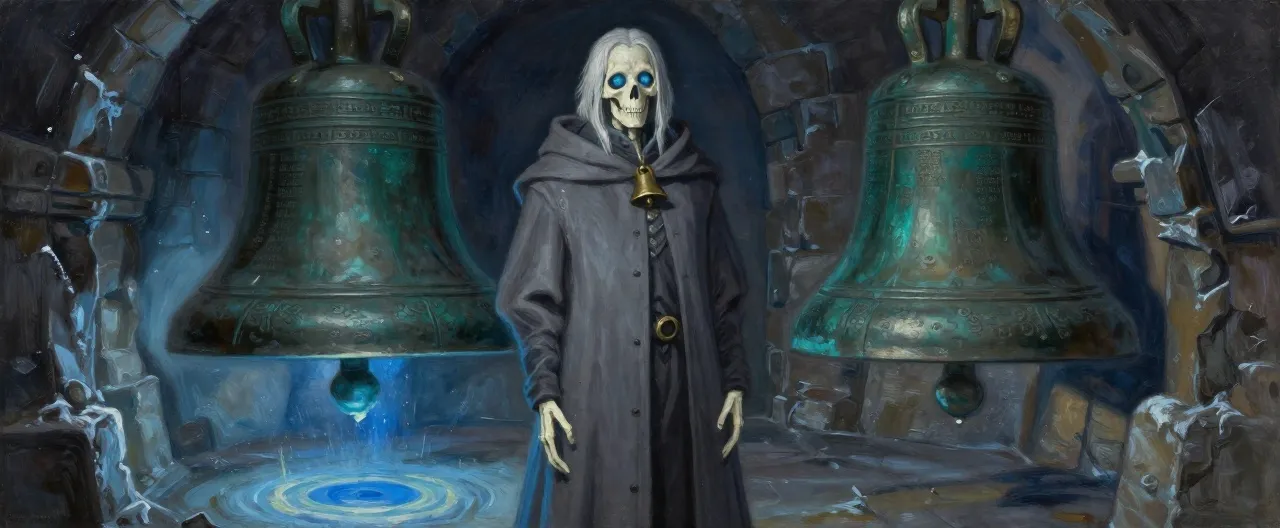
Corvath the Bell-Toller is a gaunt, desiccated figure of indeterminate age, his skin the grey-white of old parchment stretched over a skull's architecture. His remaining flesh clings to high cheekbones, and his eyes are twin points of cold blue light in dark sockets. Wisps of white hair, once a scholar's careful queue, hang lank past his shoulders. He wears a long grey coat of bellfounder's cut, buttoned to the throat, over a scholar's robe, with a bell-shaped pin of dull bronze at the collar โ€” cut, though no one in the Rye Meadow country knows it, from the very bell that holds his soul. His hands are long, precise, and bone-white, and they move like a clerk's: folding, counting, gesturing with dry patience. He smells faintly of cold bronze and old paper.

He speaks in soft, measured, unhurried sentences and never raises his voice โ€” the quiet is the threat. His metaphors are a ledger's metaphors: terms, deliveries, overdue accounts. His courtesy is elaborate and gallows-dry: 'Ah. My couriers. I was beginning to think no one would come.' He bows precisely at the waist before and after every threat, taps a slow bell-toll rhythm on any nearby surface when thinking, and drifts a half-step closer than comfort allows with his hands folded behind his back.

He is vain about his bell and his scholarship, correcting grammar mid-menace, and contemptuous of the living, whom he calls 'the warm' with faint disgust. When questioned or defied, his patience snaps into sudden icy fury โ€” and then he apologizes with such elaborate formality that the apology is worse than the rage.

Beneath the clerk's manner is a scholar who was betrayed by his own craft: a guild archivist who sold his order's secrets for a cure that never came, was bound to his own guild's masterpiece by a rival he still considers his inferior, and has spent two centuries in their ruined hall reading their ledgers and plotting a delivery he cannot make himself. His fear of Esmond is total, and the fear makes him cruel and hasty with the tools he does have โ€” cultists, informants, and now the party.

He calls them his couriers and means it as an insult. He means every courtesy as an insult. And in the inner pocket of his grey coat, sealed in wax that has taken the shape of his fingers, he carries an undelivered letter he has never once spoken of.

Before the adventure

Character Background

Three centuries ago, Corvath was the youngest archivist ever elevated to the inner rolls of the Bellfounders' Guild, a lawful order of bronze-casters and soul-archivists whose public trade โ€” bells for temples of Chauntea, Lathander, and Kelemvor across the northern reach โ€” concealed a deeper craft: the binding of souls to resonant bronze. Corvath loved the guild the way only a lonely man loves an institution: completely, and with conditions. He was brilliant, meticulous, and ambitious, and the founders' elders kept elevating him and never quite trusting him, a judgment he recorded in his private ledgers with wounded precision.

He might have died a respected guildsman if not for Vess Andrim, the apprentice courier who carried his sealed letters between the guild hall and the cabal's meeting places and never asked what was in them. When Vess fell ill of a wasting sickness the guild's physicians could not treat, Corvath did the one thing the founders' rolls forbade: he sold the guild's binding texts to a cabal of spell-scholars, in exchange for their promise of a cure. The cure never came. The betrayal was discovered. His name was struck from the founders' roll โ€” and the same season, the cabal's hunters came for the guild itself.

Among the cabal was Esmond, a spell-thief Corvath had competed with for years and consistently out-archived. Esmond could not out-scholar Corvath, so he out-waited him. When Corvath completed his lichdom โ€” the cabal's true prize, the reason they had wanted the binding texts โ€” Esmond struck at the moment of ascension, using Harrow Vell's stolen binding spell to chain Corvath's newborn undead soul to the great soul-bell of the guild hall. Then Esmond collapsed the foundry into the earth, hid Corvath's phylactery in the winter kingdom he would go on to rule, and left his rival to keep the ledger of his own ruin.

Vess died in the ambush that followed, killed by Esmond's hunters for the warning she had given Corvath โ€” the hour of warning that let him attempt an escape he did not manage. Her spirit, bound by the resonance of the bell she died within earshot of, still walks the mill road on frost-nights. Corvath has never spoken her name aloud since.

For two centuries, Corvath has lived in the Bellfounders' Vault, in the ruin of the guild that erased him, beneath the bell that holds him. He has rebuilt what he could: a cult recruited from the desperate of the Rye Meadow country, paid with coin and promises; a network of frightened informants who report by night and by bell; undead servants raised from guild apprentices whose wights, notably, still attack him on sight because his name is not on the roll.

He has been ringing the soul-bell to drain the warmth from the land โ€” partly to power his rituals, partly to weaken the boundary between planes so his portal will hold, and partly, though he would never admit it, because the cold is the only thing that has ever made him feel less alone in the dark.

His plan is simple and has taken two hundred years to assemble: the portal in Frostgate Hollow, keyed to bell-metal, opens one way into Esmond's kingdom. He cannot pass through it himself โ€” the binding holds his soul to the bell, and the bell stands in the Rye Meadow country. But warm bodies can pass. Eleven times before, he has sent couriers through. None returned. The party is the twelfth delivery, and this time he has been more careful: he has briefed himself on Esmond's fortress, he has armed his couriers when they agreed to terms, and he has โ€” for the first time in two centuries โ€” a margin note in his own handwriting that suggests the binding can be transferred.

He does not need the party to kill Esmond. He needs them to weaken him, reach the phylactery, and give Corvath back his soul. Everything else โ€” the courtesy, the contract, the bow โ€” is the ledger's arithmetic of a dead man who has finally, after two hundred years, seen a way to settle his accounts.
Threads to follow

Unresolved Plots

  • The thousand names etched on the soul-bell include souls bound by the founders for crimes the guild never recorded โ€” and at least a dozen of those souls were bound while still alive. Some are aware. Some have been listening to two centuries of Corvath's monologues, and they know things about him he does not know they know.
  • The shrine acolyte of Chauntea who fled south when the frost came took more than her faith with her: she took the shrine's copy of the founder's reforging notes and a rubbing of the counter-toll's inscription. She is alive, reachable, and does not know why three strangers might come looking for her.
  • Adele Westbrook's company was not the first. Corvath's ledger records eleven previous 'deliveries' โ€” living agents sent through the portal over two centuries. None returned. But one, a courier sent ninety years ago, sent something back: a bell-metal fragment that appeared in the vault's ritual circle one winter morning, etched with a message in Primordial that Corvath has never translated aloud.
  • The frost in the Rye Meadow country is not only the bell's leakage. It is spreading along lines that match the guild's old property boundaries โ€” as if the land itself remembers who owned it, and the cold is settling old claims. Mary Whitmore's family held one of those parcels, and her emergency silver chest contains a guild deed she has never shown anyone.
  • Esmond's border guards have begun patrolling within a mile of Frostgate Hollow โ€” closer than they have come in ninety years. Either the king knows couriers have arrived, or something on his side of the portal is pushing. Josmyn Lamb's exile suddenly looks less like punishment and more like the king clearing the ground before a move.

Beneath the surface

Secrets

  • Corvath's phylactery is not hidden in a fortress or a vault in Esmond's kingdom. It is hidden in plain sight, in the one place no one would look: the clapper of the great ice-bell that hangs in Esmond's throne room, rung by the king's own hand at every court session. Corvath knows this and has told no one, because a phylactery that close to Esmond is both perfectly safe and perfectly unreachable โ€” and because the knowledge is his last card.
  • Corvath did not sell the guild's secrets to the cabal for power or gold. He sold them to buy a cure for Vess Andrim, who was dying of a wasting illness the guild's physicians could not treat. The cabal's price was the binding texts; the cure never came; and Vess died anyway, in Esmond's ambush, carrying the last letter Corvath ever wrote her โ€” an apology he never delivered. He has never told anyone why he betrayed the guild, and he would deny it under torture, politely.
  • Corvath cannot ring the soul-bell himself. The toll that stuns and chills is rung by a mechanism โ€” a counterweighted clapper he triggers with Mage Hand and ritual gestures โ€” because the founders' binding prevents the bound soul from ringing its own bell. Every 'toll of the soul-bell' the party has heard attributed to Corvath's power is, in truth, the bell ringing *at* him, and he stands closer to it than anyone because it cannot hurt him as it hurts the living. This is why the counter-toll terrifies him: it is the only bell that could ring *about* him.

What haunts them

Fears

  • Esmond learning that living couriers have entered his kingdom โ€” because the king's reprisal would not target Corvath, who is safely caged, but the phylactery's hiding place, which Esmond could move or destroy at leisure once he knows it matters.
  • The counter-toll being rung. Not for the tactical damage โ€” for the judgment. The founders' failsafe exists to strip an unworthy keeper of the bell, and some part of Corvath, the part that still reads the guild's ledgers at night, believes the judgment would be correct.
  • Mortality. Beneath every plan to escape the binding is the terror that freedom means being alive again, alive means killable, and killable means the last two centuries of caution, cruelty, and careful bookkeeping were all for nothing. He would rather be Esmond's prisoner than a dead man's ghost โ€” and he despises himself for it.

What drives them

Aspirations

  • To stand in Esmond's throne room โ€” not as a conqueror, but as an archivist โ€” and take back the Codex of Tolling, his masterwork, from the shelf where the king in the snow keeps stolen things. He has rehearsed the speech he will give. It is devastating. He has been rehearsing it for two hundred years.
  • To settle the account of Vess Andrim: rites rung, name spoken aloud, letter delivered. He keeps the letter in his coat's inner pocket, sealed, and has carried it so long the wax has taken the shape of his fingers.
  • To be, once and finally, the ninth founder โ€” the name restored to the roll above the shaft, the guild's judgment reversed, the record set straight. He would settle for his name carved small at the bottom, beneath the eight who erased him. He would settle for being carved at all.

Personal quest ยท 1

The Ledger of Warm Names

Corvath keeps a ledger of every soul the soul-bell has toll-drained in the Rye Meadow country, and three names in it are wrong โ€” souls that survived the toll and are now walking around Brightwater carrying fragments of bell-resonance in their blood. He wants them found and 'audited' before their resonance matures into something that could crack the bell. He tasks cultists (or, in a crueler timeline, the party itself, as a test of obedience) to identify and bring these three warm-blooded anomalies to the vault alive.

Each survivor carries a bell-mark: a faint frost scar shaped like a clapper. Finding them means interrogating Brightwater, following cold trails at night, and deciding whether Corvath's 'audit' is a harvest or genuinely a threat to his binding.

Current Stage

Identify the three bell-marked survivors in Brightwater through rumor, frost-scars, and Timothy Rush's testimony.

Choice
Report the survivors to Corvath as instructed, warn them to flee, or recruit them as allies against the bell.
Reporting them feeds the bell and deepens the frost; warning them earns Brightwater's trust and Corvath's cold fury; recruiting them creates three NPC assets who can sense the soul-bell's toll before it sounds.
Alternative
Hand the survivors over, fake their deaths, or hide them in the vault's crawlspace with Stella's help.
Handing them over is the loyal path and Corvath rewards it with a piece of the bell; faking deaths requires Dobran Cole's forgery skills and risks exposure; hiding them risks the cult discovering the crawlspace.
Mechanical Rewards
  • Bell-metal token (cold resistance, 1 use)
  • Counter-toll shard amulet (advantage vs. the soul-bell's stun, at a necrotic cost)
  • Piece of the soul-bell (functions as the Portal Key)
  • Corvath's spellbook fragment (Ray of Sickness and Web, plus necromancy copying discount)
  • Transfer ritual notes (a rare ritual usable in Act III)
Narrative Rewards
  • Corvath's true history with Esmond and the cabal
  • The location of Corvath's phylactery in the winter kingdom
  • The counter-toll's existence and the Guild's judgment rite
  • Stella's freedom and Leo Porter's lasting loyalty
  • A possible path to Corvath's mortality โ€” or his destruction

Personal quest ยท 2

The Courier Who Refused Delivery

Two centuries ago, before his binding, Corvath employed a living apprentice courier named Vess Andrim โ€” a quick, cheerful young woman who carried his sealed letters between the guild hall and the cabal's meeting places, and who never asked what was in them. When Esmond's forces came, Vess was the one who warned Corvath, giving him the hour he needed to attempt his escape โ€” and Esmond's hunters killed her for it.

Corvath has never forgiven himself, though he would call it an 'unresolved account.' Her spirit, bound by the resonance of the bell she died within earshot of, still walks the mill road on frost-nights as a will-o'-wisp-like cold light. Corvath wants her laid to rest โ€” properly, with the guild's last rites, which require a bell rung by living hands at the place of her death. He cannot do it himself; undead hands cannot ring the rites.

This is the one errand he asks of the party with no deception in it, and it is the crack in his armor through which redemption might one day pass.

Current Stage

Find Vess's cold light on the mill road on a frost-night and communicate with her (she answers only to the guild's hand-signs, which Corvath teaches the party with uncharacteristic patience).

Choice
Perform the last rites at the place of her death as Corvath asks, or refuse to do a dead man's bidding.
Performing the rites frees Vess's spirit and visibly unsettles Corvath โ€” he thanks the party in a voice that almost isn't a clerk's. Refusing hardens him; the cold light continues to haunt the road and the frost deepens along it.
Mechanical Rewards
  • Vess's courier satchel, found at her death site: a bag of holding (small), containing Corvath's original pre-binding spell notes โ€” two additional wizard spells for the party's own casters to scribe
Narrative Rewards
  • Corvath's single true confession, overheard or offered: 'She carried my letters. Esmond's people killed her for it. I have never once said her name aloud since.'
  • The guild's hand-sign language, useful for silent communication in Esmond's kingdom where sound carries on ice

Personal quest ยท 3

The Vault's Ninth Founder

The Bellfounders' Vault was built by eight founders, and their names are carved above the great shaft. But the soul-bell itself is etched with a thousand names โ€” the souls bound into its bronze โ€” and one name near the clapper's seam does not match any guild record: Harrow Vell, the ninth founder, erased from the rolls. Corvath has spent decades trying to learn who Harrow Vell was and why the other founders struck his name from history, because the answer matters to him personally: the binding spell that Esmond used on Corvath was not Esmond's invention.

It was Harrow Vell's. Esmond stole it. And if Corvath can find Harrow Vell's original notes โ€” believed buried in the slag heaps beneath the vault, or carried south by the fleeing acolyte โ€” he can find the binding's flaw, and possibly its reversal. The excavation is dangerous: the slag heaps are unstable, haunted by guild-apprentice wights who obey the founders' rolls and attack anyone whose name is not carved above the shaft.

Current Stage

Excavate the slag heaps beneath the vault, evading or appeasing the apprentice wights by carving the party's names onto the founders' roll โ€” a binding of the party's own, temporary but real.

Choice
Carve the party's names into the founders' roll to pass the wights, or fight through them.
Carving names is a small, unsettling echo of Corvath's own binding โ€” the party literally writes themselves into the vault's history. Fighting risks collapsing the shaft onto the soul-bell chamber below.
Alternative
Give Harrow Vell's recovered notes to Corvath, study them first, or destroy them.
Giving them to Corvath advances his escape plan and his gratitude โ€” real, but conditional. Studying them first reveals the binding's flaw and the fact that Esmond's ice throne uses the same spell on his own subjects. Destroying them denies everyone the reversal and enrages Corvath beyond his usual courtesy.
Mechanical Rewards
  • Harrow Vell's binding notes (a rare document with campaign-wide consequences)
  • A founder's chisel of bell-metal: +1 to breaking or mending metal objects, and the only tool that can safely cut the soul-bell without shattering it
Narrative Rewards
  • The truth of the ninth founder and the origin of Esmond's binding spell
  • Corvath's genuine, unguarded gratitude โ€” the first emotion he has shown in two centuries that is not weariness or fear
  • The revelation that the eternal winter is a prison of souls, not merely weather

Major Decision

Context

When the party stands before the soul-bell, Corvath offers terms: serve as his couriers willingly, and he will open the portal gently, brief them properly, and even arm them for the cold. Refuse, and he shoves them through unprepared and uninformed. The offer is genuine โ€” his fear of Esmond makes him want the party to succeed โ€” but accepting it means taking a lich's coin and a lich's contract, and the contract has clauses.

Choice Made
Accept Corvath's formal contract of employment, or refuse and be thrown through the portal raw.
Impact

Accepting grants winter gear, a healing potion, and Corvath's honest briefing on Esmond's fortress โ€” plus a magical bell-mark on the wrist that lets Corvath speak to the party across planes (and lets him track them). Refusing means arriving in Frostgate Hollow with nothing, making the opening of Act II significantly deadlier, but free of his mark.

Major Decision

Context

The soul-bell can be damaged โ€” AC 15, 30 hit points โ€” before or during the confrontation. Shattering it strips Corvath's regeneration and weakens him for all later acts, but it also releases the thousand bound souls etched into its bronze at once: a torrent of the dead with nowhere to go, and the destruction of the only anchor keeping Corvath's soul in the Rye Meadow country at all.

Choice Made
Shatter the soul-bell to weaken Corvath, or leave it standing to keep his soul anchored where the party can find it.
Impact

Shattering: Corvath loses Bell-Bound Soul regeneration permanently and his save DC drops by 1 until reattunement โ€” but a thousand freed souls scatter into the Rye Meadow country as restless cold spirits, creating a new regional threat, and Corvath's soul drifts free toward his phylactery, making him harder to find. Leaving it: Corvath remains at full strength but predictably located, and the bound souls remain a bargaining chip โ€” some of them know Esmond's kingdom from the inside.

Major Decision

Context

If the party learns of the transfer ritual (via the Codex quest or Stella's overheard whispers), they hold the secret that could free Corvath from Esmond's binding โ€” or destroy him with it. Corvath does not know they know. In any private conversation after the vault, he will lie about the bell being his phylactery; the truth is that the bell is his cage, and the party can call that lie.

Choice Made
Confront Corvath with the truth of the binding and negotiate as equals, keep the knowledge hidden for later leverage, or sell it to Esmond's agents.
Impact

Confronting him: Corvath drops the clerk's mask entirely โ€” genuine fear, then genuine negotiation. He reveals the phylactery's location freely and offers a real alliance, though he will still betray the party at least once out of two centuries of habit. Keeping it hidden: the party holds a trump card for Act III. Selling it to Esmond: Corvath becomes huntable by the winter kingdom's agents, and the party earns Esmond's dangerous favor โ€” an audience with the king in the snow, on his terms.

Transformative Moment

Trigger

Vess's last rites are performed

Transformation

Corvath's voice loses its clerk's flatness for one full conversation. He speaks of the living without contempt for the first time in two centuries, and the party glimpses the guild archivist who existed before the cabal, before Esmond, before the bell. This moment is the redemption arc's foundation stone โ€” and if the party later betrays him, it becomes the wound that makes his villainy final.

Mechanical Changes

Toll of the Soul-Bell

Corvath will not use its stun effect against the party in the vault confrontation; the frost it leaves is thinner and melts in minutes rather than an hour.

Grief, not mercy, stays his hand โ€” but the effect on the fight is the same.

Transformative Moment

Trigger

The party learns the eternal winter is a mass soul-binding

Transformation

Corvath's role inverts. He is no longer the campaign's cold-hearted villain but the first victim of the true evil โ€” and the party's best-informed guide to the winter kingdom, because he was bound by the same spell that binds Esmond's subjects. His knowledge becomes essential; his treachery becomes tragic.

Mechanical Changes

Network of Bells

Corvath willingly shares his informant network's knowledge of the winter kingdom's border forts with the party, granting advantage on Survival and Investigation checks in Esmond's domain.

An enemy of his enemy โ€” and, for the first time, a plan that does not require the party to die.

Transformative Moment

Trigger

The party recovers Corvath's phylactery and offers him the transfer ritual instead of destruction

Transformation

The endgame fork. If the party offers mortality, Corvath must choose between two centuries of undead caution and the terrifying possibility of being warm again โ€” and of being, once mortal, exactly the kind of person Esmond's binding can destroy permanently. He will accept, and he will betray them once on the road, out of pure terror, before the choice is finally made.

Mechanical Changes

Bell-Bound Soul

Removed entirely upon successful transfer; Corvath becomes a living, mortal NPC wizard whose spells are weaker but whose freedom is real.

The binding lapses when the soul is re-hung; the bell's claim ends.

Ally

Dobran Cole

Relationship Cultist, lockbreaker, and reluctant confidant
Influence 6/10
Loyalty 4/10

Shared History

Corvath recruited Dobran Cole eight months ago through a debt broker in a river town south of Brightwater, buying the man's locks skills and his desperation at a fair price โ€” Corvath always pays, which is more than can be said for most employers of the desperate. Dobran picked the shrine cellar's locks, forged the cult's ledgers, and โ€” on Corvath's direct order โ€” posed as a guide to lead Adele Westbrook's company into the ambush on the mill road.

Corvath considers Dobran his most useful living asset precisely because Dobran knows he is damned and has stopped pretending otherwise. In return, Corvath has kept one promise: Stella Meadowbrook is alive, fed, and unharmed, because Dobran begged for it on the night the girl was taken, and Corvath honored the request with a clerk's precision โ€” 'One account settled,' he said, 'to keep the ledger honest.' Dobran is the only person Corvath speaks to without the bow, which is either affection or efficiency, and Dobran has never dared ask which.

He knows Corvath's moods better than anyone alive: the finger-tapping when the lich is calculating, the softer faster voice when he is afraid, and the elaborate apologies that follow his cold rages. Dobran uses that knowledge to keep himself and Grace's family off the ledger, and he would trade every secret he has to keep it that way.

Potential Breaking Points

  • If the party offers Dobran full immunity from Mary Whitmore's justice, he will give up the vault's guard rotation and Corvath's schedule in a heartbeat.
  • If Corvath learns Dobran has talked, the ledger gains a name โ€” and Dobran knows it, which is why he hides in the shrine cellar rather than flee south.

Enemy

Esmond, the King in the Snow

Threat Level 10/10
Conflict Type Rival, jailer, and the reason for everything

Personal Stakes

Esmond and Corvath were rivals in the same cabal of spell-scholars three centuries ago, competing for the same patron's favor and the same forbidden texts. Corvath was the better archivist; Esmond was the better thief. When Corvath completed his lichdom first, Esmond did not protest โ€” he waited, studied, and then struck at the moment of Corvath's ascension, using Harrow Vell's stolen binding spell to chain Corvath's soul to the great bell of the guild hall Esmond had already arranged to collapse into the earth.

Then he hid Corvath's phylactery in his own winter kingdom, where Corvath cannot follow, and left him to rot in a ruined vault on a plane he despises. Corvath's hatred of Esmond is not the clean hatred of an enemy; it is the humiliation of a scholar who was outplayed by a man he still, privately, considers his inferior. Esmond took his freedom, his masterwork (the Codex of Tolling), his guild hall, and his dignity, and Corvath has spent two centuries building a machine of cultists, bells, and portals for the single purpose of sending someone else โ€” anyone else, anyone warm โ€” through that portal to do what he cannot.

His fear of Esmond is total and he knows it, and the knowing makes him cruel to the couriers he needs most. If Esmond ever learns that Corvath has found living agents willing to enter his kingdom, the king will act first, and Corvath knows that too.

Possible Resolutions

  • Esmond's destruction frees Corvath's phylactery to be recovered โ€” and removes the only being Corvath has ever feared.
  • Recovering the phylactery without killing Esmond gives the party leverage over both lich and king.
  • Esmond's binding spell, once understood, can be turned against him โ€” Harrow Vell's notes are the key.

Faction

The Bellfounders' Guild (extinct)

Standing -8/10

Influence

The Bellfounders' Guild was a lawful order of bronze-casters and soul-archivists who served temples across the northern reach for four hundred years, casting bells for shrines of Chauntea, Lathander, and Kelemvor and keeping the guild's true trade secret: the binding of souls to resonant bronze for safekeeping, judgment, and โ€” in the founders' darkest texts โ€” punishment. Corvath was the guild's youngest archivist ever elevated to the inner rolls, and he betrayed it: he sold the guild's binding secrets to the cabal, believing knowledge should belong to whoever could pay, and the guild's elders struck his name from the rolls the same season the cabal's hunters came.

The guild did not survive the century that followed; the vault was its last hall, and the soul-bell was its last great work โ€” cast to be a prison, though the founders never said for whom. Corvath's relationship with the guild is the closest thing he has to conscience: he despises the founders for erasing him, envies them their craft, and has spent two centuries alone in their ruin reading their ledgers.

The apprentice wights in the slag heaps still obey the founders' roll and attack him on sight, which he finds both insulting and, in his darker hours, correct. The counter-toll โ€” the founders' failsafe against an unworthy keeper of the soul-bell โ€” is the guild's final judgment on him, still pending, and Corvath's hunt for its shards is the closest a dead man comes to dreading a verdict.

Obligations

  • The guild's last rites for dead members must be rung by living hands โ€” a duty Corvath cannot perform and has never stopped wanting performed.
  • The founders' roll binds whoever is carved upon it; Corvath's name was struck, and the wights know.

Benefits

  • Knowledge of the guild's hand-sign language, taught to the party during Vess's quest
  • The founder's chisel, if the slag heaps are excavated
  • The counter-toll's existence and the shards' locations, if Corvath can be made to share what he knows

Ready to Unleash Your Character's Full Potential?

Join thousands of players and create rich, detailed character backgrounds with Fable Fiesta!

Register to unlock personal quests, relationships, and narrative hooks!

Sign Up Now - It's Free!

No credit card required. Start creating in minutes!