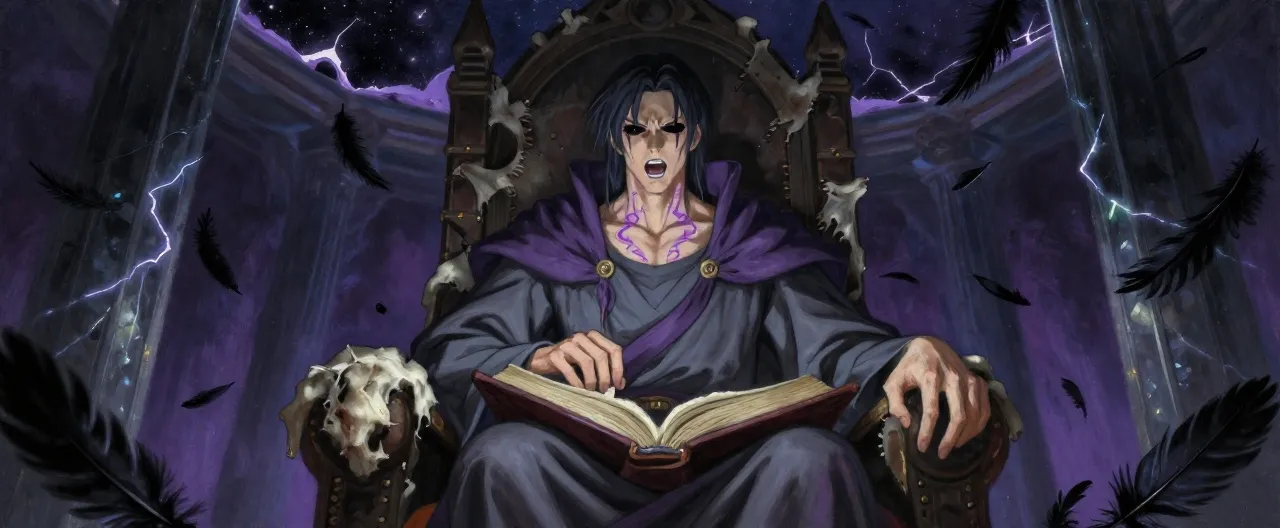
Vaelen Mor was born in a mountain village below Mount Kael, the son of a tanner and a midwife, a sickly boy afraid of the dark who nonetheless begged the traveling astronomer Orin to teach him the stars. Orin, amused and eventually fond, gave the boy his first cantrip on the Observatory's cracked dome: a light that would not gutter. For six years Mor studied under Orin, learning that magic was patience, that darkness was 'just light holding its breath,' that knowledge was a lamp carried into the unknown. He was, by every account, a gentle and brilliant student.
Then the Reach-Plague came. Mor's account—and the account carved into Choir doctrine—is that fever took his parents and his younger sister in a single winter, and that grief drove him from Orin's side into darker texts. The truth, buried so deep even Mor no longer recognizes it, is different: at nineteen, experimenting with planar breach theory far beyond his training, Mor tore a pinprick rift in his family's cellar. The void-hunger that came through did not kill quickly.
Mor sealed the rift too late. He carried his sister's body out of the dark himself, told himself the plague had done it, and never opened that memory again. The lie calcified into doctrine: death is the enemy, and only power over the boundary between life and unlife matters.
He spent fifteen years as a wandering scholar, then a court mage, then a disgraced court mage after his experiments in necromantic boundary-work were exposed. It was in disgrace, in a borrowed room above a bog-side tavern, that he first heard the whisper: a single page of the Codex of Flayed Whispers, sold to him as scrap vellum by a furtive dealer. The page whispered. Mor listened. What he heard was not temptation but recognition—the Void spoke to him the way Orin once had, patiently, as if he were the only reader it had ever wanted.
He spent the next decade gathering pages. He learned that Archmage Vaelthar, two centuries dead, had tried to swallow a shard of the Void Beyond and been flayed by his own artifact, his skin becoming the Codex's binding—thirteen pages, thirteen strips. Mor tracked fragments through bogs, asylums, and burning libraries, and with each page his body changed: grafts of void-touched skin, eyes that darkened to pits, a voice that began slipping into reverse. He founded the Unbound Choir from the ruins of older void-cults, gave it liturgy and rank and purpose, and promised them what he promised himself: an end to mortality.
Today Mor commands the Rift of Flayed Sky, a fortress of black glass suspended beneath a wound in the sky. He sits on a throne stitched from the skins of those who 'accepted salvation,' the Codex open in his lap, preparing the vessel ritual that will crown him the Void's living vessel. He has sacrificed lieutenants, villages, and his own humanity to reach this point. He believes the ritual will elevate him. The Codex believes it will feed. One of them is wrong, and the campaign's final act is the answer.
Mor's daily existence is a study in controlled dread: he does not sleep, he turns Orin's stolen orrery sphere when thinking, he writes orders with a black feather quill in reverse script, and he rehearses monologues about the Void's beauty with the nervous care of a man who cannot bear silence. He is, in the end, what happens when a frightened boy's grief is never allowed to be grief—when it is instead fed, page by page, to something that whispers back.