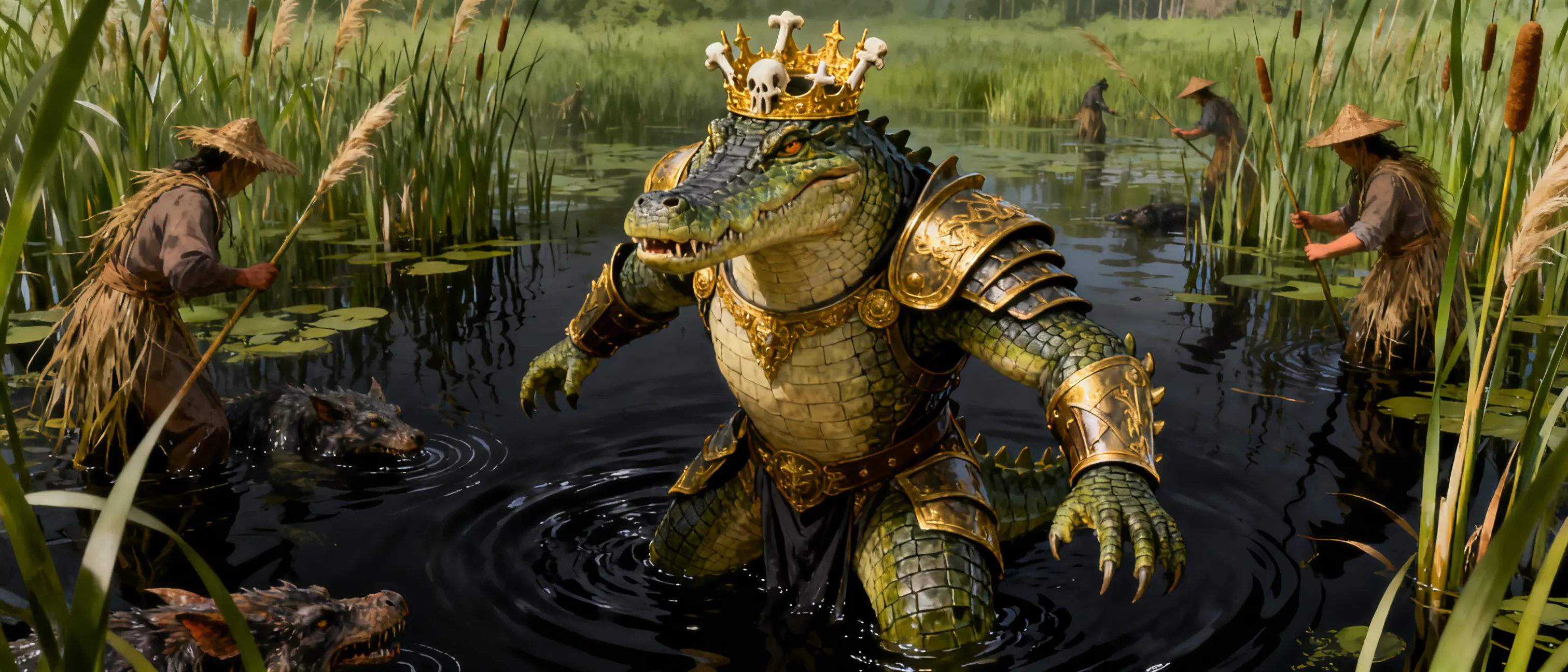
Character Background
Razzak was not born into nobility in the clean, torchlit sense that southern courts prefer to tell the story. He was born in the mire, or at least he insists he was, and in the swamp that is a distinction with little meaning. In his telling, the water recognized him first. In the quieter version of the tale, he was a sharp-eyed hatchling from a half-drowned reed village that learned early how quickly the swamp can eat the weak. His first lessons were not in honor but in supply: how to count fish, how to read the line of a submerged current, how to spot the silence that means a predator is near. He learned that every living thing in the swamp survives by taking from something else, and that anyone who denies this is either a fool or a liar.
As he grew, Razzak displayed an uncanny talent for reading people as if they were tributaries. He knew where they would bend, where they would flood, and where they could be dammed. He was charismatic long before he was powerful. He could speak to frightened marsh folk in a voice that sounded almost kind, then turn the same voice cold enough to make even hardened collectors hesitate. He learned ceremony from traveling temple agents, bargain law from smugglers, and intimidation from watching beasts tear apart the careless. He took all of it and forged it into one principle: the swamp should have a single will, and that will should be his.
His rise to power came through a mixture of opportunism and sacrilege. He discovered an older shrine half-buried in black water, one that spoke of oath, dominion, and the right of the hungry to rule the flooded lands. Whether he found a relic there or stole one from beneath the altar depends on which witness is still alive, but the result was the same. Razzak gained a symbol of authority that the swamp folk recognized instinctively. With it came obedience from beasts, fear from collectors, and an eerie legitimacy that made his rule feel less like an occupation and more like a remembered law.
That power was never clean. The crown, signet, or relic he wears does not simply grant authority; it also binds. The more he uses it, the more the swamp answers, and the more his own identity becomes tangled with the ancient force below the mire. He tells himself this is the price of kingship. In private, perhaps only in the dark when the water is still, he may fear that he is not the master at all. But Razzak cannot afford fear for long. He has built a court on certainty, and everyone around him has learned that uncertainty is the first meal a predator takes.
Razzak's personality is theatrical because theater gives him distance. If every meeting is an audience, then every challenge is a performance, and performance can be controlled. He prefers to smile when others expect anger, to offer respect when others expect violence, and to use politeness like a net thrown over a struggling opponent. Defiance offends him profoundly, not merely because it threatens his rule, but because it denies the story he has built about himself. He is not content to be strong. He must be inevitable.
His allies are mostly functionaries and frightened opportunists. Some collectors obey because they are cruel. Others because they are trapped. A few because they think Razzak is the only thing keeping worse horrors from rising out of the mire. That belief is important to him. He cultivates it. He wants his enemies to hate him, but he also wants them to admit, at least in their hearts, that he is necessary. This is the seed of both his power and his possible ruin.
If the party confronts him with mercy, he may treat it as insult before he recognizes it as an alternative. If they expose the swamp’s older power, he may become desperate, determined, or briefly humbled. Redemption is possible, but only by making him surrender the very thing he has mistaken for identity: the crown, the role, and the intoxicating lie that domination is the same thing as rule. Until then, King Razzak remains what the mire has taught him to be: a predator wrapped in ceremony, a tyrant with manners, and a hungry sovereign who believes every road in the swamp should eventually lead to his jaws.