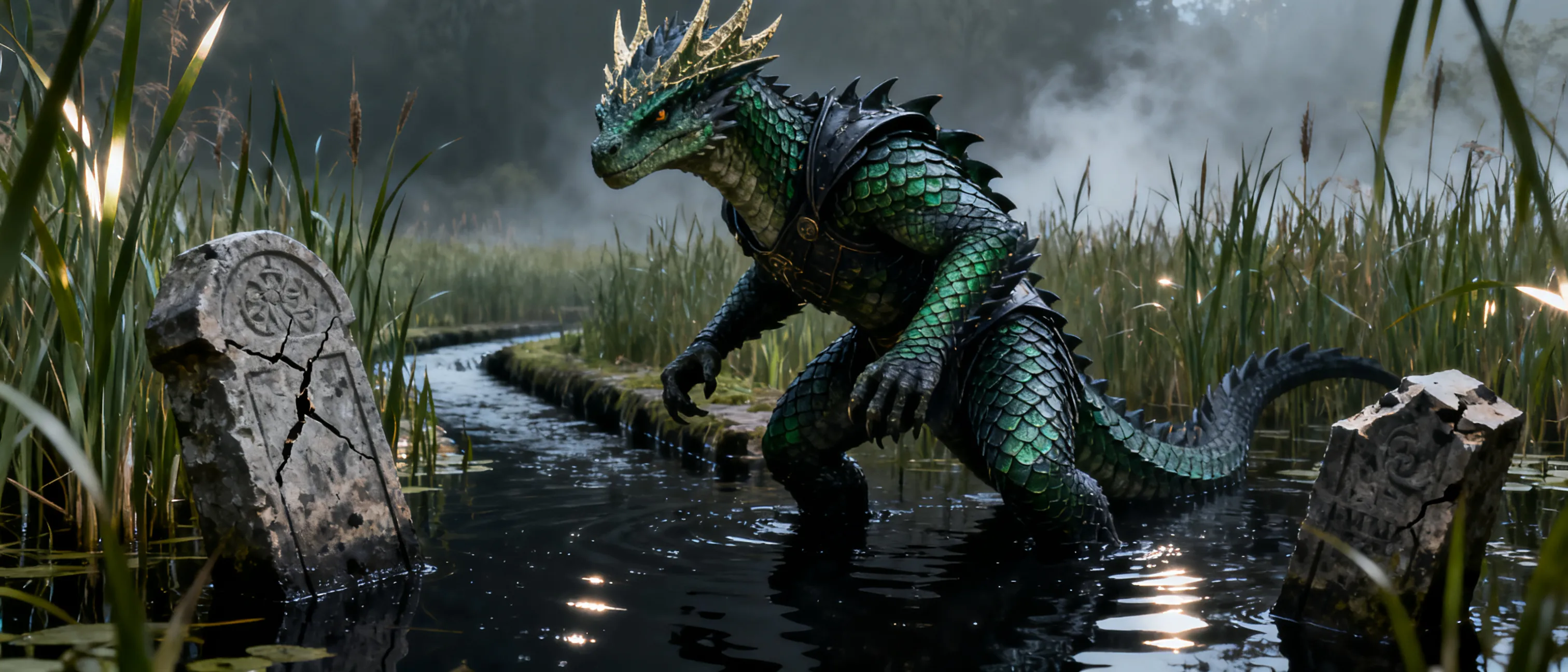
King Varkhos, the Mire Crown

Level 2 Swamp-Bred Human Fighter (None)

Available with DM subscription
STR
15 (+2)
DEX
14 (+2)
CON
14 (+2)
INT
10
WIS
12 (+1)
CHA
13 (+1)

Defense

Armor Class 18 (Scale mail, shield)
Hit Points 20 (2d10+4 +2)
Speed 30 ft., swim 20 ft.

Proficiencies & Skills

Saving Throws Strength, Constitution
Skills Stealth +4, Athletics +4, Deception +3, Intimidation +3

Features

Mire-Court Tactician

Custom
At will

Varkhos is always treated as having advantage on Charisma (Intimidation) checks made against swamp locals, frightened prisoners, or creatures that have seen one of his ambushes within the last hour. This represents his royal-judge cadence and the fact that everyone in the swamp has heard of his punishments. This feature is custom and narrative-facing, not a replacement for combat statistics.

Hidden Channel Predator

Custom

While in shallow water, mud, reeds, or dim swamp terrain, Varkhos can attempt to Hide as a bonus action if he is lightly obscured or behind cover. In addition, his swim speed in swamp terrain becomes 20 feet, and he ignores nonmagical difficult terrain caused by mud or standing water during his movement. This feature is custom and intended to reinforce his terrain-control style.

Fighter Level 1

Class Level 1

The character gains proficiency with all armor, shields, and martial weapons; proficiency in Strength and Constitution saving throws; and two skill proficiencies from the fighter list.

Criminal Skill Package

Background Level 1

The background grants proficiency in Sleight of Hand and Stealth, reflecting underhanded dealings, infiltration, and route-running through hidden channels.

Criminal Feat: Alert

Background Level 1

The character gains Initiative Proficiency and can swap initiative with a willing ally after rolling initiative, if neither is Incapacitated.

Action Surge

Class Level 2
Once per short rest

On the character's turn, they can take one additional action, except the Magic action. This feature refreshes on a short or long rest.

Second Wind

Class Level 1
Once per short rest

As a bonus action, the character regains 1d10 + fighter level hit points. This feature refreshes on a short or long rest.

Fighting Style: Defense

Class Level 1

While wearing armor, the character gains a +1 bonus to Armor Class.

Character Information

King Varkhos, the Mire Crown, rules the swamp like a patient catastrophe. He does not roar or brag. He speaks with the measured certainty of a judge delivering sentence, and with the stillness of something that has already chosen where to bite. To the frightened settlements along the mire's edge, he is not merely a bandit chief or monster in a crown. He is the shape fear takes when it learns to count grain, gold, and lives.

Varkhos believes the swamp is honest in a way dryland kingdoms are not. Roads break, walls crumble, laws are ignored, but the channels remain, the leeches remain, the hunger remains. In his mind, only a ruler ruthless enough to match that truth can keep the region from collapsing into constant predation. He demands tribute not because he loves wealth, but because tribute proves dependence. Every crate, ferry toll, and map fragment brought to him confirms that the swamp belongs to him first and everyone else only by permission.

He is slow to anger, but never forgiving. He prefers to weaken enemies before they ever see his face, using collectors, informants, and the swamp itself as a weapon. If confronted openly, he tries to pull the battle into deep water and broken ground where panic does half the work. His greatest strength is not his claws or steel, but his patience. He waits for mistakes. He waits for fear. Then he strikes where people are already losing their footing.

The party may defeat him, bargain with him, or force him into retreat, but they will always be dealing with a ruler who thinks survival justifies cruelty. That belief makes him dangerous, memorable, and hard to fully trust even when he is on the heroes' side.

Character Background

Varkhos was not born wearing a crown. He was born on the swamp's edge, where the waterline moved with the season and every family learned that survival was negotiation. As a child, he watched boats disappear into fog, watched reeds hide both fish and knives, and learned early that the law of distant towns never reached the deepest marsh. When people in his hamlet argued over food or passage, the strongest voice usually won, but the strongest voice was not always the wisest. Sometimes it was the voice that understood where the current would carry a body, where the mud would hold a trap, or which path looked safest until dusk.

He grew up small for his age, all sharp eyes and watchful silence. Other children mocked his caution until the day a flood broke a causeway and took two of their number. Varkhos survived because he had already mapped the higher roots, the firmer banks, and the hidden bends in the channel. He was old enough to understand something simple and terrible: in the swamp, information was power, and power was the difference between being eaten and becoming the thing others feared.

As a young man he worked among ferrymen, boat cutters, and muck traders. He learned how tribute moved, how bribes changed hands, and how panic spread faster than disease after a raid. He also learned that many would rather obey a tyrant who promised stability than trust a neighbor who promised fairness and failed. That lesson shaped him. He did not become cruel in a single moment. He became convinced, piece by piece, that cruelty administered with discipline was kinder than chaos left to itself. He told himself that the swamp already demanded sacrifice; he was simply the one honest enough to collect it.

When a local power fractured under flood, disease, and infighting, Varkhos seized the opening. He took over a half-drowned stronghold, first by controlling the routes, then by controlling the collectors, then by making every safe crossing contingent on tribute. He studied old route marks, submerged supply lines, and the habits of villagers who tried to hide their goods. He used human opportunists and swamp-born beasts together, not out of loyalty to either, but because fear works best when it comes from more than one direction. His marshhold became a place where people came to kneel, bargain, or vanish.

Varkhos is not a madman. That is what makes him so dangerous. He keeps ledgers. He values predictability. He punishes waste. He lets rumor do work that swords cannot. He can be patient enough to allow a village one good week before demanding a harsher tithe the next. He can speak kindly to a messenger even as he decides that messenger's family should be watched. He never rushes because he believes panic belongs to other people. He wants others to feel the swamp closing around them while he remains the still center.

His bonds are few but real in their own ugly way. He trusts informants who have proven they can survive his suspicion. He values collectors who understand that obedience is cheaper than rebellion. He remembers those who insult him, not because they wounded his pride, but because they revealed a weakness in his control. His ideal is simple: order through dependence. His flaw is equally simple: he cannot imagine a community strong enough to govern itself without a ruler like him. If the party offers proof otherwise, they challenge more than his power. They challenge the story he tells himself to survive being the monster in the crown.

Whether he is defeated, bargained with, or left to brood beneath a new order, Varkhos changes the swamp forever. If he falls, the tribute network collapses and the settlements can begin making their own future. If he is spared, he becomes a bleak ally against deeper horrors in the marsh, but never a safe one. In either case, he remains what he always was: a ruler who believes the swamp is strongest when someone is willing to become its teeth.

Unresolved Plots

  • Who first taught Varkhos the hidden canals, and why did they trust him with that knowledge?
  • Several tribute captives vanished before reaching the marshhold, and no one knows where they were taken.
  • One of Varkhos' ledgers lists payments to a source outside the swamp, suggesting a larger power or buyer behind his rule.
  • The villagers suspect someone in Reedbank has been feeding the king information in exchange for protection.
  • A submerged causeway beneath the blackwater may lead to a forgotten chamber under the throne room.

Secrets

  • Varkhos is not just cruel; he is terrified of being ordinary and forgotten.
  • He keeps a private route map hidden in a watertight tube, separate from the collectors' copies.
  • He once spared a child who could identify him by his original name, and that mercy still haunts him.

Fears

  • Being forced into open water without his route advantage.
  • Losing control of the tribute ledger and becoming unable to predict the swamp.
  • Discovering that the settlements can survive without any king at all.

Aspirations

  • Make every ferry, canoe, and channel answer to his permission.
  • Be remembered as the ruler who tamed the swamp through discipline.
  • Turn the marshhold into a fortress that no rebel, beast, or rival can breach.

QUEST -- The Tributary Ledger

Varkhos believes the swamp only works when every path is counted, taxed, and feared. His first personal quest is the recovery and consolidation of the tribute ledgers that track who pays, who resists, and who can be broken without destroying the supply routes. He wants every canoe launch, ferry landing, and half-sunken road to answer to him, not because he is greedy in a simple sense, but because he truly believes that order must be enforced through dependence. If he can recover the missing route pages, prison manifests, and collection marks, he can tighten his grip on the region without needing open war. The quest matters because it reveals what Varkhos values most: control through logistics, not just violence. It also exposes his blind spot, which is that he sees people as channels to be managed rather than communities that may choose to resist. If the party interrupts this quest, his network becomes less predictable and his response grows crueler, but also more desperate.

Current Stage

Trace the missing tribute boat and determine which hidden canal was used to reroute the cargo.

Choice

Pursue the route clue quietly and recover the ledger pages before Varkhos notices.

If the ledger is recovered intact, the characters learn how organized and far-reaching Varkhos' tributary network is. They also gain a practical weakness to exploit later, because the routes themselves are the king's real power. The king grows suspicious, but the party gains leverage and local trust.
Alternative

Burn the ledgers publicly to rally the village against the king.

Destroying the records makes a powerful statement, but it also erases the cleanest evidence of who is being coerced, who is collaborating, and where prisoners are being moved. Some villagers feel inspired, while others panic because they know retaliation is coming.
Mechanical Rewards
  • If the party defeats or humiliates Varkhos, the tribute network fractures, reducing patrols and travel hazards in the swamp.
  • If negotiated with, Varkhos can become a temporary regional ally who grants safe passage through one hidden canal route.
  • If the party exposes his ledger system, they gain evidence useful for later persuasion, intimidation, or blackmail in swamp settlements.
Narrative Rewards
  • The swamp settlements gain hope that the king can be challenged.
  • The party earns the attention of frightened boatmen, collectors, and informants who know secret routes.
  • The campaign gains a stronger political layer, with every safe channel becoming a story of power.
QUEST -- The King Beneath the Waterline

Varkhos is obsessed with fighting where he has the advantage: deep water, narrow causeways, hidden reeds, and places where panic does more damage than steel. His second quest is to control the battlefield itself by controlling the swamp's edges. He wants to widen the flooded throne room, sink old roads, and collapse any high ground the party might use against him. This quest matters because it shows that his tyranny is environmental, not merely political. He is not only a villain who commands followers; he is a villain who has turned geography into a weapon. The heroes can respond by learning the same terrain, building defenses, and turning the swamp's own geography back against him. As a character beat, this teaches Varkhos that power without stability is vulnerable to clever resistance.

Current Stage

Identify the hidden water channels that let Varkhos move troops unseen.

Choice

Map the channels and share them with the village defenders.

The settlement gains practical knowledge and can resist future raids with confidence. Varkhos loses the secrecy that made his patrols terrifying, and he responds by changing routes and punishing informants.
Alternative

Seal the channels with debris and traps.

This is a decisive tactical strike that can slow collectors and cut off Varkhos' mobility. However, it can also flood innocent areas or strand local boat traffic if done carelessly, creating a moral cost the party must live with.
Mechanical Rewards
  • If completed, the party gains a strategic understanding of swamp movement and hidden channels.
  • One successful plan against the king can grant a permanent bonus to survival or navigation checks in swamp terrain, at the GM's discretion.
  • The party may claim or destroy hidden route maps, reducing enemy mobility in future sessions.
Narrative Rewards
  • The heroes become known as the people who learned the swamp's secret roads.
  • Villagers begin sharing their own maps, secrets, and warnings with the party.
  • The campaign shifts from survival to liberation and strategy.

QUEST -- The Price of Mercy

If the party defeats Varkhos but does not destroy him, he may offer cooperation against a deeper force in the marsh. That offer is not kindness; it is calculation. His final personal quest is to test whether survival, tribute, and vengeance can coexist in a way that keeps him relevant. He wants to know whether mercy is only a tool other rulers pretend to value. This quest is important because it puts the entire campaign's moral pressure into one enemy. Varkhos can become a useful, ugly ally, but never a safe one. He will try to prove that all governments are coercive in the end. Whether the characters accept, reject, or exploit that claim tells them who they are becoming as leaders.

Current Stage

Set terms for any alliance and decide what Varkhos must surrender.

Choice

Demand hostages, maps, and a sworn truce before any cooperation.

Varkhos is forced to give up tangible leverage, which makes any alliance less dangerous but also more fragile. He will resent the humiliation, yet he will recognize strength. This can create a tense but functional partnership if the party keeps pressure on him.
Alternative

Refuse any alliance and finish him regardless of larger threats.

The heroes make a clear moral choice at the cost of a possible strategic advantage. This can be satisfying and clean, but it may leave the party without the local knowledge Varkhos possesses, especially if the deeper marsh threat becomes active.
Mechanical Rewards
  • Unlocks a final regional change: either the swamp becomes freer, or it becomes ordered under a new regime.
  • The party may gain a permanent contact among former collectors or boatmen if they handle Varkhos' end carefully.
  • If Varkhos is spared, he can serve as a conditional ally against a greater marsh threat, granting one high-value piece of intelligence per arc.
Narrative Rewards
  • The characters define what justice means in the swamp.
  • The end of Varkhos becomes a visible turning point for the entire campaign.
  • The swamp's future changes from fear of tribute to a struggle over governance and memory.

Major Decision

Context

The first time the party confronts his tribute system directly, Varkhos must choose between theatrical mercy and immediate punishment.

Choice Made

Present himself as a lawful judge who spares some captives while punishing one example in public.

Impact

This reinforces his image as a patient ruler and can split local opinion, but it also exposes his need for control through spectacle. Mechanically, it gives him a recurring intimidation edge in the region and makes later social scenes harder for the party if they fail to counter his narrative.

Major Decision

Context

When the party starts disrupting hidden routes, Varkhos must decide whether to defend the channels or sacrifice lesser collectors to preserve his throne room.

Choice Made

Abandon subordinate forces to save the heart of his power.

Impact

He becomes colder and more strategic, willing to lose pieces to protect the board. This can remove some patrol threats while increasing the danger of his elite defenses. It also creates opportunities for defectors who feel betrayed.

Major Decision

Context

If the party corners him at the marshhold, he must choose between fighting to the death or negotiating from weakness.

Choice Made

Offer a truce that preserves his life at the cost of tribute control.

Impact

This creates the most dangerous version of Varkhos: a wounded tyrant with a reason to survive. Mechanically, he may become a temporary ally with access to route knowledge, but his betrayal risk remains high and should shape future encounters.

Transformative Moment

Trigger

The tribute ledger is stolen or publicly exposed.

Transformation

Varkhos realizes that fear alone does not secure logistics. He begins taking personal interest in witnesses, informants, and the families of collectors, becoming more deliberate and personally cruel.

Mechanical Changes

Behavior

Shifts from broad patrols to targeted reprisals and hostage pressure.

He no longer trusts impersonal control and starts hunting the party's support network.
Encounter Style

Favor ambushes near water and retreat routes over open patrols.

He knows direct authority is becoming fragile.

Transformative Moment

Trigger

The party survives a major raid and defends a settlement.

Transformation

For the first time, Varkhos sees organized resistance rather than frightened compliance. This changes him from a local bully into a ruler who believes he is at war.

Mechanical Changes

Motivation

Escalates from taxation to suppression of rebellion.

He interprets defense as political insurrection.
Reputation

Collectors and informants become more nervous and more violent.

They expect harsher orders and preemptive punishment.

Transformative Moment

Trigger

His throne room is breached or threatened.

Transformation

The king is forced to confront the possibility that the swamp can outlast him. If he survives, he becomes either vindictive and desperate or practical and unexpectedly diplomatic.

Mechanical Changes

Tactics

May trade brute force for alliances, traps, or bargains.

He cannot assume terrain alone will save him.
Legacy

A defeated Varkhos leaves behind a power vacuum that can spawn new factions.

His collapse changes the campaign from survival against a tyrant to governance after tyranny.

Ally:
Elder Marra

Relationship Uneasy civic rival turned temporary interlocutor
Influence 3/10
Loyalty 2/10

Shared History

Marra has spent years trying to keep the swamp settlements alive by paying, bargaining, and delaying disaster. Varkhos respects her because she understands the practical side of leadership, but he also sees her as a problem: someone who can organize people without ruling them through fear. Their relationship is built on repeated negotiations over tribute schedules, flood damage, prisoner exchanges, and road access. He never threatens her casually, because he knows she can hold a community together long enough to ruin a simple raid. She, in turn, knows that he is not stupid or impulsive, which makes every conversation with him feel like standing beside a still river full of teeth.

Potential Breaking Points

  • If the village refuses one more tribute payment, Varkhos may blame Marra and target her family.
  • If Marra sees a chance to end the raids permanently, she may help the heroes expose his informants.
  • Varkhos may offer Marra protected status if she publicly denounces the party.

Enemy:
Captain Brack of the Reed Cutters

Threat Level 2/10
Conflict Type Ambush commander and rival collector captain

Personal Stakes

Brack believes Varkhos will eventually discard him, so he keeps copies of route notes and tribute tallies as insurance. He is useful, cowardly, and dangerous in exactly the way an underling becomes dangerous when he knows too much. Varkhos tolerates him because Brack can be sent where loyalty is uncertain, but their relationship is poisoned by mutual suspicion. Brack would gladly betray the king if he thought it would keep him alive and profitable, yet he fears that Varkhos already expects this and is simply waiting for the right moment to make an example of him.

Possible Resolutions

  • Expose Brack to turn him into a source of route intelligence.
  • Defeat him in a public raid to weaken Varkhos' collector network.
  • Offer him a better deal than the king and watch whether his fear outweighs his greed.

Faction: The Marsh Toll Collectors

Standing -8/10
Influence They control hidden channels, ferry schedules, and punitive raids across the swamp edge.

Obligations

  • Deliver tribute goods, prisoners, and route notes to the marshhold.
  • Enforce Varkhos' decrees at villages and crossings.
  • Report all signs of organized resistance or new paths through the swamp.

Benefits

  • Access to safe travel on known routes for loyal agents.
  • Protection from bandit attacks while under the king's banner.
  • The right to confiscate goods from those who fail to pay.

Ready to Unleash Your Character's Full Potential?

Join thousands of players and create rich, detailed character backgrounds with Fable Fiesta!

Register to unlock personal quests, relationships, and narrative hooks!

Sign Up Now - It's Free!

No credit card required. Start creating in minutes!