Varek Mourn

Level 2 Human Cleric (War Domain)

Available with DM subscription
STR
12 (+1)
DEX
10
CON
15 (+2)
INT
8 (-1)
WIS
17 (+3)
CHA
13 (+1)

Defense

Armor Class 16 (Scale mail and shield)
Hit Points 17 (2d8 + 4 +2)
Speed 30 ft.

Proficiencies & Skills

Saving Throws Wisdom, Charisma
Skills Insight +5, Religion +1

Features

Acolyte

Background Level 1

Skill Proficiencies: Insight, Religion. Tool Proficiency: Calligrapher's Supplies. Feat: Magic Initiate (Cleric). Varek learned sacred forms, hymn-codes, and the anatomy of faith before he ever learned how to pray for mercy.

Channel Divinity: Turn Undead

Class Level 2
1/Short Rest

As a Magic action, undead that can hear or see Varek within 30 feet must make a Wisdom save or become turned. Varek uses this as a ritualized purge, not compassion, and often times it to create a corridor for escape.

Human Traits

Species Level 1

Medium humanoid. You have no darkvision. Human features are represented here as a disciplined, adaptable survivor shaped by hardship and study; Varek relies on careful planning, not innate gifts.

War Priest

Subclass Level 1
Proficiency Bonus per Long Rest

When Varek takes the Attack action, he can make one weapon attack as a Bonus Action. He uses this sparingly, preferring to let minions and terrain do the work before committing his own blade.

Divine Order

Class Level 1

Varek has devoted training that supports battlefield control and exacting discipline. He keeps his formation tight, protects his evidence, and uses positioning as if it were a liturgy.

Magic Initiate (Cleric)

Background Feat Level 1
1/Long Rest for the chosen 1st-level spell; cantrips at will

You gain two Cleric cantrips and one 1st-level Cleric spell that you can cast once per Long Rest without a spell slot. Your spellcasting ability for these spells is Wisdom.

Channel Divinity: Guided Strike

War Domain Level 2
1/Short Rest

When Varek makes an attack roll, he can add +10 to the roll after seeing the d20. He saves this for a decisive strike against a healer, scout, or isolated target.

Resourceful

Species Level 1

Varek is trained to improvise under pressure, carrying records, notes, tools, and toxins with methodical care. He treats every scrap of information as a weapon.

Cleric Spellcasting

Class Level 1

You can cast prepared Cleric spells using Wisdom. Your spell save DC is 13 and your spell attack bonus is +5. You prepare 5 Cleric spells after each Long Rest.

War Domain Spell: Divine Favor

Subclass Level 1
always prepared

Varek always has divine favor prepared. He can call on grim certainty to sharpen his strikes when escape is no longer possible.

Spellcasting

Wisdom DC 13 +5 to hit Level 1: 3 slots

Varek prepares 5 cleric spells each day. He typically swaps among command, healing word, inflict wounds, sanctuary, and detect magic or shield of faith depending on the scene. The Magic Initiate feat provides guidance, resistance, thaumaturgy, and one additional 1st-level cleric spell; for simplicity, the stat block above includes the feat cantrips and one practical 1st-level option in his prepared list.

Guidance

Cantrip SRD
Divination 1 Action Touch V, S

A willing creature adds 1d4 to one ability check of its choice before the spell ends.

Resistance

Cantrip SRD
Abjuration 1 Action Touch V, S, M

A willing creature adds 1d4 to one saving throw of its choice before the spell ends.

Thaumaturgy

Cantrip SRD
Transmutation 1 Action 30 feet V

You create a minor supernatural effect, such as booming voices, trembling earth, or slamming doors.

Command

Level 1 SRD
Enchantment 1 Action 60 feet V

You speak a one-word command to a creature; on a failed save, it must obey on its next turn if possible.

Divine Favor

Level 1 SRD
Transmutation 1 Bonus Action Self V, S

Your weapon attacks deal extra radiant damage for the duration.

Healing Word

Level 1 SRD
Abjuration 1 Bonus Action 60 feet V

A creature of your choice regains hit points at range. Varek uses it to keep cultists alive long enough to extract useful data.

Inflict Wounds

Level 1 SRD
Necromancy 1 Action Touch V, S

Make a melee spell attack; on a hit, the target takes heavy necrotic damage. Varek favors this against cornered, exposed, or isolated foes.

Sanctuary

Level 1 SRD
Abjuration 1 Bonus Action 30 feet V, S, M

A ward discourages enemies from attacking the warded creature unless they succeed on a Wisdom save. Varek uses it as a retreat tool or to shield a key witness.

Character Information

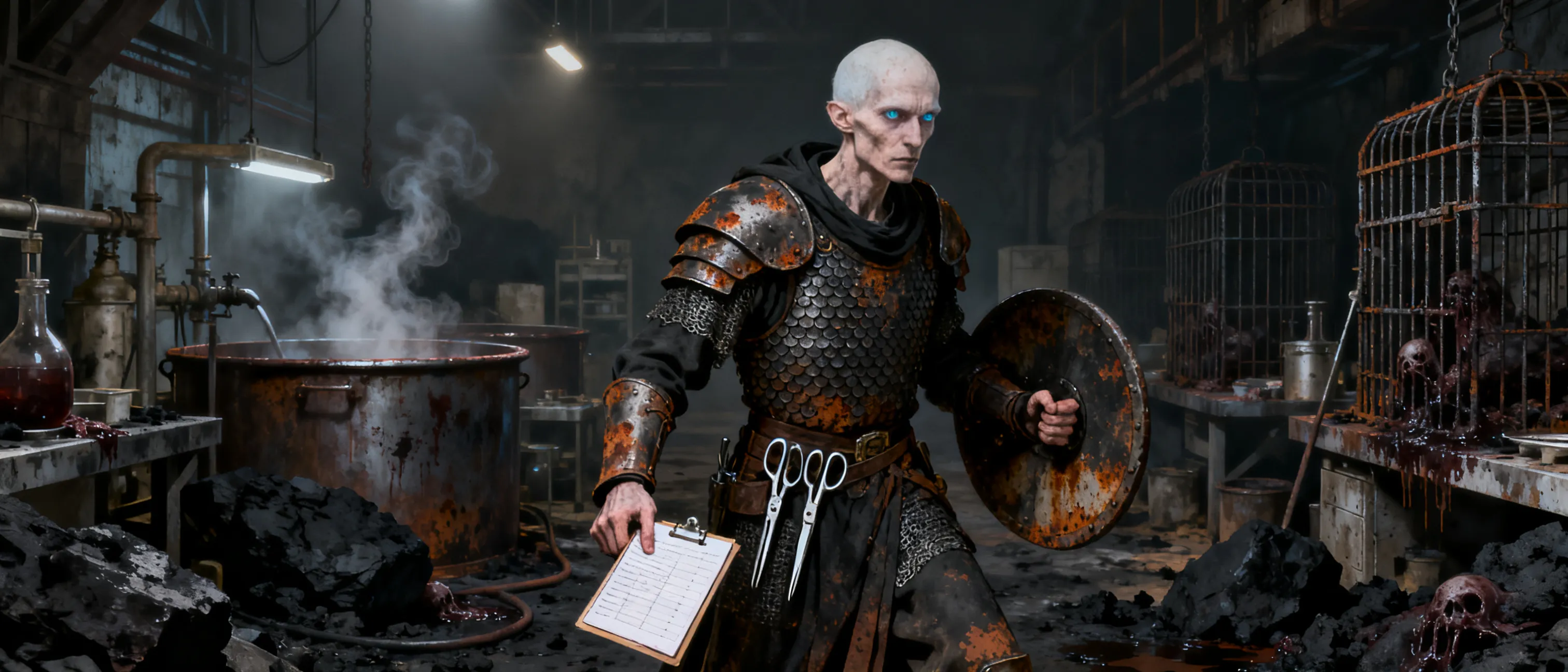
Varek Mourn is the kind of villain who never needs to shout to be terrifying. He speaks in the measured cadence of a surgeon and treats every wound, outbreak, and scream as a useful observation. To him, suffering is not a moral problem but an instrument: a blade used to cut away weakness before a larger conflict begins. In the first act of the campaign, he serves as the hidden hand behind the Dark Mutant outbreak, directing cultists, bandits, and corrupted beasts from a concealed quarry laboratory. He avoids fair fights, preferring traps, disposable followers, and battlefield denial over courage. When cornered, he becomes ruthless, focusing on healers, isolated characters, and anyone who looks capable of keeping others alive.

What makes Varek compelling is that he is not chaotic. He is devout, organized, and deeply convinced that his methods are justified. He is the sort of enemy who believes history will thank him if enough people survive long enough to fear him. That certainty makes him dangerous, but it also creates a weakness: he cannot easily process evidence that his work is simply devouring the innocent. If the heroes capture him instead of killing him, they gain a living source of truth about the conspiracy behind the outbreaks. If they confront him with the right proof, he may not repent, but he can break.

As a villain, Varek is designed to fit a harsh, heroic, survival-driven campaign. He is not the final evil, but he is a cruel and intelligent first answer to the question of who made the monsters. Defeating him matters because it reveals the next layer of the wound.

Character Background

Varek Mourn was not born into villainy; he was raised into discipline, scarcity, and the belief that every hardship had a purpose. As a child, he lived in a border settlement where winter illness was just as deadly as bandits. His earliest memories are not of comfort, but of long hours copying scripture, boiling herbs, and watching adults make impossible choices about who would be fed, who would be treated, and who would be left to endure. The local faith house gave him structure. It also gave him a language for obedience, sacrifice, and ritual purity, and Varek learned quickly that people found reassurance in certainty even when certainty was only a mask for fear.

He was an attentive student. While other initiates drifted toward prayer, songs, or community rites, Varek became fascinated by the practical side of care: bandaging, dosage, quarantine, purification, record-keeping. He was excellent at observation and even better at detachment. If someone had a fever, he wanted to know what caused it. If a limb had to be cut away to save a life, he did not flinch. This made him valuable during an outbreak in his youth, when the settlement was hit by a wasting sickness that killed more than half the surrounding farms. Varek helped organize the sickhouse, isolate the worst cases, and keep the records that allowed the survivors to endure. He was praised for being calm, efficient, and unafraid.

That praise changed him. He began to believe that emotional resistance was a flaw, that mercy without structure was merely sentiment, and that suffering only became evil when it was wasted. Where others saw tragedy, he saw process. Where others saw grief, he saw data. The first time he allowed one patient to be used in an experimental treatment without proper consent, he justified it as necessity. The treatment failed. The patient died. Varek did not stop. He simply made his notes cleaner.

Over time, his work hardened into doctrine. He started calling himself a purifier, then a steward, then an instrument of necessary correction. He collected records, supply manifests, prayer texts, and medical annotations with equal care. He found that secrecy made his methods easier to defend and that frightened followers were easier to command than enthusiastic ones. When the larger conspiracy behind the Dark Mutants offered him access to hidden laboratory material, corrupt residue, and living specimens, Varek saw an answer to his lifelong obsession: if monsters could be made, then fear itself could be engineered. He would not simply treat outbreaks. He would shape them.

In the quarry laboratory beneath Blackwater Ford, Varek finally became what he had always been becoming. He took a ruined space of stone and labor and turned it into a place of controlled ruin. There he tested residue, dosed captives, altered beasts, and mapped how panic spread through a village faster than any contagion. He built a small circle of cultists and hired bandits around himself, not because he trusted them, but because he understood their appetites. He gave them structure, purpose, and enough fear to keep them loyal. He used stolen village records to predict supply routes and movement patterns. He kept one corrupted war-beast as a living proof that pain could be shaped into utility. Every success reinforced his belief that the world did not need kindness; it needed management.

Yet Varek is not entirely free of conscience. That is what makes him dangerous and potentially breakable. He does not enjoy cruelty in a theatrical sense. He is not loud, ecstatic, or reckless. He is controlled, almost reverent, and therefore capable of convincing himself that the terrible thing he is doing is a form of mercy. This is also his flaw. He can be shaken by evidence that his work is consuming the innocent rather than saving the many. If confronted by a survivor, a burned ledger, or a living witness he cannot dismiss, he may hesitate in a way that surprises even him. He may not become good, but he can become uncertain.

Varek’s goals are simple to state and horrifying to hear. He wants to purify the world through controlled suffering. He wants fear to become a tool of order. He wants the outbreaks to break resistance before the true campaign begins. And above all, he wants to leave no evidence that he was ever anything other than necessary. That desire makes him a perfect Act I villain: local in scale, personal in cruelty, and large enough in ideology to cast a long shadow over the campaign that follows. The heroes can defeat him, capture him, or force him to speak. Any of those choices will matter, because Varek is one of the first men in the setting who proves the monsters were made by human hands.
Unresolved Plots

  • A second quarry site may exist farther inland, and Varek’s notes imply it is larger than the first.
  • Someone in the village records was altered to hide shipment dates, suggesting an accomplice with civic authority.
  • The corruption residue on the war-beast does not match the main vats, hinting at a separate formula source.
  • Varek keeps referring to a ‘larger campaign’ that has not yet begun, and his coded notes suggest he is only one overseer among several.
  • A defector from his cult knows the location of a hidden supply caravan but is too frightened to speak without protection.

Secrets

  • Varek was originally trained to preserve lives, not ruin them; his first experiments were justified as emergency triage after a local plague scare.
  • He keeps a private list of villages he once saved, because he uses those successes to excuse everything that came after.
  • One of his current supplies came from a monastery account he forged under another brother’s name.

Fears

  • Being proven wrong in public in front of followers he considers replaceable but useful.
  • Losing control of a living creation and being forced to confront the consequences without the shield of doctrine.
  • Discovering that the larger conspiracy sees him as expendable

Aspirations

  • To build a force so terrifying that kingdoms submit before open war begins.
  • To prove that suffering can be rationed, directed, and made ‘useful’ instead of chaotic.
  • To erase all evidence that he was ever motivated by fear rather than conviction.

QUEST -- The Quarry’s Final Ledger

Varek has hidden the true accounting of the outbreak in a sealed quarry ledger, but the book is more than bookkeeping. It records names, shipments, failed batches, and the exact villages used to test early mutant strain reactions. He believes information is only valuable when it can be used to compel obedience, so he keeps the ledger close and lets it act as both confession and threat. This quest centers on Varek recovering, protecting, or destroying the ledger before the heroes can use it to expose the operation’s scale. If the party captures it first, they gain a direct map of the conspiracy’s next steps. If Varek retrieves it, he learns how much the heroes already know and begins adapting his tactics to their strengths.

Current Stage

Locate the quarry ledger chest hidden behind the false wall of Varek’s field office. The heroes might find it through interrogation, clues in shipment marks, or a follow-up raid on the laboratory.

Choice

Steal the ledger intact

If Varek loses the ledger, his composure cracks for the first time. He becomes more cautious, shifts to disposable messengers, and starts erasing witnesses rather than preserving experiments. The heroes gain a concrete trail leading to additional sites and officials. It also gives them names and routes they can use to intercept future convoys.
Alternative

Burn the ledger before anyone can read it

Destroying the ledger denies Varek a key resource and may deny the party a major clue as well. He treats the loss as an enemy act against his theology, not a setback, and immediately pivots toward intimidation and surprise strikes. The heroes lose hard evidence, but they also force him into improvisation, making his later plans messier and more desperate.
Mechanical Rewards
  • Gain access to Varek’s hidden route map, allowing the party to bypass one trapped corridor or ambush site in Act I.
  • If the party captures him alive, they can interrogate him for one additional conspiracy clue and one named contact above him in the chain.
  • Recovering the ledger or beast records may grant a permanent +1 bonus to one Investigation check per long rest related to mutant outbreaks, at the GM’s discretion.
  • If redeemed or partially broken, Varek may surrender one prepared spell formula or alchemical note that becomes a reusable plot asset.
Narrative Rewards
  • The heroes learn that the outbreaks are engineered rather than random.
  • The party gains a living source of information about the quarry laboratory and the next layer of the conspiracy.
  • A captured Varek can be used as a dangerous witness, creating tension between justice, mercy, and practical survival.

QUEST -- The Beast That Would Not Obey

Varek’s trained war-beast is not just an asset; it is an unfinished argument. He believes the creature proves that pain can refine flesh into purpose, that obedience can be created through controlled harm, and that fear is merely a shaping tool. The beast’s continuing corruption threatens to expose the limits of that belief. This quest pushes Varek toward a choice between escalating his cruelty, abandoning the beast, or destroying a living witness to his methods. The heroes can use the beast as evidence, as a rescue target, or as a source of battlefield leverage. The emotional stakes matter because the creature reflects Varek’s worldview in motion: a thing he made, cannot fully command, and cannot honestly love.

Current Stage

Track the beast to its holding pen, chain line, or feeding pit. The site should reveal Varek’s ritualized handling methods, his notes on dosage, and the animal’s growing panic response.

Choice

Rescue the beast

Saving the beast denies Varek a symbol and gives the party a chance to show that control is not the same thing as care. The creature may remain dangerous, but it can become a reluctant ally, a source of clues, or a burden the party must manage. This also deeply unsettles Varek because it proves he failed to own the outcome of his own work.
Alternative

Kill the beast to end the threat

Killing the beast is clean, practical, and emotionally expensive. It prevents further corruption and may protect civilians, but it also reinforces the campaign’s grim tone. Varek will interpret the act as proof that the heroes only know how to destroy, and he may become more vindictive. The party may gain relief, but also a lingering sense that they ended a tragedy rather than solved it.
Mechanical Rewards
  • A rescued beast can be used as a mount, scout, or burden carrier under strict GM control if the party wins its trust.
  • Destroying the beast’s conditioning collar reveals a hidden reservoir of alchemical residue usable for one investigation or crafting clue.
  • Tampering with Varek’s control notes may impose disadvantage on one of his future beast-related tactics, at the GM’s discretion.
Narrative Rewards
  • The heroes prove Varek’s experiments are not clean science but suffering made systematic.
  • The party can present the beast as evidence of abuse to the Guardians or village survivors.
  • Varek’s authority over his own creations is visibly weakened.

QUEST -- The Wound in the Chapel Stone

Varek’s earliest field work was conducted around the ruined chapel and its hidden undercroft, where he tested how panic, confinement, and secrecy accelerated obedience. The chapel is not just a location; it is the place where his theology and his methods fused into one doctrine. This quest explores the origin of his certainty. He believes that if the world is already broken, then controlled pain is preferable to uncontrolled collapse. The heroes can exploit that doctrine, challenge it with proof of innocents harmed, or simply force him back into the place where he first learned to treat people like specimens. In narrative terms, this quest can turn the chapel into a symbolic battlefield: a site of false purification, false mercy, and the first cracks in Varek’s identity.

Current Stage

Return to the chapel undercroft and recover the marked records, residues, and ritual notes Varek left behind.

Choice

Leave the chapel sealed and untouched

If the party chooses caution, they preserve the site and avoid releasing additional hazards. Varek may still gain some advantage from hidden remnants, but the chapel remains a haunting mystery for later. This is the safest option and the one most aligned with survivors’ needs, though it may leave some clues buried too deep to recover easily.
Alternative

Open every sealed chamber and expose the truth

A thorough excavation may yield the strongest evidence of Varek’s methods, but it also risks unleashing old contamination, frightened undead, or unstable alchemical residue. The act of fully exposing the chapel becomes a symbolic rejection of Varek’s logic: the truth matters more than the comfort of silence.
Mechanical Rewards
  • Recovering the chapel records can provide one permanent clue advantage on future checks involving alchemical contamination or hidden laboratories.
  • If Varek is confronted here and captured, the party may force him to reveal one secret location without a roll, at the GM’s discretion.
  • The chapel’s hidden rites may be turned into a one-time ward granting advantage against fear or disease in the next dungeon crawl.
Narrative Rewards
  • The heroes learn where Varek learned his doctrine and why he sees suffering as a tool.
  • The chapel becomes a meaningful symbol of resistance rather than a place of defeat.
  • A captured record can be handed to the Guardians as proof that the outbreaks are engineered.

Major Decision

Context

The heroes have the quarry ledger and enough proof to expose the operation.

Choice Made

Varek must decide whether to flee, surrender, or burn his own network to prevent capture.

Impact

If he flees, he survives to become a recurring antagonist and gains a reputation for ruthless escape. If he surrenders, the party gains interrogation leverage and a living source of intelligence. If he burns the network, the immediate threat lessens, but the region suffers from poisoned routes, destroyed evidence, and lingering contamination.

Major Decision

Context

The war-beast is wounded, cornered, or uncontrollable during a major confrontation.

Choice Made

Varek can abandon the beast, attempt to save it, or kill it himself to deny the heroes a witness.

Impact

Abandonment makes him colder and more desperate. Attempting to save it may reveal a sliver of care that the heroes can exploit later. Killing it may harden him, but it also proves his attachment was always conditional, which can shock cultists and survivors alike.

Major Decision

Context

He is shown undeniable evidence that innocents were consumed by his methods.

Choice Made

He can accept the evidence, deny it, or insist the losses were necessary.

Impact

Acceptance is rare but transformative: it can make him capturable, break his clinical certainty, and reveal hidden conspiracy details. Denial preserves his villainy and may trigger escalation. Insistence on necessity keeps him coherent but visibly damaged, creating a more dangerous and fanatic adversary.

Transformative Moment

Trigger

A survivor describes the exact moment a contaminated batch consumed a family in the village well.

Transformation

Varek is forced to hear the human cost behind his statistics. For the first time, his language fails to fully contain the result. He becomes less certain that suffering can be controlled, and his battlefield behavior turns more protective of secrecy than of doctrine.

Mechanical Changes

Morale

May hesitate or retreat if confronted with living victims and proof of collateral damage.

His confidence is shaken by direct evidence that the outbreak has consumed innocents.
Tactics

Switches from stable positioning to emergency escape planning.

He can no longer rely on the illusion that his work remains tidy and contained.

Transformative Moment

Trigger

The party uses his own surgical metaphors back at him in front of cultists or villagers.

Transformation

Varek realizes his detachment can be turned against him. The same clinical voice he uses to control others becomes a liability, because people now hear not wisdom but coldness. He may overcorrect by becoming harsher, or he may briefly expose the insecurity underneath his certainty.

Mechanical Changes

Social Presence

Loses credibility with wavering followers if publicly challenged.

His language no longer sounds holy; it sounds predatory.
Reaction to Bargains

May offer practical deals instead of ideological sermons.

He becomes more transactional when his doctrine stops working.

Transformative Moment

Trigger

He is forced to choose between preserving evidence and saving a subordinate he claims is useful.

Transformation

This is where Varek’s worldview becomes clearest: if he sacrifices the subordinate, he proves he values his experiment over people. If he saves them, he reveals a crack in the machine-like persona. Either way, he changes because the heroes have pushed him into a choice he cannot narrate as cleanly as before.

Mechanical Changes

Allies

Loyalty of cultists may weaken or splinter after witnessing his choice.

His followers see what he truly prioritizes.
Escape Plan

If he saves someone, his retreat path becomes slower and more visible.

Compassion or pragmatism costs him initiative and time.

Ally:
Brother Halven

Relationship Former monastery colleague and current covert supplier
Influence 6/10
Loyalty 42/10

Shared History

Halven and Varek studied together in a minor religious house where both learned ritual discipline, copying scripture, and the habits of confession. Halven admired Varek’s calm precision before realizing that calm had become indifference. Years later, Halven quietly supplies food, paper, and medical reagents to the quarry because he believes Varek can still be reasoned with, or at least managed. Varek treats him with almost professional courtesy, which makes the relationship more dangerous than open hostility. Halven knows enough about Varek’s habits to predict his movements, but not enough to stop him without risking his own life and the collapse of the few remaining ties that keep him honest.

Potential Breaking Points

  • Halven may turn if shown the full extent of the mutant suffering.
  • He is terrified Varek will expose his supply route.
  • He still wants proof that Varek was once capable of mercy.

Enemy:
Sister Elira

Threat Level 5/10
Conflict Type Ideological and investigative opposition

Personal Stakes

Elira recognizes that Varek’s outbreak is engineered and has begun rallying villagers, witnesses, and Guardians against him. She is one of the few people who can name his methods without fear, making her both a moral threat and a practical one.

Possible Resolutions

  • Capture her and use her testimony to shape the narrative
  • Attempt to discredit her before the Guardians
  • Kill her, which risks making him a symbol of cruelty rather than a hidden overseer

Faction: The Guardians of the Light

Standing -3/10
Influence They are actively hunting Varek’s supply chain and warning settlements about mutant outbreaks. Their influence is moral, military, and investigative; they are one of the few organized forces capable of linking his field lab to a wider conspiracy.

Obligations

  • He must avoid leaving identifiable traces tied to the Guardians’ recovered clues.
  • He needs to monitor their messengers and false leads carefully.
  • If captured, he must decide whether to betray the larger conspiracy or protect it out of doctrine.

Benefits

  • Access to stolen records and local routes.
  • Able to exploit their fear of outbreak escalation.
  • Possible leverage through captured civilians and cult defectors.

Ready to Unleash Your Character's Full Potential?

Join thousands of players and create rich, detailed character backgrounds with Fable Fiesta!

Register to unlock personal quests, relationships, and narrative hooks!

Sign Up Now - It's Free!

No credit card required. Start creating in minutes!