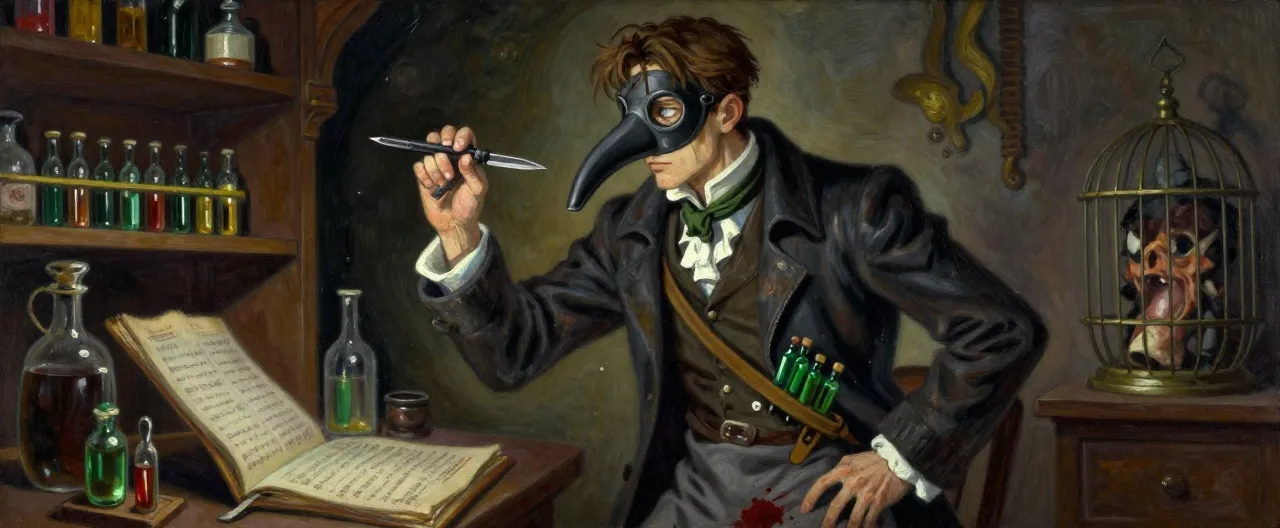
Orlan Fesk was once the finest diagnostician in Nostramus, a temple-trained physician whose lectures on anatomy drew students from three cities. He lived modestly with his wife Cettine and daughter Wren in a crooked house above the temple row, and his only ambition was a chair at the physicians' guild. Then the Grey Fever came, riding a grain ship from the south, and Nostramus learned what a real plague was.
Fesk worked the wards for nineteen days without sleep, and he watched his own household sicken despite every precaution his science could devise. Cettine died on the eleventh day. Wren — small, stubborn Wren — fought for eleven more, and Fesk broke every rule of his profession trying experimental regimens on her, his own daughter his first unauthorized test subject. She died of the treatment, though he has spent fifteen years telling himself otherwise. When the fever burned out, the guild commended his 'dedication' and reassigned him to the poor ward. That was the day something finished breaking.
He spent years drifting through back-alley practice and grave-side dissection, chasing the question the guild would not ask: why do the weak die and the strong linger? His notes grew darker, his subjects less willing, until Corvane Ashgrove found him in a rented cellar over a corpse that had no business being opened. The Ratbound Bishop offered him what the guild never could — purpose, a god-shaped framework for his arithmetic of survival, and eventually the ley-touched means to craft a plague no prayer could cure. Fesk did not embrace the Choir's faith; he tolerated it, the way a surgeon tolerates an assistant. His religion is the ledger.
Now he works from a hidden laboratory in the Crypt of Mercy beneath the Temple of Mercy, breeding the weeping plague by hand and infecting the dying one cot at a time, hidden inside the one place no one thinks to search. He walks the plague wards openly in his doctor's mask, welcomed as a savior by the families whose relatives he has marked. His cultist assistants handle the rough work; his scalpel handles the precise work; his vials handle the rest.
He keeps a coded ledger of every subject, every strain, every outcome — a book that is simultaneously his masterpiece, his confession, and, if the right hands seize it, the seed of the cure that will undo him. Sister Neris, once his most gifted student, works fifty feet above his laboratory, and he considers her his unfinished experiment. He has buried his family twice now: once in earth, once in doctrine. The second burial holds.