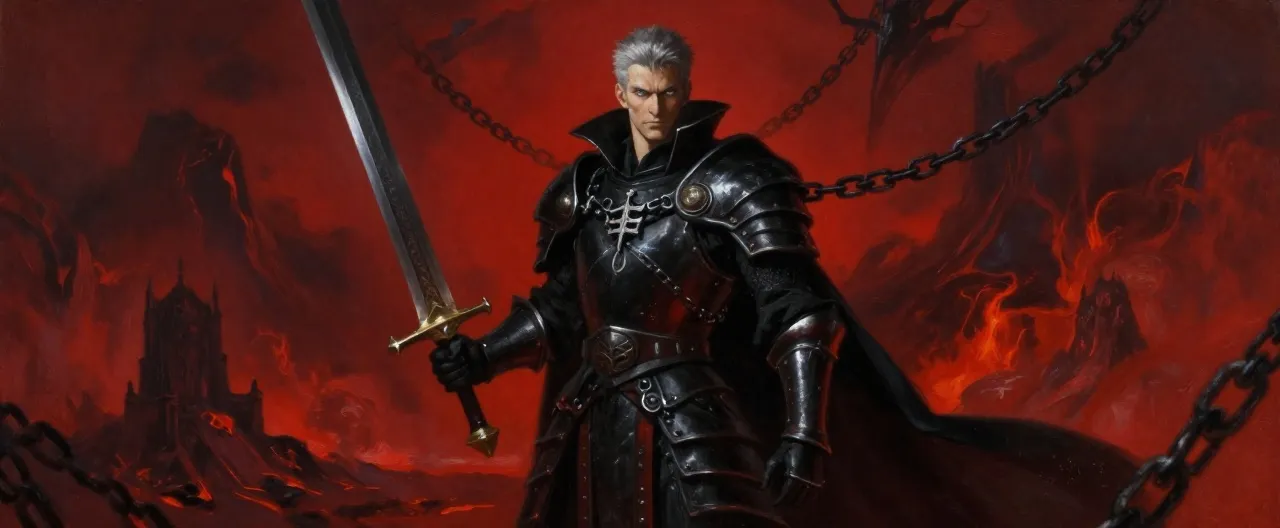
Thorne was born in old Emberfall forty-seven years before the banishment, the son of a tanner and a midwife, in the crowded fever-ward district where the poor died of treatable sickness because the crown's healers served only the noble quarters. He was a devout child in a kingdom where faith had grown ornamental, memorizing liturgies the priests no longer believed, and at fourteen he watched his younger brother die of a fever that a single healing potion, priced beyond the family's year of wages, would have cured.
He resolved then that the world's cruelty was not malice but disorder, and that a man of true conviction could impose order on a chaotic world. He joined the temple guard, then the crown's templars, and by twenty-five he had a reputation as the templar who never took bribes, never showed mercy to the guilty, and never lost a prisoner. It was this reputation that brought him to the attention of King Kaelthar Vane, then a young, ambitious monarch chafing under the old aristocracy, and the two men recognized in each other the same cold architecture of will.
Vane promoted him rapidly, and Thorne became the sword of the king's new order, breaking the noble factions that had ruled through corruption for generations. For a decade, Thorne believed he was building a just kingdom. He married a physician named Elara, who ran a free clinic in the fever-ward he had grown up in, and they had a daughter, Miren, whom he adored with a ferocity that frightened him.
Then came the plague year. Miren sickened first, and died despite everything Elara knew, and Elara, who had caught it tending the sick, followed her toward the grave within the month. And it was then, in the blackest hour of his life, that King Vane came to Thorne personally, with an offer: the king had recently entered into certain arrangements with powers beyond the Material Plane, and for a price, Elara could live.
The price was Thorne's soul, pledged upon the end of his service. Thorne signed without hesitation. Elara recovered in a single night, remembering nothing, and Thorne told her the fever had passed. He never told her otherwise. But the engine that saved her was new, and hungry, and its prototype needed souls of particular quality, and Vane, with exquisite cruelty, suggested that Miren's soul, already at rest, would be a fitting first contribution from a man who owed so much.
Thorne refused, once. Then he was shown what happened to souls that resisted the engine, and he understood that his refusal would only condemn his daughter to something worse, and his wife to be unmade as a debt-collection. He carried Miren's body to the vault himself. He has never forgiven himself, and he has never stopped believing that if the empire is strong enough, if order is absolute enough, no father will ever again be offered that choice.
When the party of heroes stormed the Obsidian Throne forty-three years ago, Thorne was not present; he was in the provinces, harvesting rebels. He returned to find his king an Emperor, his service extended indefinitely by the pact, and the empire transformed into the machine he now administers. He told himself the banishment of the heroes was justice. He told himself many things. In the four decades since, he has built the inquisitorial corps from a dozen men into the empire's nervous system, trained every soul collector serving under the Legion's banner, and kept, in a locked case beneath his breastplate, a ledger written in his own blood: every name, every date, every word he spoke as he took each soul.
He tells himself it is a record of justice. On the worst nights, he knows it is a confession waiting for someone brave enough to read it aloud. Now the banished heroes have returned, the engine whispers his daughter's lullaby, and Vorgath's emissaries circle like flies over a wound. The ledger's final page is blank. Thorne has begun, very quietly, to wonder what should be written there.