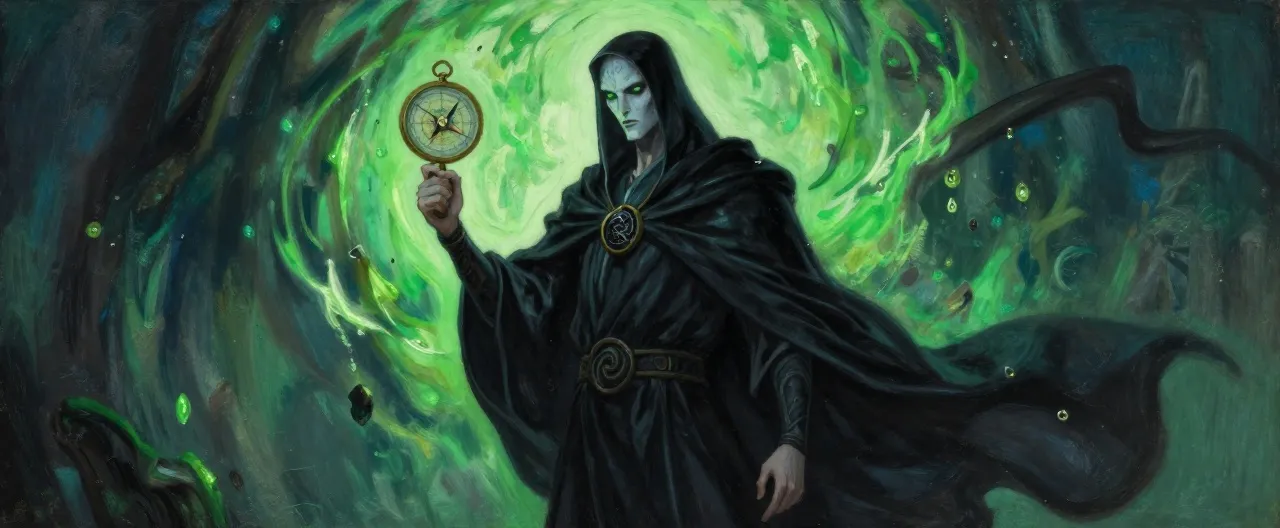
Veyron was born in Starfall, the port city of scholars and sailors, to a family of chart-sellers who never rose above peddling secondhand star maps to merchants. He was a precocious, joyless child who memorized constellations before he could swim and resented the sea for blocking his view of the sky. At fourteen he was apprenticed into the Grand Library, and at nineteen he became the youngest initiate ever accepted into the Astral Cartographers—the ancient order that mapped the multiverse from citadels floating in the silver void.
The guild gave him everything his Starfall childhood had denied: purpose, prestige, and the keys to the Vault of Stars, where the Horizon Needle slept on its pedestal of black stone.
He rose fast. He authored three celebrated star charts, including the Atlas of Unmapped Angles, a work of such strange genius that senior Cartographers whispered he saw the planes at angles no one else could. The council gave him the post no one wanted: rift-watcher, the scholar assigned to monitor planar instabilities at the edge of mapped space. For years he watched nothing. Then, one night at the Observatory of Falling Stars, a hairline rift opened in the mirror-hall, and Veyron looked into it longer than any living being had survived looking.
He heard the Choir—a chorus of Far Realm voices, vast and patient—and it spoke to him of gates, of keys, of a needle forged from a dying star, and of a promise: you shall become as a god.
He returned to the Citadel changed. He warned the council of an incursion; they saw a broken man raving. He presented his evidence; they quietly scheduled his examination for madness. And so Veyron made the choice that defines him: rather than report again and be erased, he performed an old, forbidden rite of severance, cutting his own conscience out of his soul so that nothing—not doubt, not shame, not love—could blur his clarity again. The rite left a lattice of scar tissue over his heart that the Far Realm symbols on his skin have avoided ever since, as if in fear.
Erasure came anyway. The council struck his charts from the archives, voided his guild vows, and wrote him off as the cautionary tale he remains today. Veyron vanished into the planes for a decade, gathering the mad, the brilliant, and the discarded—scholars the guild had failed, soldiers the void had broken, like the dragonborn Warden Thal, whom he found half-dissolved and spoke back into something like sanity. He built the Far Realm Cult around a desecrated symbol: the black spiral, an inverted Cartographer compass rose.
He raised his fortress of black iron within sight of the dead Citadel, so its spires would mar the guild's silver skyline, and he had his old mentor Lyra imprisoned—not killed, he tells himself—when she tried to sabotage his first gate experiment.
Now Veyron has everything a plan requires except its keys. The Horizon Needle sleeps in the ruined Observatory. The Astral Compass waits in the Citadel he was once proud to serve. The Maw of Nothing, the black hole at the Astral Plane's edge, churns with the power source his ritual demands. His agents move across the planes; his spy sits somewhere in Starfall's scholar council; his amulet lets him command the horrors of the Far Realm and shields his mind from the madness that devoured the guild that abandoned him.
But the Choir has gone silent, a rival presence squats in his black hole feeding on his patron's whispers, and the Needle—when he finally grasps it—will refuse him, because the multiverse itself keeps a record of what he cut away. Veyron believes his victory is inevitable. He is wrong in ways he has surgically removed the ability to see, and everything the party does—every clue, every rescue, every rejected grasp—presses on the wounds he cannot map.