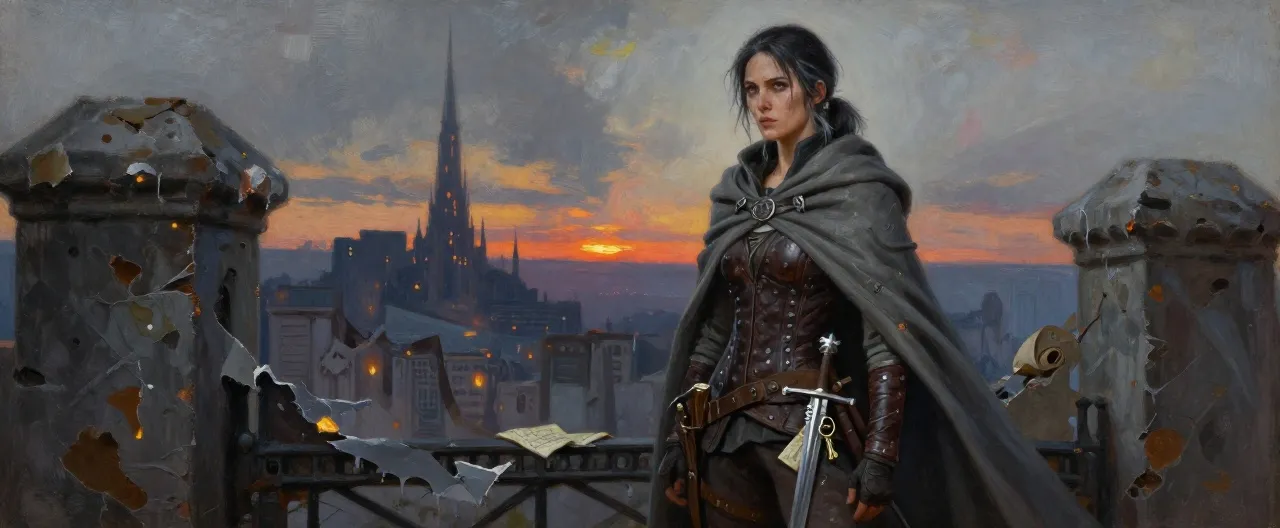
Mara Voss was born in Emberfall, the old capital, in the final year of King Kaelthar Vane's reign—a year her people would later mark as the last year of the world. Her father was a stonemason who worked the cathedral district; her mother sold dyed cloth in the square market. Mara remembers ordinary things: the smell of wet dye, her father's chalk-dusted hands, a brother lost to fever before she could form a memory of him.
On the night the heroes of the realm stormed the Obsidian Throne, seven-year-old Mara was asleep in a root cellar beneath her aunt's house while her parents attended a festival in the square. The banishment trap fired. The heroes vanished. And within hours, Vane's soldiers—now loyal to an emperor who claimed the heroes had betrayed the crown—swept the city, burning districts that had sheltered the old regime's friends. The Voss house burned. Her parents never came home.
Mara survived the purge years in the ruins of Emberfall, one of hundreds of feral children the new empire called 'ash rats.' She learned to read by deciphering proclamations nailed to the obelisk, learned to steal from Legion supply wagons, and learned the geography of survival: which sewers flooded, which patrol captains took bribes, which neighbors could be trusted with a hungry child and which would sell one. At eleven she was caught lifting bread from a Legion mess and was saved by Corvin Hale, a smuggler with three safe houses and one functioning conscience.
Corvin did not adopt her; he employed her. She ran messages through checkpoint lines no adult could pass, because no guard searched a dirty ash rat carrying scrap for resale.
By fifteen, Mara was Corvin's best courier, and by sixteen she had made the mistake that would define her conscience forever: to protect a safe house she believed was compromised, she informed on a neighbor sheltering Legion deserters, expecting a raid and a warning. The man was executed. His family was taken by soul collectors—black-robed agents of the Inquisition who harvested the condemned for something beneath the Obsidian Throne. Mara learned the word 'soul engine' years later, and when she did, she understood what she had fed. She has never confessed it to anyone. The resistance she would build was, in part, a penance.
At nineteen, Corvin Hale was betrayed, tortured, and killed, and Mara inherited the network: three safe houses, a ring of keys, and a list of names half of whom were already dead. She nearly died that winter, hiding in a flooded smuggler's tunnel while High Inquisitor Thorne's veterans searched the district above. She rebuilt anyway. Over the next two decades, she transformed a dying cell into the Emberfall resistance—a web of forgers, widow informants, disgruntled harbor clerks, and smugglers, anchored in the Free Port of Tidewatch, where Vane's reach was blunted by money and salt. She brokered the Tidewatch Accords that would become the seed of the Free Peoples Alliance, trading patrol maps to merchant princes and stolen arcane texts to rebel mages.
Her war with the empire's instruments has scarred her in ways she counts like a ledger. High Inquisitor Thorne destroyed her first cell twelve years ago and took her lieutenant Bren—she does not know what Bren told him before his soul was shipped to the engine. Lady Seraphine, the spymaster, has spent fifteen years dismantling Mara's networks with charm and patience, and the two women have fought a shadow war across two provinces. Four assassination attempts. Three burned safe houses. One betrayal—the Saltcellar—that killed nine of her people and was never solved. Mara carries all of it in a face that rarely shows anything at all.
And through it all, she grew up on the legend of the vanished heroes: the party who went to kill Vane and never came back, whose names were carved on the obelisk among the dead, whose graves—she discovered quietly—were empty. When the returned party walks into Emberfall's square, unaged after forty-three years, Mara Voss meets the myth of her childhood wearing familiar faces. She tests them before she trusts them, because hope is the most dangerous thing a resistance leader can spend.
But if they prove true, she will give them everything: her safe houses, her maps, her network, and the full weight of a life spent learning exactly how to burn an empire down.