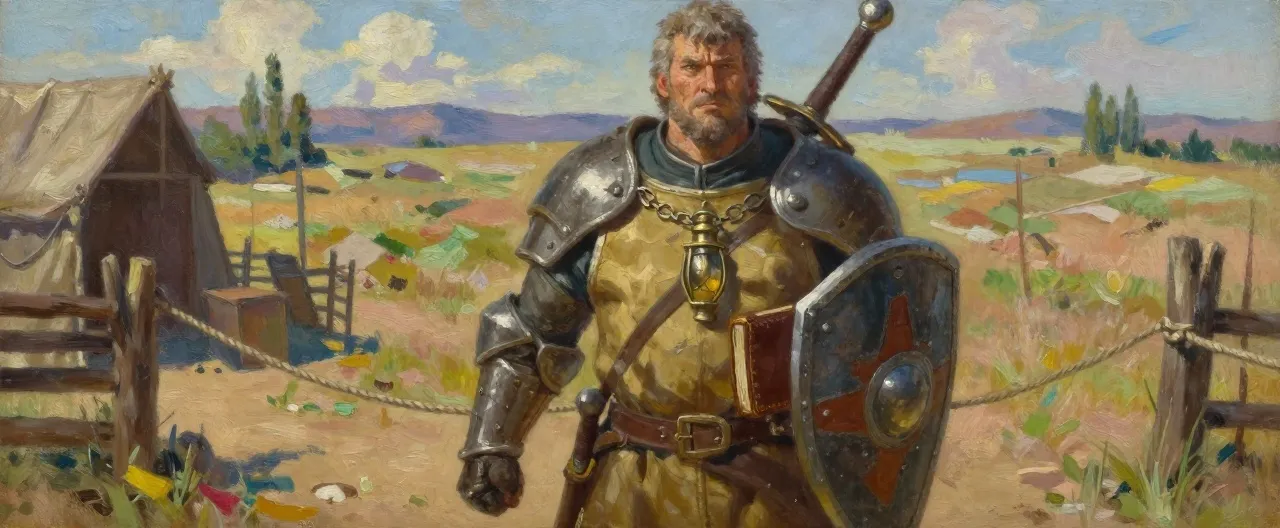
Richard Langham was born in the South Downs, the son of a carter and a dwarf smith's daughter, and grew up around wagons, weights and honest arithmetic. He took the Lantern Watch's coin at twenty-two in Castillo, not out of piety but because the pay was steady and the food was better than carting. He was assigned to the quartermaster's trade within a year — he was good at sums, indifferent at preaching, and had a memory for numbers that made the armoury sergeants weep with relief. Sixteen years later he is the man who keeps the Old Turnpike's waystation network fed, armed, shod and paid, and he is very good at it.
He learned Dwarvish from his mother's kin among the armorers and never mentions the connection; a quartermaster with nonhuman family draws comments in the Watch that he does not care to answer. He rose by competence, not politics. His stores were never short. His ledgers never needed a second audit. Knights three ranks his senior come to him when they need a route costed, a wagon repaired or a requisition untangled, and his word on the contents of any waystation from the South Downs to the Pilgrim Gate is accepted without question.
That trust is the tragedy of Richard Langham. Two years ago, a Red Ledger press-gang ambushed a Watch patrol on the turnpike and took a crate of Watch arms — arms Richard had personally signed out of the Castillo armoury, on a route he had personally costed to save half a day's cartage. Two men died. The loss was never reported, because the patrol's sergeant, Leonard Moss, was too ashamed to file it, and Richard never chased the paperwork because the crate was, officially, never missing. Since then he has seen dawn-gold stamped shields on bandits' arms twice and told himself each time that stamps get copied. It was easier than the alternative.
For six years he has stopped at Shepherd's Rest every season, buying mules from a polite man in a good coat, eating stew from a clean kitchen, and signing the caravan company's remount receipts without reading them — because the front half of the waystation was honest, and he never asked what the back half was. The rope line ran twenty feet from Cora Fairweather's kitchen door and he never once looked past it. Every entry in his six years of immaculate ledgers is now, in retrospect, a record of how well corruption hides inside competence.
The party is about to change that. When they show him the gate ledger that lists people by number, or the grain wagon with the false floor and the shackles underneath, the arithmetic he has spent his life trusting will turn on him like a blade. He will find his own requisitions dated the weeks Tinford's villagers vanished. He will find the dawn-gold stamp on the stolen crate in the Stockade's back room and know, finally, that the ambush was not banditry but inventory — the Ledger harvesting the Watch itself.
What rises from that wreckage is not a broken man but an angry one, and Richard's anger is the supply-wagon kind: slow to start, impossible to stop, and crushing everything in a straight line. He will put ten Watchmen and himself on the Stockade raid if the party gives him proof, and he will fight beside them in the pens with a longsword and a shield and four superiority dice and the specific, methodical violence of a man who has finally read every line.
Afterwards he will write two letters. One goes to Captain Ilsa March in Castillo, and its weight opens her door. The other goes to Leonard Moss in Tinford, and it says, in full: 'The crate is recovered. The route was mine. Come and countersign.'
Richard's arc across the campaign is the arc of a lawful good man learning that the law is only as good as the man who reads it all the way through. He begins as the Watch's competence and ends as its conscience — the provost who audits the auditors, the officer who files a report against himself, the quartermaster who learns that the most important inventory he will ever take is of his own omissions. By the time the party reaches the Forgotten Shrine, Richard Langham is the reason Captain Ilsa March has forty Watchmen on the stair, and the reason she trusts the strangers who led them there.