Corvin Sallow

Level 1 — (variant: Sage origin) Human Wizard (— (School chosen at level 2))

Available with DM subscription
STR
10
DEX
14 (+2)
CON
13 (+1)
INT
16 (+3)
WIS
12 (+1)
CHA
8 (-1)

Defense

Armor Class 12 (Unarmored (no armor worn))
Hit Points 7 (1d6 + 1 +1)
Speed 30 ft.

Proficiencies & Skills

Saving Throws Intelligence, Wisdom
Skills Arcana +5, History +5, Insight +3, Investigation +5

Features

Old Tongue of the Seven Nations (language)

Custom — campaign language, granted as one of the Human's bonus languages Level 1

Custom campaign language. Corvin is a linguist of the northern tongues: the script and speech of the Seven Nations, whose inscriptions he was hired to translate and whose surviving records the Ashvane Concord is quietly destroying. He can read and write it slowly and speak it badly — which, on the Verdant Strand, may prove useful. (DM note: treat as a rare language; reading Seven Nations inscriptions with it grants advantage on related History checks.)

Spellbook

Class (SRD 5. 2) Level 1
At will

Corvin's spellbook contains six level-1 spells and two cantrips. It currently holds Detect Magic, Comprehend Languages, Magic Missile, Shield, Sleep, and Find Familiar, plus the cantrips Fire Bolt, Mage Hand, and Light. His brother Oren's last letter — three lines, ending mid-sentence — is folded between the pages. Copying a new spell costs 50 gp of ink and paper per level and 2 hours per spell level.

Magic Initiate (Wizard) — Sage Background Feat

Background (SRD 5. 2) Level 1
Comprehend Languages: 1/Long Rest without a slot

Corvin gains two Wizard cantrips and one 1st-level Wizard spell (Comprehend Languages) that he can cast once per Long Rest without expending a spell slot. The cantrips chosen are Light and Prestidigitation — small scholarly conveniences he learned copying marginalia.

Human Heritage

Species (SRD 5. 2) Level 1

Corvin knows one extra skill (History, from his Human heritage and upbringing in the counting-houses) and gains +1 to Intelligence, Wisdom, and Constitution. He is Medium, Humanoid, with Human speed.

Arcane Recovery

Class (SRD 5. 2) Level 1
1/Long Rest

Once per day, Corvin can regain expended spell slots with a combined value equal to half his Wizard level (rounded down, minimum 1) — one 1st-level slot at level 1 — when he finishes a Short Rest.

Ritual Casting

Class (SRD 5. 2) Level 1
At will

Corvin can cast certain spells as rituals if the spell has the ritual tag and is in his spellbook (e.g., Detect Magic). The ritual version takes 10 minutes longer and costs no spell slot.

Spellcasting (Wizard)

Class (SRD 5. 2) Level 1
At will

With a Magic action, Corvin casts one of his prepared spells that has a casting time of 1 action, expending a spell slot as normal.

Spellcasting

Intelligence DC 13 +5 to hit Level 1: 2 slots

Corvin prepares 4 spells per day (Intelligence modifier + Wizard level). All cantrips and prepared spells below are in his spellbook. Magic Initiate grants Comprehend Languages once per Long Rest without a slot.

Detect Magic

Level 1 SRD 5.2
Divination 1 action Self V, S, M (a pinch of soot and salt)

For the duration, Corvin senses the presence of magic within 30 feet. If magic is present, he can use an action to see a faint aura around one visible creature or object bearing it, and learn its school. Corvin learned this spell reading Concord manifests — it tells him which ledgers are not merely paper.

Comprehend Languages

Level 1 SRD 5.2
Divination 1 action Self V, S, M (a pinch of copper dust)

For the duration, Corvin understands the literal meaning of any spoken or written language he hears or reads — including the scraped and rewritten words in a corrected scripture, though not the meaning behind the rewriting. The spell does not grant fluency in unknown scripts, but it lets him read the old tongue faster than he can speak it.

Magic Missile

Level 1 SRD 5.2
Evocation 1 action 120 feet V, S

Corvin creates three glowing darts of force that each strike a creature he can see within range for 1d4+1 force damage automatically. The darts strike simultaneously and can be aimed at one target or several. It is the one spell he has practiced until his hands shook — because somewhere north, someone made his brother stop writing mid-sentence.

Shield

Level 1 SRD 5.2
Abjuration 1 action Self V, S

An invisible barrier of magical force surrounds Corvin until the start of his next turn, granting +5 to AC and immunity to Magic Missile. Corvin casts it when men with coral bells come to collect what they are owed.

Fog Cloud

Level 1 SRD 5.2
Conjuration 1 action 120 feet V, S, M (a bit of down or mouse fur)

Corvin calls an illusory mist that fills a 20-foot sphere, heavily obscuring it. The mist is a pale grey fog — and Corvin has learned that fog, on this coast, is never just weather. He casts it to cover retreats and to make men afraid of their own superstitions.

Mirror Image

Level 1 SRD 5.2
Illusion 1 action Self V, S, M (a sliver of mirror or a clear glass bead)

Corvin creates an illusory duplicate of himself that mimics his movements and can move, speak, and act as he directs. Attacks made against him have a chance to strike the image instead. He uses it when he must be in two places at once — or when he must be seen somewhere he is not.

Light

Level 1 SRD 5.2
Evocation 1 action Touch V, S, M (a bit of tallow, a pinch of copper dust, a spark)

This spell creates a burst of light that Corvin can direct at a creature or object. If Corvin targets a creature with the spell, the caster must make a Constitution save or be blinded until the end of Corvin's next turn. Corvin uses it to illuminate old manuscripts — and to blind men who reach for him in the dark.

Prestidigitation

Level 1 SRD 5.2
Transmutation 1 action 10 feet V, S

Corvin creates one of the following magical effects: create or extinguish a small flame, create a small trinket or illusory object, clean or soil a small object, or produce a small sensory effect. He uses it to warm ink, dry wet paper, and light the lamps in the counting-houses where he reads the Concord's ledgers.

Behind the character

Character Information

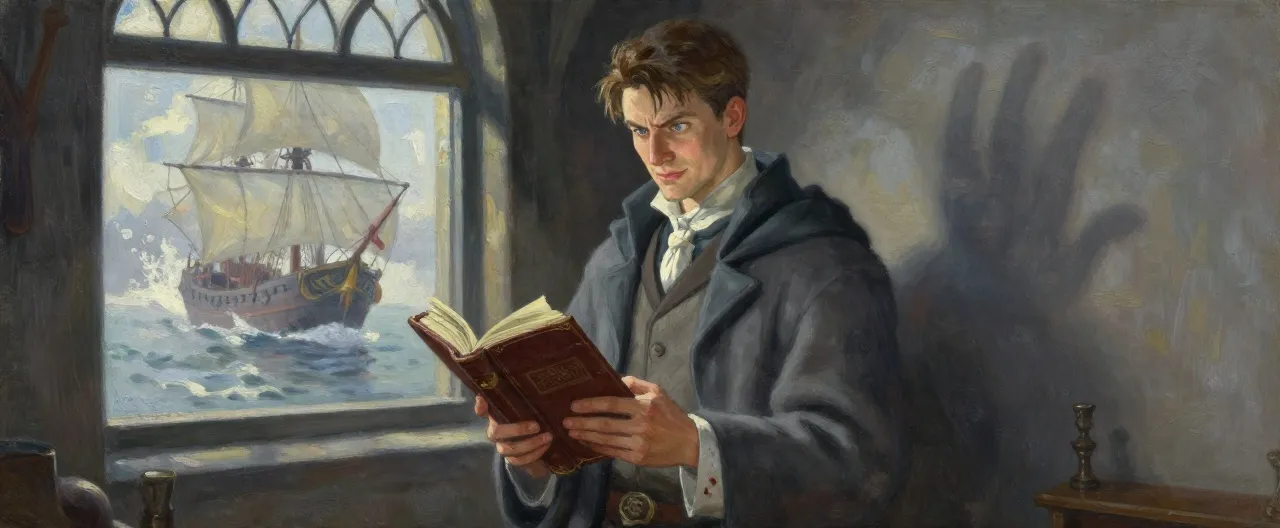
Corvin Sallow is a thin, tidy young man in a salt-stained scholar's robe worn over a grey wool coat, with ink stains worked so deep into his cuffs that they look like shadow. He carries his leather-bound spellbook pressed to his chest with one hand, the way another man might carry a child, and a folded letter peeks from the book's spine — three lines, ending mid-sentence, eleven months old. His face is courteous, watchful, and quietly furious: he thanks the harbourmaster who lies to him, compliments the wine at the table where he is being cheated, and writes down everything in a small neat hand.

He is a linguist before he is a wizard, and it shows. He reads the old tongue of the Seven Nations slowly and speaks it worse, and he has a scholar's habit of correcting grammar — including the grammar of men threatening him — because precision is the only weapon he trusted before he learned any other. He is Lawful Neutral in the way of a man who believes the record must be kept even when the record damns him: he does not lie, he does not embellish, and he does not forgive. His fury is not loud. It is a filing system.

The year since his brother Oren's letters stopped has changed him. He took the Ashvane Concord's coin to translate inscriptions and watched the expedition sail without him; he has since spent twelve months in Lordinium's counting-houses reading Concord manifests, learning that the company he served has been buying people, and teaching himself the small destructive magics a frightened man can learn from a book. He is not brave. He has simply decided that being afraid is not a reason to stop reading, and reading is no longer enough.

He came north because Peg Leg Carl is the only captain not on the Concord's payroll, and because somewhere on an island called Borealis there is a dig site, a man with a schedule, and a letter that has not been finished.

Before the adventure

Character Background

Background Details

The Letter That Stopped

Corvin Sallow was born the second son of a Lordinium counting-house family — the Sallows, who have kept other people's numbers straight for four generations without ever being rich enough to matter. His father wanted him in the ledgers. His mother wanted him in the Cathedral. What Corvin wanted was the drawer at the back of the family study, where his grandfather kept a rubbing of an inscription in the old tongue of the Seven Nations, taken from a stone that no longer exists.

He taught himself to read it from that rubbing, badly at first and then well, and by nineteen he was the youngest translator the Concord's survey office had ever hired.

The work was good and the work was quiet. The Ashvane Concord paid him to translate inscriptions brought north by survey ships — fragments of the Seven Nations script, mostly broken, mostly unremarkable. Corvin noticed early that the fragments were always broken in the same places, always at the same words, and he assumed erosion. He was twenty-two when he understood that the breaks were chisel marks, and that the Concord was not collecting the old tongue but destroying it, one inscription at a time, before anyone could read what the Seven Nations had actually written. He said nothing. He needed the coin, and his brother Oren needed the work, and saying nothing seemed like a small cowardice with a salary.

Then the Concord organized its great northern expedition — ninety souls, no cargo, a hold full of nothing — and hired Oren, not Corvin, because Oren was strong and Corvin was clever, and the expedition's manifest needed hands more than it needed a linguist who had started asking about chisel marks. Corvin watched the ship sail from the High Quay with his brother's face in the crowd and a translation fee in his pocket, and he told himself it was a trading voyage.

The letters came north-to-south for a month: the fog, the black sand, the fruit that grows too well, the dig sites marked on charts Oren was not supposed to see. Then eleven months ago the letters stopped. The last one is three lines long and ends mid-sentence: *'They have asked me to hold a woman at the altar and I have said—'*

The Year of Reading

Corvin has spent the year since in Lordinium's counting-houses, and he has learned to read the Concord the way he reads any dead language: from its surviving fragments. He copied manifests. He traced notaries. He learned that the Concord's ships sail north with souls and come back with salt-pearls, that three ships not on the Concord's payroll have been lost in the same fog, and that a woman with a coral bell books a room in Greyharbor the night before each one goes down. He learned that the Hollow Choir supplies names and the Concord supplies passage, and that the arithmetic adds up to something no ledger will say out loud.

He also learned magic, because reading was no longer enough. A man who can only read what was written cannot stop the writing, and Corvin has decided — quietly, methodically, with the same patience he brings to a dead alphabet — that he will not be a reader anymore. He keeps his brother's last letter folded between the pages of his spellbook, and he has practiced Magic Missile until his hands shook, because somewhere north there is a man with a schedule who made his brother stop writing mid-sentence, and Corvin intends to correct the sentence.

He came to Peg Leg Carl because Carl is the only man sailing north who is not on the Concord's payroll, and because Carl flinches at the word 'return', which means Carl knows something about the price. Corvin signed the charter with a calligrapher's hand, asked nine questions, noted which ones Carl answered with a joke, and went below to arrange his ink.

On Borealis

What Corvin does not yet know is that the island his brother is stranded on is the homeland of the Seven Nations, that the Concord is feeding it eleven people a month, and that the last letter's unfinished sentence — *'and I have said—'* — ends with the word 'no'. Oren Sallow deserted rather than hold the woman down at the altar, and he has been living on fruit and guilt on the black sand of the Verdant Strand ever since, watching the treeline, waiting for a brother he is certain will hate him.

Corvin will not hate him. Corvin will correct his grammar, and then he will stand beside him.
Threads to follow

Unresolved Plots

  • The unfinished sentence: Oren's last letter ends 'and I have said—'. Corvin has spent eleven months not knowing whether the next word was 'no' or 'yes', and the answer changes what kind of brother he has, what kind of man Oren is, and whether the Concord's shore camp holds a deserter or a collaborator.
  • The Concord's cipher: Corvin has been reading the Concord's internal mail for eight months and knows a tithe schedule exists — eleven names a month, sent north. He has told no one. When the party finds Vane's sealed orders at Frostmarch, Corvin must decide whether to admit he already knew, and why he stayed silent.
  • The grandfather's rubbing: the stone it came from does not exist anymore, but the rubbing shows a fragment of the Thirteenth's name — half of it, cut off at the edge. The other half is somewhere on Borealis, and Corvin has spent his whole life with half a name he cannot pronounce.
  • The notary's debt: Tamsin Vey, the Lordinium notary who holds Corvin's outstanding Concord fee, is herself in debt to the Hollow Choir — and the Choir has begun calling in her debts in names rather than coin. She will sell Corvin's travel plans to buy her own safety.
  • The second letter: Corvin's father, in the counting-house, receives a letter from the Concord two days before the Saltspray sails — a letter Corvin intercepts and reads. It is a polite notice that the Sallow family's accounts are under review, and that the review will conclude favourably if Corvin's northern voyage concludes unfavourably.

Beneath the surface

Secrets

  • Corvin translated for the Ashvane Concord for three years and took their coin knowing the inscriptions were being destroyed; he has never told anyone that his silence was purchased.
  • Corvin's grandfather's rubbing — the source of his old tongue — was taken from a stone in the Lordinium Cathedral's undercroft, which means the Cathedral once held Seven Nations originals and destroyed them first.
  • Corvin can read Concord cipher. He cracked it in the counting-houses and has been reading the Concord's internal mail for eight months; he knows the tithe schedule exists and has told no one, because saying it aloud would make it real and make him a target of the Choir.

What haunts them

Fears

  • That Oren deserted willingly — that the last letter's unfinished sentence ends with consent rather than refusal, and that his brother chose the altar.
  • That his own translations, sold to the Concord for coin, were the map the Concord used to find and destroy the inscriptions — that his scholarship is the chisel.
  • That he will be made to hold someone down at an altar himself, and that he will discover, in the moment, that his careful neutrality is just obedience with better handwriting.

What drives them

Aspirations

  • To bring Oren Sallow home alive, and to hear the end of the sentence his brother could not finish writing.
  • To read the true inscriptions of the Seven Nations and publish them — every scraped word restored — before the Concord's chisels finish their work.
  • To become fluent in the old tongue: to speak it as well as he reads it, so that the last living language of the Seven Nations has one more voice.

Personal quest · 1

The Brother Who Would Not Hold Her Down

Corvin's last letter from Oren was three lines long and ended mid-sentence: 'They have asked me to hold a woman at the altar and I have said—'. On the black sand of the Verdant Strand, Corvin finds the Concord's shore camp, ninety bedrolls, eleven flowered bodies, and a hollow-eyed deserter in a green coat who will not come out of the treeline until he hears his own name spoken. Oren Sallow deserted rather than hold the woman down, and he has been living on fruit and guilt ever since, and he will not go back to the Tide-Heart for anyone.

Corvin must get his brother to talk — about the dig sites, about Vane's arithmetic, about the woman at the altar — and then decide whether to send him south to safety or drag him to the coral bowl to testify against the admiral who made him a coward.

Current Stage

Corvin must earn his brother's trust: bury the eleven flowered bodies, or speak the old tongue badly enough that Oren recognizes the family accent. Oren will not approach an armed party or a Concord uniform, and he flinches at the word 'altar'. Corvin must decide whether to lead with the letter or with the burial — and whether to tell his brother, in the first minute, that the letter was never finished or that Corvin read it a hundred times before he understood it was a question Oren was asking permission to answer.

Mechanical Rewards
  • Oren's Concord map of the dig sites (Sevenfold Hollow, the Ossuary, the Tide-Heart)
  • Oren's sailor's knife, which he presses on Corvin with the words 'you'll need a blade that has refused something'
  • A petrel familiar — Oren's tame bird, which Corvin can bind with Find Familiar and which knows the island's treelines
Narrative Rewards
  • The end of the sentence: Oren speaks the word he could not write — 'no' — and Corvin finally knows his brother.

Personal quest · 2

The Prayer Book of the Drowned Shrine

Corvin's grandfather kept a rubbing of a Seven Nations inscription in a drawer at the back of the family study — the document that taught Corvin the old tongue. The stone it was taken from no longer exists; the Concord's survey office catalogued it as 'recovered, fragmentary, valueless' and the fragment was sold to a Lordinium bindery for pulping eleven years ago. Corvin has traced the sale. The bindery was Quill's.

Tessaly Quill bought the lot at auction, could not read it, and bound the fragments into the covers of a prayer book she sold to the Cathedral of the Twelve — where it has sat on a lectern in the Salt Quarter's Drowned Shrine ever since, read aloud every tide by Mother Ulva, who cannot read what she is saying. Corvin must recover the prayer book from the flooded shrine, unbind it without destroying the fragments, and reassemble the inscription — which turns out to be a partial list of the Twelve's names, in the old tongue, with the Thirteenth's name half-visible where the rubbing was cut off at the edge.

Current Stage

Corvin must get into the Drowned Shrine at high tide, when it floods and the congregation leaves, and take a prayer book off a lectern in front of a shrinekeeper who was a Hollow Choir initiate for eleven years. He can steal it, buy it, or tell Ulva the truth — and telling the truth is the only path that does not end with Ulva ringing a bell Corvin does not want rung.

Mechanical Rewards
  • Corvin learns the true half-name of the Thirteenth, granting advantage on all Religion and Arcana checks concerning the Thirteenth, the binding, and the breaking rite
  • The reassembled rubbing, which Corvin can show to Ithra of the Hollow — she has been waiting three hundred years for someone to bring her a name, and it opens the Hall of Nations' sealed record without a fight
  • A bound prayer book worth nothing and everything: the Choir cannot scrape what Corvin has memorized, and Mother Sable knows it
Narrative Rewards
  • Corvin's grandfather, it turns out, was a Choir initiate who could not finish the work — the rubbing was his resignation letter, hidden in a drawer for forty years.

Personal quest · 3

The Fifteen That Remain

Corvin took the Concord's coin for three years and translated its inscriptions, and he has never once written down what he found — because writing it down makes him a witness, and witnesses to the Concord do not drown in harbours, they drown in the Weeping Firth. But the Concord's manifests record what was recovered, and Corvin has spent eight months copying them from memory into a private ledger he keeps sewn into the spine of his spellbook.

The ledger is a map of the erasure: forty-six inscriptions catalogued, thirty-one destroyed, fifteen unaccounted for. Corvin intends to find the fifteen. The trail leads through Greyharbor's harbourmaster — who is paid to keep the losses quiet — to a warehouse on the Greyharbor coal quay where the Concord stores what it has not yet destroyed: fifteen crates of recovered inscriptions, catalogued and crated and waiting for a ship that has not come.

Corvin must get into the warehouse, read what is in the crates, and decide what to do with fifteen stone fragments that the Concord will burn rather than lose — and one of them, he discovers, is not an inscription at all. It is a letter, in the old tongue, written by a Seven Nations hand and addressed to whoever came next.

Current Stage

Corvin must decide whether to tell the party what he has been copying for eight months — the cipher, the manifests, the tithe schedule he read in a notary's mail and said nothing about. The confession costs him the party's trust or buys him the party's help, and he cannot open the warehouse alone.

Mechanical Rewards
  • The fifteen inscriptions, copied into Corvin's spellbook as a permanent record — including one that describes the Gate of the Twelve's working in the old tongue, granting advantage on the gate's Arcana check
  • The Seven Nations letter, which names the tithe, the bloom, and the Thirteenth's refusal in a contemporary hand — the party's first primary source, worth more than any codex
  • A Concord cargo manifest that proves the warehouse exists and names the harbourmaster's take
Narrative Rewards
  • The letter's last line is the same warning as the scripture's — 'any return shall incur a price of blood' — but written as advice, not prophecy, and signed with a name.

Major Decision

Context

Before the Saltspray sails, Corvin's last outstanding contract with the Ashvane Concord comes due. The notary Tamsin Vey offers the fee with a smile and a warning: refuse it publicly and the Concord will know his face before he ever sees the fog.

Choice Made
Corvin can take the Concord's translation fee he is still owed — a purse of salt-pearls and 200 gp held by a notary in Lordinium — or publicly refuse it, naming the Concord's chisel-work in front of the notary's witnesses. Taking the coin funds his spellbook and his brother's rescue but makes him, on paper, a Concord contractor; refusing it makes an enemy of the notary and the Choir's clerks who watch him.
Impact

Taking the coin grants 200 gp and a salt-pearl (worth 50 gp) but marks Corvin: Concord patrols on Borealis recognize him and offer him terms instead of crossbows — and the party can be betrayed by that recognition. Refusing publicly grants Inspiration at every Concord negotiation and makes Mother Sable's Choir treat him as a target rather than an asset, raising the stakes of every Choir scene.

Major Decision

Context

Brother Cassian will not say the price plainly, and Corvin is the only party member who can read the gate's inscription in the old tongue: 'Twelve keep. The Thirteenth is kept.' The inscription also names the substitute — a coral bell, a lens, or the astrolabe's thirteenth ring — which Corvin can find if he looks.

Choice Made
At the Gate of the Twelve, Corvin can translate the gate's working aloud — a life given freely, or a life taken — before the party decides, or he can stay silent and let the party choose blind. Speaking the truth plainly may cost the party a life they would not have spent; staying silent preserves their options but makes Corvin complicit in whatever is chosen.
Impact

Translating truthfully grants Corvin a permanent +1 to Wisdom (the gate marks him as a keeper of true words) and the party learns all substitutes. Staying silent grants Corvin +1 to Charisma (he learns what silence costs) but if the party pays with a life taken, the Ossuary's DCs rise by 2 and Sister Venn will not aid them — a consequence Corvin must carry.

Major Decision

Context

On the black sand of the Verdant Strand, Corvin finds Oren alive, hollow-eyed, and unwilling to return to the Tide-Heart for anyone. The confession ends with a question: what does Corvin need his brother to be — safe, or useful?

Choice Made
When Oren confesses, Corvin chooses: send his brother home in the landing boat to safety and a Lordinium that will hang a deserter, or keep him beside him at the Tide-Heart where Oren must testify — and where Oren may be taken as the hundred-and-first. Either way, Corvin learns a new spell from the choice itself.
Impact

Sending Oren home grants Corvin the Find Familiar ritual permanently bound to Oren's petrel — a familiar that finds him anywhere on Borealis and carries one message — and Corvin gains the Scion of Preservation feat: once per long rest, he may instead take the damage of any ally within 30 feet. Keeping Oren for testimony grants Corvin advantage on all Persuasion checks against Concord personnel (his brother's confession is the party's best evidence) but Oren can be tithed if the party fails at the Tide-Heart.

Transformative Moment

Trigger

Reading the true record beneath the Hall of Nations' floor (Act III)

Transformation

The first time Corvin reads a Seven Nations inscription in the Hall of Nations and understands it without his grandfather's rubbing — the language lives, and so does the crime of erasing it.

Mechanical Changes

Transformative Moment

Trigger

Hearing Oren's confession on the Verdant Strand (Act III)

Transformation

Corvin stops being a reader and becomes a writer: he begins keeping the expedition's true ledger, in the old tongue, against the day someone scrapes every other copy.

Mechanical Changes

Transformative Moment

Trigger

Discovering the Concord's manifest of inscriptions (Act I, Greyharbor)

Transformation

Corvin learns that the Concord's chisel marks were not random — they were following a list, and his own translations were the key that told them which words to remove.

Mechanical Changes

Ally

Tessaly Quill, the Binder

Relationship ally
Influence 1/10
Loyalty 1/10

Shared History

Tessaly Quill bought the lot of pulped Concord fragments at auction eleven years ago because no one else would bid, and she has been keeping them in wax ever since — not because she could read them, but because a binder does not let a book be destroyed twice. Corvin came to her shop in the first month of his year of reading, showed her his grandfather's rubbing, and watched a brisk, glue-fingered woman go very still and then very kind.

She has since let him work in her back room through two winters, taught him to unbind without tearing, and never once asked him why a counting-house linguist needed to learn the binder's trade. She knows he is translating something the Cathedral would burn, and she has decided, in the way of the Salt Quarter, that it is not her business until it is on her floor. When Corvin signed Carl's charter, Tessaly pressed a wax satchel into his hand — for the codex, she said, but Corvin knows it is for whatever else comes up out of the water.

She is the only person in Lordinium who has said his brother's name out loud without Corvin saying it first: 'Oren Sallow,' she told him, 'sails with the strong ones and writes with the weak ones. He'll have kept writing.' She was almost right, and the almost is what Corvin carries.

Potential Breaking Points

  • If the Choir offers Tessaly her brother's name in exchange for Corvin's whereabouts, she will hesitate — and hesitation is all Corvin needs to see, because he has read enough ledgers to know what a woman pricing her loyalty looks like.
  • If Corvin's private ledger of Concord manifests is discovered in her shop, Tessaly will burn it rather than let the Choir take it, and she will not ask him first.

Enemy

The Ashvane Concord (and its notary, Tamsin Vey)

Threat Level 2/10
Conflict Type ideological

Personal Stakes

Corvin worked for the Concord for three years and never asked the right question until it was too late to ask it safely. Tamsin Vey notarized his contracts, witnessed his translations, and holds his outstanding fee — and she is the person who will decide, with a signature, whether the Concord treats Corvin as a contractor who has gone quiet or a witness who has gone north. She has already written two letters about him.

He has read both, because he cracked the Concord's cipher eight months ago and has never told her. What he cannot decide is whether Tamsin is the Concord's clerk or the Choir's — her debts are with the Choir, her signature is with the Concord, and her fear is her own. She is the enemy who remembers his birthday, offers him tea, and will sign the paper that puts his name on a tithe schedule if the arithmetic requires it. Corvin hates her the way you hate a mirror: she is what he would have become if Oren had never sailed.

Possible Resolutions

  • Corvin can buy Tamsin's loyalty with the Concord cipher — proof that he could ruin her and chooses not to — and gain an informant inside the Choir's paperwork.
  • Corvin can ruin her: publish her two letters, and the Choir will eat its own notary to protect the schedule. She will not survive the month, and Corvin will have to decide whether that was justice or just tidier murder.

Faction

The Hollow Choir

Standing -1/10

Influence

The Hollow Choir erased the word 'tithe' from every scripture on the Crown Coast for three hundred years, and Corvin is the first person in a generation who can prove it — because he can read the old tongue the erasures were meant to bury. The Choir does not know this yet. When it learns, Mother Sable will not send knives; she will send clerks, a harbour writ, and a polite woman with a coral bell who will explain, reasonably, that the codex must go back into the water.

Corvin's standing with the Choir is a single number that only goes down: every document he saves, every fragment he memorizes, every name he speaks aloud is a line item in a ledger Mother Sable keeps in a locked room above the Cathedral scriptorium. He has already been entered in it — 'Sallow, Corvin. Linguist. Brother tithed. Watch.' — because the Choir's records are better than the Crown's and the Choir has known about Oren since the letters stopped.

Corvin's value to the Choir is as a warning: the last scholar who noticed an erasure drowned in Lordinium harbour, and the Choir would prefer Corvin to drown politely, legally, and with a receipt.

Obligations

  • Corvin's private ledger of Concord manifests is the single most dangerous document in Lordinium — if the Choir takes it, the tithe schedule is confirmed and the party's deniability ends.
  • Tessaly Quill's safety is Corvin's debt: the Choir knows she helped him, and her shop is the first door they will knock on.

Benefits

  • Access to the Salt Quarter's smugglers' cellars
  • Tessaly Quill's unbinding skills and her Choir receipts
  • Mother Ulva's blessings and her silence about what Corvin carries

Ready to Unleash Your Character's Full Potential?

Join thousands of players and create rich, detailed character backgrounds with Fable Fiesta!

Register to unlock personal quests, relationships, and narrative hooks!

Sign Up Now - It's Free!

No credit card required. Start creating in minutes!