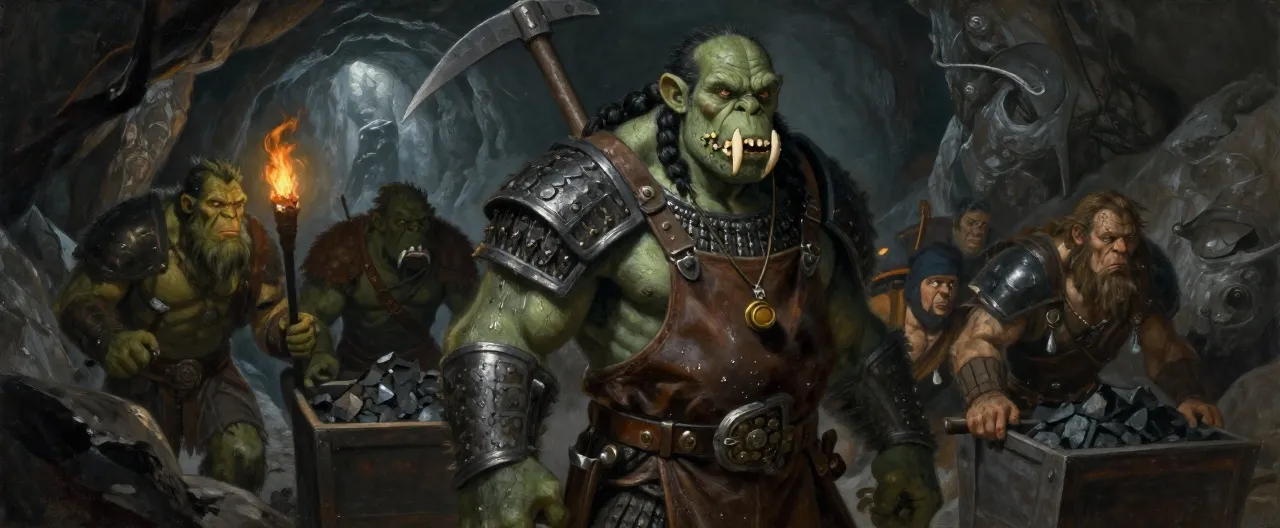
Grask was born in the last generation of the breeding pits, which is a sentence that means more than it says. He never knew the old warlords' glory — he knew the tunnels, the ration bowls, and the iron smell of the god-machine shipments that passed through the deep pits when he was old enough to carry. He was conscripted into the horde at fifteen and served six years as a line-breaker, a shield-brother in Gorak's band, and by all accounts he was good at the only job he was given: breaking lines.
He burned the Copperknee convoy in the third year of the war. He spared its smith. He has spent the years since trying to work out which of those two facts defines him. When the horde broke at the Ashen Scar, Grask's band was ordered to hold the pits' mouth — the rearguard that let civilians flee into the deep tunnels. He held through the first horn and the second.
At the third horn, with the alliance shields closing and the god-machine's fire turning on its own makers, Grask ran. He has never said the word 'deserted' to anyone, including himself. He crawled into a collapsed mine shaft in the northern mountains and did not come out for three days. When he did, a Deepforge survey crew was staking the seam, and instead of killing him — the reasonable option, in that season — their foreman handed him a shovel and said, 'Ore doesn't care what you ran from.'
Grask has been paying back that shovel ever since. He rebuilt Iron Vein Mine from a flooded ruin into the Holds' richest surface vein, and he did it with a rule that was, in that place and time, almost heretical: the ore belongs to whoever pulls it, and every hand gets the same wage. Orc, dwarf, human — the whistle makes no distinction. The crew he assembled is the only family he will admit to: Hilda Coppervane, the dwarven engineer who taught him to read and runs the pumps like a heart; Torvald and Bekka, the dwarf brothers who argue about everything except work; Samm the widower; Wendel the driller, whose betrayal Grask has not yet discovered; and forty others who follow the whistle into the dark because it has never once lied to them.
Grask's politics are simple and absolute: he will not take sides. He watched the Accord's banners rise and fall; he watched dwarves sell steel to the men who burned his band; he watched elves and humans sharpen old grievances on the same whetstone. He concluded, somewhere in the third year of peace, that every banner is a debt collected in someone else's blood, and the only honest work left is underground.
This conviction will be tested to destruction. The Choir's saboteurs attack his mine; the Crown's paymaster buys his traitors; Gorak — his shield-brother, the man whose third horn he abandoned — hides starving in the pits below; and a war machine wearing the faces of his dead comrades hums in the deep. Every faction wants Iron Vein Mine, and every faction assumes a neutral orc can be bought, frightened, or blamed.
They are all wrong, and discovering how wrong will cost several of them dearly. Grask's greatest contradiction is that a man who refuses to take sides has, by surviving, already taken the only side that matters: the side of the people who just want to work. He does not see it yet. The campaign's job is to make him see it — and then make him decide what a foreman owes when the war finally comes down the mountain to his door.