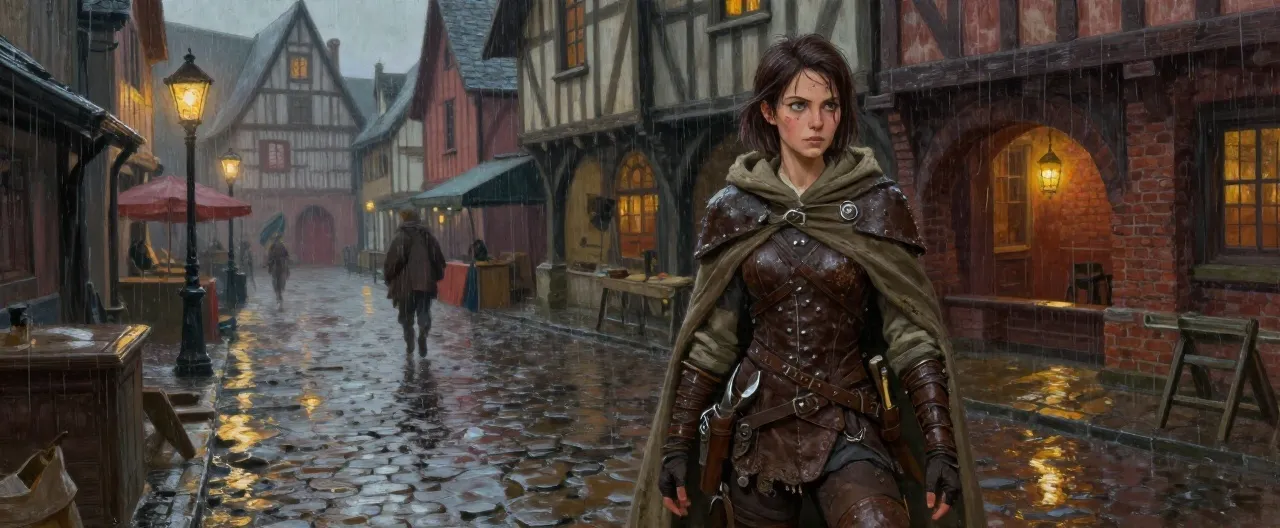
Tessa Roper grew up in the barge towns along the trade rivers of the western Heartlands, the daughter of a wool factor's tally-clerk and a woman who mended sails. Her mother died of river fever when Tessa was nine. Her father followed within the year — not to sickness, but to debt. He had signed a note to keep the household afloat after the fever took his wife, and when the harvest failed he couldn't pay.
She was eleven when the collectors came, when she watched men carry her father's desk out the door with him still sitting at it, and then carry him to debtors' holding. She never saw him clear the ledger. Nobody ever does, she learned later; that's the point of the trade.
She survived on the streets of a river town running errands for a syndicate of fences and debt-collectors — and there's an ugly irony in that she has never fully forgiven herself for. By fourteen she was opening doors for them. By sixteen she was running their book, learning how ledgers lie, how debts get sold twice to two different buyers, how a coin that looks silver is really copper under the tarnish.
She learned the craft the way working people learn anything: hands first, questions after. She learned thieves' cant from an old Halfling fence named Dori Cobblewick, who also taught her enough of the language to be useful on the trade roads, and who told her once, 'The paper's always true, girl. It's the people signing it that lie.' Tessa has built half her philosophy on that sentence.
What finally broke her association with the syndicate was a job she refused to finish: marking a widow's shop for a forced sale, the same way her father's desk had been marked. She walked out with the copper token from her first job and nothing else, and she has been drifting since — taking honest-enough work as a courier, a lock-opener for people being squeezed by worse people, a finder of things that paper trails say shouldn't exist. She sends what coin she can spare downriver to an old neighbor who's raising the younger kids she grew up with.
She has no patience for priests who talk about Tymora's favor as if luck were earned, and none for sanctimony of any kind, but she'll nod at a shrine of Kelemvor now and then — a god who keeps honest records of the dead appeals to her sense of the world. The Harpers have sounded her out once or twice on her travels; she likes what they claim to stand for and doesn't yet trust anyone who claims to stand for something for free.
Amberford is not her town. She came up the River Road on a courier job that dissolved when her client did, and she was planning to move on — until the barges stopped, the refugees crowded the bridge, and she heard the story everyone in the Belltower Inn was telling with lowered voices: clerks vanishing, ledgers burning, the watch paid to look elsewhere. She knows what it looks like when someone buys silence to hide a ledger's true shape.
She lived in a house that burned down the same way, in every way that matters. When Meg Fairbank sat down across from her, shaking and soaked, holding a page she wasn't supposed to have copied, Tessa recognized the girl in the too-big coat she used to be — and stayed.