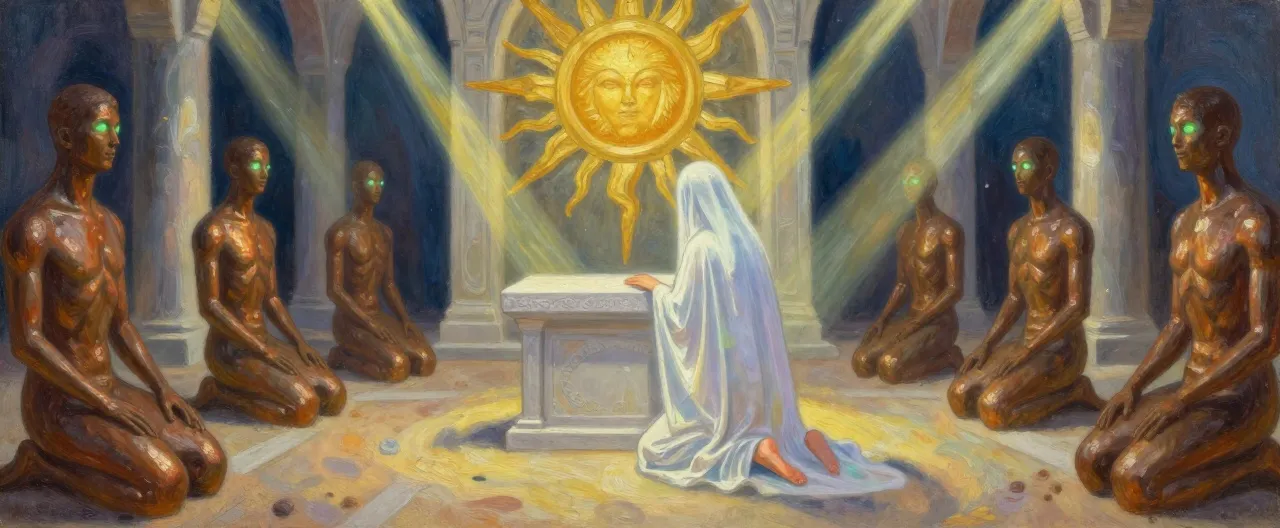
The man who would become the Last Abbot was born in a river-city of gold and jade in the Verdant Vale's final flourishing century, the third son of a chandler with no inheritance to give him. At nine years old he was given to the Keepers of the Green Flame as a tithe-offering, a common practice of the age, and he never resented it. The order raised him at the Cliffside Temple, a monastery carved five hundred feet up a cliff face above the vale's western rivers, where forty Keepers maintained the Sun-Disk and taught the binding's renewal rites.
He took his final vows barefoot, as all Keepers did, speaking the words every novice learned: 'The dust remembers the rain.' He rose slowly through the ranks by the simple method of outliving his elders, and by his sixtieth year he wore the abbot's white robes. It was not a triumph. Each renewal rite required volunteers—Keepers willing to kneel at the ziggurat's Heart of Dust and give their lives to the seal—and each generation the willing grew fewer.
The Abbot was chosen once, in his fortieth year, when the cage flickered and the rite demanded a life. He knelt willingly. His predecessor, the old Abbot Sennet, put a hand on his shoulder, said 'Not yet, child—your knees are younger than mine,' and took his place. The boy who was spared became the man who could never stop kneeling. When the Hollow Sun's rage finally came—the season the rivers vanished and the great trees turned to stone in a single day—the temple's Keepers faced a choice the order had dreaded for a century: renew the binding with too few volunteers, or flee.
Most fled. The Abbot stayed. He does not remember dying; he remembers kneeling, and the light going strange, and then three hundred years of dust. His spirit remains bound by the vow he swore to Sennet's memory: hold the temple until rain returns. In that time he has watched the desert swallow the roads, watched ash-wrapped pilgrims begin appearing a generation ago, and watched a woman's grandmother flee the temple carrying the mad Keeper's heretical scriptures—the seed of the Ashbound cult.
He blames himself for not destroying those pages. He blames the order for lying about the binding's cost. He blames the Hollow Sun for nothing, because he alone remembers that it was once the dry season's gentle spirit, and that imprisonment, not malice, drove it mad. Now the Marchant Expedition's survivors climb his cliff, and the Abbot feels something he has not felt in centuries: hope that his vigil might end.
He will test them with courtesy, teach them the greeting that calms his bronze guardians, and—if they offer water at his altar, the one gift that means life in the Glasswaste—tell them the truth that could save or doom the Vale: the seal drinks a life freely given. That is why the Keepers failed. They grew too few willing to die. Whether the party finds more willing than the order ever had is the question his three hundred years of kneeling have been waiting to ask.