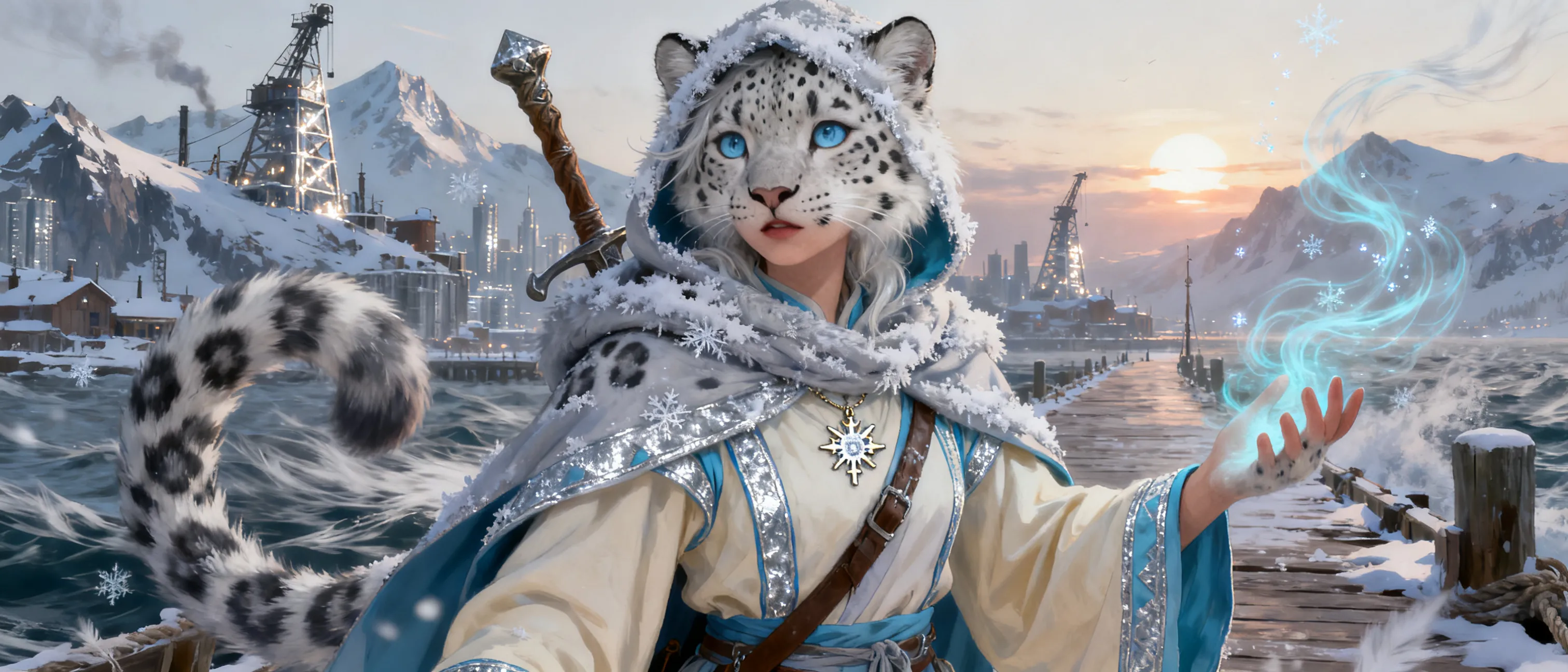
Seraphine Frostmane was born on the northern coast, where the mountains meet a cold gray sea and winter is less a season than a permanent neighbor. Her people, the snow Bengal tabaxi-kin, live in small cliffside and shore communities sustained by fishing, trapping, and a stubborn faith that the sun will always come back after the long dark. She was born during a snowstorm, and her grandmother swore the wind stopped howling the moment she first cried — the first of many small omens the family would half-jokingly attach to her over the years.
Faith structured her childhood. Her parents were devout, and when it became clear that their daughter was clever, restless, and prone to staring at things that weren't there, they arranged for her tutoring under a local priest — a patient, dry-witted man of a snowflake-and-sun order who taught her letters, liturgy, herbal lore, and the discipline of daily prayer. From him she learned Guidance and Sacred Flame, the small practical miracles of his calling, and more importantly she learned that power without structure is dangerous. His lessons are the root of her Lawful Good streak: ritual, duty, honesty, care for the sick and the stranded.
But the priest could not explain what was happening to her. When she wept, frost bloomed on the window glass. When she raged at a schoolyard bully, the puddles froze with a sound like tiny bells. The village called it a blessing; the priest, more honestly, called it unknown, and wrote letters to colleagues in the south. One of those letters reached the Academy — a respected school of arcane learning — and at fourteen Seraphine was sent south with a trunk of clothes, her pendant, and a letter of introduction.
The Academy was a shock of warmth, noise, and competition. She tested as a sorcerer rather than a wizard: the magic was in her, not in her books, and no instructor could match its signature to any known bloodline. The faculty catalogued the frost phenomena, prescribed breathing exercises and meditation, and told her the truth kindly: they would understand her origin better when it matured, likely around her twentieth year. She graduated quickly — her talent was undeniable even if its source was a mystery — and left with more questions than she arrived with.
Graduation brought an assignment rather than a homecoming: a two-year internship posting to Nyanhattan, a boomtown on the northern frontier that has exploded almost overnight around the discovery of rich silver mines. Migrants pour in by the caravan-load — miners, merchants, speculators, fortune-tellers, and the predators who follow all of them. The outpost city is raw, muddy, half-built, and thrilling, its skyline bristling with new towers and old ambitions. Seraphine arrived intending to serve her internship, send money home, and study her bloodline in peace.
She has not gotten to keep that intention. From her first week in the city, she has felt it: something wicked whispering on the horizon. Not a voice she can hear with her ears — more a pressure on the edge of her senses, a wrongness in the wind coming down from the mountains, a frost that forms in patterns she doesn't recognize on the nights it is strongest. The mines have disturbed something. She is certain of it, though she cannot yet prove it, and the older she gets and the closer her bloodline comes to waking, the louder the whisper becomes.
Now she walks a careful line: a dutiful intern by day, casting cantrips and tending the injured with her one gift of healing, and by night a young woman poring over mining charts and old expedition journals, trying to understand what the silver veins have awakened. She has two years, a quarterstaff, a handful of spells, and the growing certainty that Nyanhattan's boom is built on something that was better left buried — and that the whispering on the horizon has begun to whisper back to her.