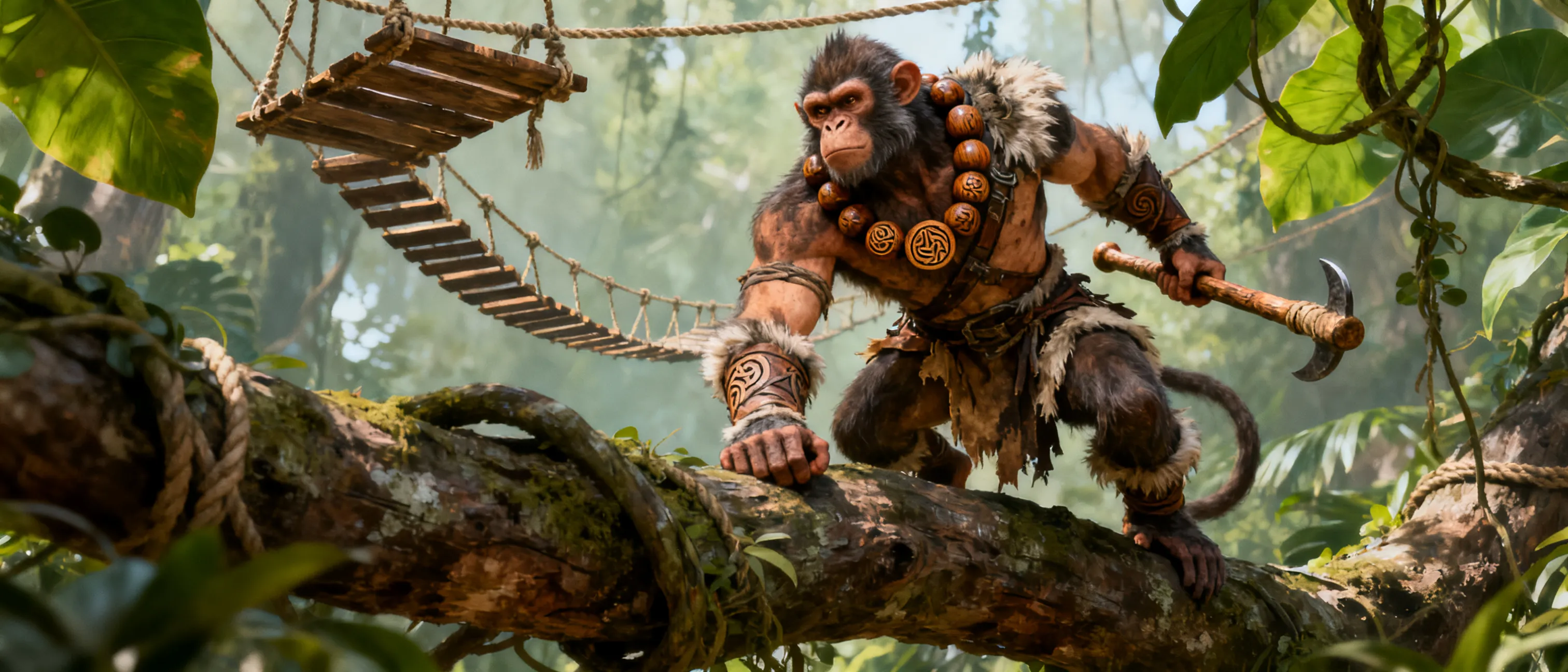
Character Background
Borne of Canopy was born in a settlement that clung to the high limbs of ancient jungle giants, where homes were built from woven hardwood, vine lashings, and broad leaf-thatch roofs that hummed in the rain. Their people lived by height and motion. Children learned to grip bark before they learned to write, and every adult had a practical skill: ropework, drying fruit, bridge maintenance, grafting, or trade-song. Borne’s earliest memories are of hanging cargo nets full of spices and medicinal leaves while older traders shouted weights, prices, and route warnings in quick, clipped banter across neighboring platforms. The language of commerce in the canopy was not calm and measured; it was bright, fast, and full of improvisation. Borne absorbed it all, learning the rhythm of exchange before they were old enough to carry a proper load.
From a young age, Borne had a gift for climbing and balance. While other children slipped or hesitated, they moved through the treetops as though the branches were made for them. Elders noticed that Borne rarely wasted motion. They placed hands where support would be strongest, chose holds with instinctive caution, and judged distances by eye with remarkable accuracy. This talent made them useful early, but it also made them curious. Borne began accompanying adults on short trading runs between platforms, where they carried light bundles, helped repair damaged lashings, and listened to the talk of merchants who passed through the canopy routes from faraway places. They learned how a cracked beam could ruin a transaction, how a badly tied bundle could spoil an entire shipment, and how a friendly greeting could save hours of argument.
The turning point in Borne’s life came during a season of hard storms. A merchant caravan arriving by the upper routes was forced to seek shelter when a series of rain-swollen crossings became unstable. The settlement’s trade season was already thin, and several households depended on that caravan’s cargo of tools, salt, and lamp oil. When raiders and opportunistic thieves tried to exploit the confusion, Borne did not wait for a better-armed elder to act. They grabbed a quarterstaff from a tool rack, climbed above the commotion, and began directing people along the safest routes while striking at threats from the branchways. Borne’s strength, speed, and nerve helped prevent panic from spreading. More importantly, they showed a mind for protection: they didn’t simply fight, they defended the lines of movement that kept everyone alive.
In the aftermath, a guild factor visiting the settlement took notice. The trader saw not just muscle, but judgment—someone who could protect goods without treating people like cargo. Under that mentor’s guidance, Borne began studying the mechanics of trade and caravan security in earnest. They learned how to inspect lumber, tally cargo, judge honest weight by feel, and speak in the practical shorthand used by merchants. Carpenter’s tools became as important to them as their staff, because a broken platform or unsafe brace could be as dangerous as a blade. They practiced making repairs after storms, reinforcing bridges, and reading signs of rot or stress in the timber. Over time, they became known as someone who could both fix and fend off trouble.
Borne’s outlook is shaped by those years of labor. They believe that freedom is only meaningful when routes are safe enough to use, that communities grow stronger when they can trade without fear, and that craft is a form of respect. They are loyal to the people who keep promises, because in a place of shifting weather and dangerous heights, trust is the most valuable tool of all. Their bond is to the canopy routes and the merchants, artisans, and laborers who depend on them. Their ideal is practical solidarity: everyone should have a fair chance to move, work, and survive. Their flaw is a stubborn conviction that if a task is necessary, they alone should take it on. Borne often shoulders too much, pushing through exhaustion and danger rather than asking for help, because they hate the thought of someone else paying for a mistake they believe they could have prevented. This makes them dependable, but it can also make them reckless in quieter, more personal ways.
Now Borne walks the world as a newly sworn Canopy-Vanguard, carrying a quarterstaff, a scale for weighing jungle goods, and a pouch of trade tokens made from exotic hardwood beads. They are beginning to understand that protecting a route means protecting the people who rely on it, and that the strongest bridge is not made of wood alone, but of trust, skill, and steady hands.