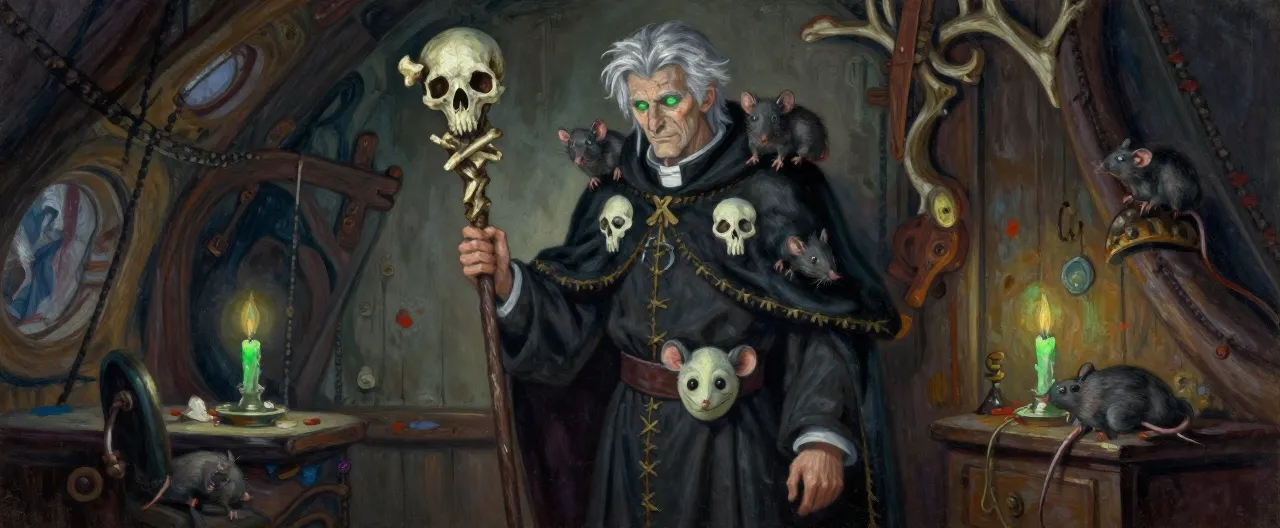
Corvane Ashgrove was born the son of a Ratwharf fish-gutter and a temple laundress, and he spent the first half of his life climbing toward respectability with the patient discipline of a man who has known hunger. He entered the Temple of Mercy as an acolyte at nineteen, was ordained at thirty, and by forty-five he was the most beloved priest in temple row — the one who sat with the dying through the night, who buried the poor for free, who argued with the temple elders for better medicine in the wards.
His wife died young; his granddaughter Liora was the light of his retirement years, and he had begun, quietly, to plan the sermon he would one day give about the temple's duty to the harbor poor. Then came the fever season that killed Liora and fourteen of his ward's patients in a single month, while the temple elders debated budgets and the nobles behind their walls sent nothing but prayers.
Corvane did what a healer does: he eased the dying with laudanum, mercifully, secretly, and when the elders discovered it, they did not see mercy. They saw a scandal, stripped his stole, and cast him out in the rain at sixty years old, with nothing but his cassock and a grief the temple had no room for. That night, in the sewer culvert where he sheltered, something ancient that had waited beneath Nostramus for centuries heard a heart break in exactly the right shape.
The Gnawing Choir did not tempt Corvane with power; it offered him meaning. It told him his mercy had been holy and the temple's cruelty was the true plague, that pestilence was not punishment but purification, and that rats — the despised, the unclean, the survivors — were its chosen messengers. Corvane wept in the dark and said yes. Twelve years later, the Ratbound Choir is his congregation, the ghost ship Weeping Sister is his cathedral, and the weeping plague is his sermon made flesh.
He has not raised his voice since the night he was cast out. He speaks softly, paternally, with absolute conviction, offering every opponent a place at his side before he offers them death — and meaning it both times. He keeps his granddaughter's body in a glass casket in the ship's hold, preserved against the day the ritual grants him the power to call her back, and it is for her, more than for any god, that he will burn a city.
His plan is threefold: let the plague weaken Nostramus until the faithful few remain, complete the ritual at the sunken shrine to make the sickness airborne and irreversible, and sacrifice the willing Odessa Marr aboard the Weeping Sister to shed his mortal flesh and become the Ratbound Bishop eternal — an immortal shepherd over a kingdom of the cleansed. He is not mad. He is worse: he is kind, and he is certain, and he has done the arithmetic of acceptable loss with a healer's steady hands. Redemption is impossible for Corvane not because he cannot be reached but because he has already forgiven himself for everything, in advance, in Liora's name.