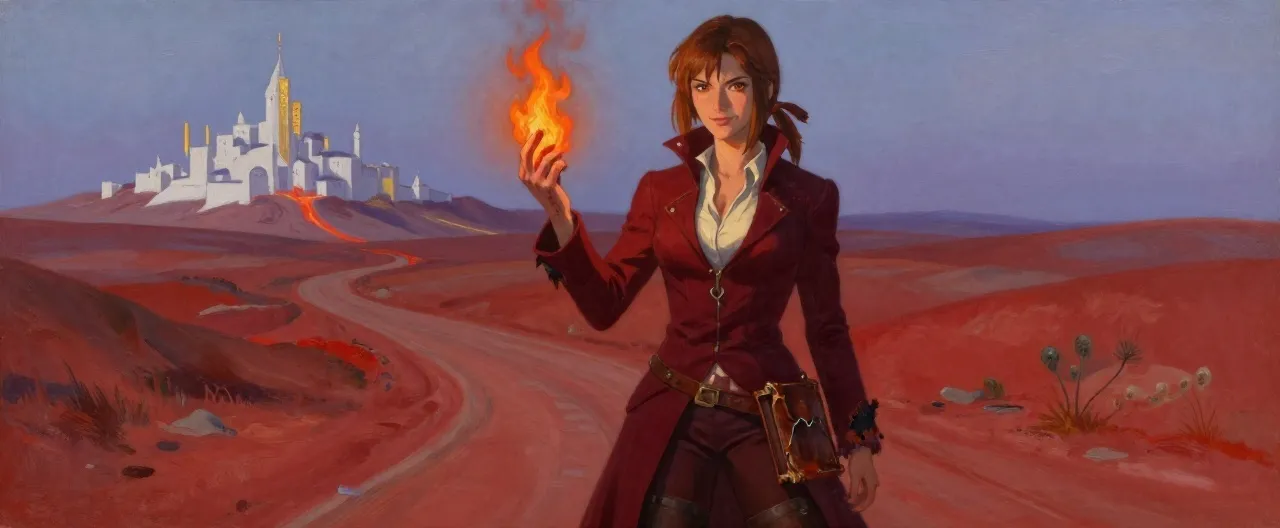
Lysandra Fairholt was born the second child of Aldous Fairholt, head of the Fairholt merchant-noble house of the South Downs — a family that made its fortune in wool contracts and fine cloth and its reputation in knowing exactly which bribes to decline. The Fairholt name opened doors from the Downs to the caravan towns, and Lysandra grew up in a house where good cloth, good manners, and a good name were the three pillars of everything.
She was a bright, restless child with a temper like a struck flint, and when the amber flash first appeared in her eyes and a hearth-fire leapt at her shout, her father did what proud men do with inconvenient daughters: he sent her away, to an academy, to be trained and contained.
The academy was seven years of rhetoric, deportment, and controlled breathing exercises designed to teach her that her fire was a problem to be managed rather than a bloodline to be honored. One teacher in particular — the one whose scorched spellbook now hangs at Lysandra's belt — made a project of breaking her finger-snapping habit, punishing her for it publicly until the whole class learned to flinch. Lysandra learned the academy's diction, its manners, and its contempt, and she kept her fire banked and her temper banked and her resentment compounding, until the night a confrontation in the women's dormitory — provoked, though she has never said by whom — lit her firebolt and the whole wing with it.
Eleven girls, a great deal of smoke, and one girl, Vessa Marlowe, hurt worse than the rest. Lysandra was expelled by letter. Her father's reply was four words: find your own path, then.
She left the South Downs with her fine clothes, her scorched spellbook taken from the burning dormitory out of spite, and a half-written letter she has never finished. She has been walking northeast along the Old Turnpike ever since, following dreams she cannot explain: a white city on a mesa, banners of dawn-gold, and a warm golden light beneath the stone that seems to be reaching for her. The dreams have grown louder with every mile, and the burn scar on her palm — older than the dormitory fire, from a child's desperate attempt to force her magic to come early — aches when certain things are near.
What Lysandra does not yet know is that the dreams are the Dawnfire beneath Castillo reaching for a hand that can carry it, that the light calls its own champions, and that the road she is walking runs through villages being quietly harvested by slavers who tithe a tenth of every sale to a cult that sings. She does not know that the Fairholt house is drowning in Red Ledger debts, that the teacher whose spellbook she carries has joined the Choir of the Open Gate, or that the girl she burned is following her trail down the Turnpike.
She knows only that she is not sorry about the fire, that her father's last words were a dismissal, and that something under a white city wants her — and for the first time in seven years, wanting her is exactly what she needs.
Her noble bearing still opens doors: commoners of the badlands recognise good cloth and a good name, and households that trade with the South Downs will give her deference, shelter, or audience — though her scandal travels with her reputation once her surname is spoken. She has the Skilled feat's training in Arcana, Deception, and Investigation, and the Magic Initiate's breadth beyond her sorcerer's spells. She carries herself like an accusation, and she is, in the end, right to: the badlands have been accusing people for years, and she has arrived to make the accusation stick.