Brother Osmund Crane, the Hollow Shepherd

Level 3 Human Cleric (Light Domain)

Available with DM subscription
Register to save this character forever!

This character will be deleted in 6 days. Create a free account to claim all your generated content.

STR
12 (+1)
DEX
10
CON
14 (+2)
INT
13 (+1)
WIS
16 (+3)
CHA
10

Defense

Armor Class 16 (Scale Mail (14) + Shield (2))
Hit Points 24 (3d8 + 6 (Constitution) — take maximum for a villain: 8+2 + 8+2 + 8+2 = 30; DM may use 26 for a fairer fight +2)
Speed 30 ft.

Proficiencies & Skills

Saving Throws wisdom, charisma
Skills Insight +5, Religion +3

Features

Censer of Numb Apathy

villain feature Level 3
action

As an action, Crane swings his brass reliquary censer, and a wave of harvested calm rolls out. Each creature of his choice within 30 feet must succeed on a DC 13 Wisdom saving throw or be overcome with numb apathy until the end of Crane's next turn: the target cannot take reactions and has disadvantage on its next attack roll. Creatures that succeed are immune to this censer's effect for 1 minute. Crane can use this a number of times per combat equal to his Wisdom modifier (3 uses); the censer must be reloaded with a harvested emotion (1 minute of quiet prayer) between combats.

Shatter a Half-Filled Vessel

villain feature Level 3
bonus_action

Once per combat, if cornered or reduced below half hit points, Crane can hurl a half-filled clay vessel to the floor. The harvested grief inside bursts free: every creature within 15 feet must make a DC 13 Wisdom saving throw or be overcome with sorrow for 1 minute — the target's speed is halved and it has disadvantage on attack rolls and ability checks. A creature that succeeds is unaffected. Crane weeps while he does it, and means the tears.

The Shepherd's Voice

villain feature Level 3
bonus_action

As a bonus action, Crane calls out the name of a 'donor' — a villager the party may have met, or a name he should not know. One creature of his choice within 60 feet that can hear him must make a DC 13 Wisdom saving throw or have disadvantage on its next attack roll against Crane or his acolytes as doubt creeps in. He never lies while doing it; he simply decides what you are allowed to know.

The Hollow Testimony

villain feature Level 3
special

Over the course of a long conversation (at least 10 minutes of talking), Crane can harvest a strong emotion from a willing or restrained creature, storing it in a brass vessel. The creature loses one specific feeling (fear, grief, joy, longing, etc.) and knows it is gone. This is not combat magic and requires the victim's stillness — it is the crime, not the weapon.

Channel Divinity: Radiance of the Dawn

subclass Level 2
action

As an action, Crane emits magical daylight in a 30-foot radius. Each creature in the area that is not a construct or undead must make a DC 13 Constitution save, taking 2d10 radiant damage on a failure or half on a success. This damage is halved against creatures that have taken no damage yet this fight — Crane flinches from hurting 'whole' people.

Channel Divinity: Turn Undead

class Level 2
action

As an action, Crane presents his holy symbol and each undead of CR 1 or lower within 30 feet that can see him must make a DC 13 Wisdom save or be turned for 1 minute. Crane is deeply uncomfortable using this — he suspects the thing in the deep shaft would answer if he called it instead.

Warding Flare

subclass Level 1
reaction

When an attacker that Crane can see hits him or a creature within 30 feet, Crane can take his reaction to impose disadvantage on the attack roll. He uses this to protect his acolytes first and himself second — his donors must not be frightened by bloodshed.

Spellcasting (Cleric)

class Level 1

Crane prepares spells from the cleric list using Wisdom (spell save DC 13, spell attack +5). He can swap prepared spells only when finishing a Long Rest — and he never rests well, because something answers when he prays.

Divine Domain: Light

subclass Level 1

Crane serves Lathander, the Morninglord, in name. His domain grants the Light cantrip and the following domain spells always prepared: Burning Hands, Faerie Fire, Flaming Sphere, Scorching Ray.

Darkvision (Human, 0 ft.)

species Level 1

Crane is human and sees in the dark no better than anyone else — a fact he finds quietly humiliating, given what he serves.

Spellcasting

wisdom DC 13 +5 to hit Level 1: 4 slots Level 2: 2 slots

Domain spells (Burning Hands, Faerie Fire, Flaming Sphere, Scorching Ray) are always prepared and do not count against his 6 prepared spells. Crane's prepared list above is 6 spells. If the DM wants a harder fight, add Scorching Ray (3 rays, +5 to hit, 2d6 fire each) as his opening attack after the censer.

Guidance

Cantrip cleric_cantrip
divination action Touch V, S

Touch a willing creature; before it makes an ability check within the next minute, it can add 1d4 to the roll once. Crane murmurs this over his acolytes constantly — 'let the dawn guide you.'

Sacred Flame

Cantrip cleric_cantrip
evocation action 60 feet V, S

Flame-like radiance descends on a creature Crane can see within range. The target makes a DC 13 Dexterity save, taking 1d8 radiant damage on a failure (no cover benefit), half on a success. Damage increases to 2d8 at character level 5.

Thaumaturgy

Cantrip cleric_cantrip
transmutation action 30 feet V

A minor divine manifestation: Crane's voice booms triple volume, his eyes flare with light, or flames flicker in gold. He uses it to make his reasonable voice sound reasonable-er.

Light

Cantrip light_domain
evocation action Touch V, M (a firefly or phosphorescent moss)

An object glows with bright light in a 20-foot radius and dim light for 20 feet beyond. Crane casts it on the reliquary so the donors can see what is being asked of them.

Bless

Level 1 cleric_spell
enchantment action 30 feet V, S, M (a sprinkling of holy water)

Up to three creatures of Crane's choice add 1d4 to attack rolls and saving throws for 1 minute (Concentration). He blesses his acolytes before every fight, and apologises to them after.

Command

Level 1 cleric_spell
enchantment action 60 feet V

One creature Crane can see must succeed on a DC 13 Wisdom save or obey a one-word command ('Kneel.' 'Stay.' 'Listen.') on its next turn. He prefers 'Listen.'

Cure Wounds

Level 1 cleric_spell
evocation action Touch V, S

A creature Crane touches regains 1d8 + 3 hit points. He patches his toughs' split knuckles without being asked, which unsettles them more than threats would.

Shield of Faith

Level 1 cleric_spell
abjuration bonus_action 60 feet V, S, M (a small parchment with a holy text)

A shimmering field grants a creature of Crane's choice +2 AC for 10 minutes (Concentration). He casts it on Colin Tracey and calls it 'a shepherd's duty.'

Aid

Level 2 cleric_spell
abjuration action 30 feet V, S, M (a tiny strip of white cloth)

Up to three creatures each gain 5 temporary hit points and their hit point maximum increases by 5 for 8 hours. Crane casts it on his whole cell each morning — everyone deserves to endure.

Spiritual Weapon

Level 2 cleric_spell
evocation bonus_action 60 feet V, S

A floating spectral mace appears and attacks: +5 to hit, 1d8 + 3 force damage on a hit, moving 30 feet and striking again as a bonus action for 1 minute (Concentration). It is shaped like the gauntlet sigil of his order, which he no longer finds funny.

Flaming Sphere

Level 2 light_domain_spell
conjuration action 60 feet V, S, M (a bit of tallow, a pinch of sulphur, and a dust of dried brass filings)

A 5-foot-diameter sphere of flame appears and can be moved 30 feet each turn (bonus action), dealing 2d6 fire damage (DC 13 Dex save, half on success) to creatures it touches. Lasts 1 minute, Concentration. In the whitewashed gallery its light makes the twelve painted symbols seem to move.

Behind the character

Character Information

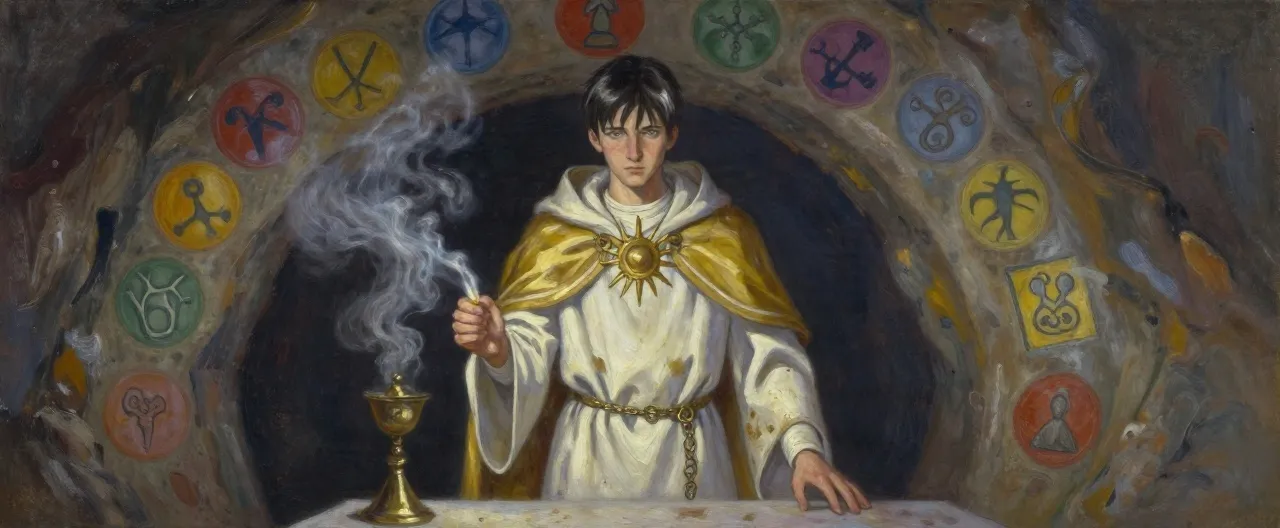
Brother Osmund Crane is a gaunt human priest in his early forties, a former soldier of the Order of the Gauntlet who traded the sword for the censer and has never quite decided whether that was a promotion or a surrender. He has soft, uncallused hands, thinning dark hair gone white at the temples, and pale grey eyes that focus slightly past your face, as if he is reading something written on the air behind you.

He wears a travel-stained white-and-gold Gauntlet robe over a mud-hemmed cassock, a brass reliquary censer chained at his belt, and the brass sunburst of Lathander at his throat — and he smells faintly of incense and saltpeter, the scent of the chapel he has carved out of a dead mine.

Crane is soft-spoken, patient, and unbearably reasonable. He never raises his voice, even mid-battle, and he never lies outright; he simply decides what you are allowed to know, answering hard questions with true statements that miss the point. He calls the people he empties 'donors' and means it as a kindness. He uses full names and titles as a courtesy and a leash — 'Mistress Shipwright,' 'Brother Coldwell' — and he goes perfectly still and sad when contradicted, like a man watching a child refuse medicine. When nervous, which is often, he hums four bars of a Morninglord hymn over and over.

He is genuinely kind in intent and genuinely certain in purpose: he believes the twelve vessels are failing, the breach is reopening, and every feeling he takes is a life he saves. He is also quietly terrified — of the dark he cannot see in, of the thing below the shaft that answers his prayers, and of the growing suspicion that the voice guiding him does not have the world's interests at heart.

He guards King Osmund's ritual notes obsessively, reads them by lamplight when he cannot sleep, and has written at the front of them, in fresh ink, a promise he may not be able to keep: to give everything back.

Before the adventure

Character Background

Crane was born in a garrison town on the old border marches, the third son of a farrier who expected him to shoe horses and got a boy who could quote scripture before he could shoe a pony. He took the Order of the Gauntlet's oaths at nineteen — smite evil, act with honor, suffer no treachery — and for eleven years he was, by every account that survives him, the most decent man in his chapter house.

He healed pilgrims' blisters without being asked. He carried fallen brothers on his back out of two losing engagements. He was the better preacher and the worse swordsman, and he was at peace with both.

Nine years ago, marsh fever took his wife and infant son in a single week while he was on assignment. He returned to find two graves and a house that smelled of someone else's bread. He did not leave the Order. He did the worse thing: he kept working, perfectly, and felt nothing, and mistook the numbness for discipline. His brothers noticed. He hummed hymns when they asked how he was, the same four bars, over and over.

The fen circuit was his own request. A drowned chapel east of Milestone had been reported to hold pre-Imperial carvings, and the Order's zeal carried him east before anyone thought to ask what a lone brother intended with a ruin. He found the carvings — a ring of twelve marks, chiselled off three centuries ago — and beneath the flooded altar stone, wrapped in waxed leather, a fragment of King Osmund the Undying's own ritual notes.

He read them in one night by lamplight. By dawn he understood three things: the king had split his soul into twelve phylacteries to hold shut a breach to the Far Realm; each vessel was bound to a single human emotion; and the vessels were failing. When one cracks, its emotion drains out of everyone nearby — and the fen's missing feelings, Crane concluded, were not theft. They were leakage. The world was already losing the war, and nobody had noticed but him.

He could not reach the king's original vessels. So he decided to build new ones. The doctrine assembled itself with the terrible neatness of all true fanaticism: if the vessels hold emotions, and the vessels are failing, then emotions must be gathered and bound — and a priest with a brass censer and a congregation of trusting fen folk was perfectly positioned to do the gathering. He harvested his own grief first, alone, in the drowned chapel, the night he found the notes, and woke feeling clean for the first time in nine years. That cleanliness is the engine of everything since. He knows what absence feels like from the inside, and he is selling it as salvation.

He is not acting alone, though he believes he is. Something beneath the deep shaft in the Saltpeter Caves — something that slipped through the breach the king died to seal — has been answering his prayers for three months, teaching him binding rites the fragment only sketches, feeding his certainty a line at a time, and steering him, gently, toward gathering all twelve vessels in one place. Crane has noticed that Lathander never answers.

He has decided this is distance, not judgment. He reads the line in the king's own hand — 'the vessels must be scattered, never gathered' — every night, and reinterprets it every night, and every night the reinterpretation gets harder.

His cell is small and devoted: Colin Tracey, the first donor, who gave up his shame in a Milestone barn and has followed Crane with the flat certainty of a man whose doubt was surgically removed; two more acolytes drawn from fen families Crane 'relieved'; and a handful of hired toughs who think they are guarding a mine claim. He consecrated the worked-out saltpeter mine as a 'chapel of the twelve,' whitewashed its gallery, and painted the twelve symbols in twelve colors — and then discovered, with a chill he has never confessed, that his careful priest's hand was tracing marks that were already there, in the chisel-work beneath the whitewash, older than his handwriting. He did not invent the chapel. He found it.

He heals his toughs' split knuckles without being asked, which unsettles them more than threats would. He blesses his acolytes before every fight and apologizes to them after. He keeps a list of donors' names, and next to most of them, the word 'mercy.' Next to Meg Aldor's name there is nothing, because some vessels, he has decided, should stay empty. And at the front of the king's notes, in fresh ink, in his own careful hand, is a promise: to return every harvested feeling to every donor once the breach is closed.

The shaft's voice has told him this is unnecessary. He has written the promise anyway. It is the last thing he does every night before the lamp goes out, and it is the only prayer left that he believes anyone hears.
Threads to follow

Unresolved Plots

  • The thing beneath the deep shaft has been guiding Crane toward gathering all twelve vessels in one place — but a vessel gathered is a vessel that can be cracked, and Crane has never asked himself why his patron wants them concentrated. The answer is the hinge of Act II.
  • A rival collector is ahead of Crane on at least two of the twelve vessels. Crane's notes mention a seal he did not recognize, and the eastern buyer's agent at the Four Corners smithy wears a crown ring and pays in the same old gold. Someone else is reading the king's notes — and has been for longer.
  • The nearest original vessel, the Vessel of Grief, lies along the eastern coast in a town that has forgotten how to mourn. When it cracks — and Crane's notes say the vessels are failing — everyone in that town will feel three hundred years of stored grief at once. Nobody has planned for this.
  • The line in older ink — 'the king is not dead, and he is not alone' — has never been explained. Crane assumes it refers to the king's servants. The shaft's voice, when pressed, goes quiet in a way that suggests it is either lying or afraid.
  • The Border Fort's garrison was emptied of fear three hundred years ago and walked into the marsh in a single week. Their bones are in the reed beds south of the rise. Whatever emptied them was not Crane's reliquary — it was the original ritual, and it worked exactly as designed.

Beneath the surface

Secrets

  • Crane is no relation to King Osmund the Undying, and he hates the coincidence of his name with a passion he confesses to no one. He chose his vocation partly to escape the name, and the king's notes finding him anyway felt, at first, like a joke at his expense — then like a calling. The shaft's voice uses his name now, and it sounds, to Crane's ear, exactly like his mother did.
  • Crane's own grief — for a wife and infant son lost to marsh fever nine years ago — was the first emotion he ever harvested, and he did it to himself, alone, in the drowned chapel, the night he found the notes. He believes it was the only way to think clearly enough to save the world. He has never told anyone, including Colin, that the calm he wears is second-hand.
  • Crane knows the vessels were never meant to be remade. The fragment says so plainly, in the king's own hand: the vessels must be scattered, never gathered. He has decided this line refers to the original ritual's requirements, not to a warning, because the alternative — that he is doing exactly what the breach wants — is a thought he cannot survive. He reads that line every night and reinterprets it every night, and it is wearing him down to the wick.

What haunts them

Fears

  • That the voice in the shaft is not a servant of the king's purpose but the thing the king died to hold back — and that every vessel Crane fills is a brick being pulled out of the wall.
  • That Lathander's silence is not distance but judgment: that the Morninglord saw what Crane was becoming and turned away, and the fen's missing feelings are simply what happens when a god stops watching a man.
  • That somewhere in the reliquary is the grief he took from himself — and that if it is ever returned, he will not be able to bear it, and everything he has done will have been for nothing he can live with.

What drives them

Aspirations

  • To finish the twelve vessels and seal the breach before it opens — to be, in his own accounting, the second man in history to save the world, and this time to do it without making a king of himself.
  • To return every harvested feeling to every donor once the breach is closed — a promise he has written at the front of his notes, in fresh ink, and which the shaft's voice has told him is unnecessary. He has started to suspect the voice is right, and it terrifies him.
  • To face Alden Marsh and the Order of the Gauntlet with the work complete and say: I was right, and you would have stopped me, and the world is still here. He rehearses the conversation during sleepless nights in the caves, and in every rehearsal, Alden believes him.

Personal quest · 1

The Drowned Chapel Fragment

Crane must return to the drowned chapel east of Milestone where he first found King Osmund's ritual notes, to recover the pages he left behind when the crypt coffin's scored lid frightened his acolytes into fleeing. The flooded nave holds the rest of the fragment — and something in the crypt has moved since he left.

Current Stage

Crane travels the reed paths at night, avoiding the fen folk who now recognize him.

Choice
Approach the chapel openly or send Colin Tracey ahead
If Crane goes himself, he hears the shaft-voice more clearly than ever; if he sends Colin, Colin returns changed, humming the wrong hymn.
Alternative
Read the fragment at the altar or take it unopened to the caves
Reading it at the drowned altar completes the king's ritual context — and tells Crane the vessels were never meant to be remade.
Mechanical Rewards
  • The complete ritual fragment: Crane learns all twelve vessel names and their binding emotions.
  • A permanent +1 to his Religion checks when working on vessel-craft.
  • One additional use of Channel Divinity per short rest, granted by the whispering patron.
Narrative Rewards
  • Crane's certainty hardens into fanaticism — or, if he reads the fragment honestly, cracks into the doubt that can later save him.
  • The crypt voice now knows Crane's name, and uses it.

Personal quest · 2

The First Donor's Debt

Colin Tracey was Crane's first donor — a boy who gave up his shame willingly, in a Milestone barn, after Crane's sermon on the burden of guilt. Colin's mother has followed the trail east to the Saltpeter Caves looking for her son, and Crane must decide what to do with a grieving woman who is, by his own doctrine, a perfect donor.

Current Stage

Colin's mother, Ada Tracey, arrives at the caves asking after her boy.

Choice
Harvest her grief, send her away, or reunite her with Colin
Harvesting Ada's grief would fill the grief vessel faster than anything else Crane has taken — and would break Colin in a way even the removal of shame cannot explain.
Mechanical Rewards
  • Depending on choices: a filled Grief Vessel, a wavering senior acolyte, or a warned and armed town.
  • If Crane confesses, he gains 'The Reluctant Restoration' — the ability to return one harvested emotion, once, at great personal cost (one level of exhaustion per restoration).
Narrative Rewards
  • Crane's relationship with Colin either deepens into something genuinely paternal or shatters into the first crack in his certainty.

Personal quest · 3

The Order's Quiet Letter

A letter bearing the gauntlet seal has reached the Four Corners shrine: the Order of the Gauntlet has noticed that Brother Osmund Crane stopped sending reports three months ago, and that his last tithe-wagon was paid in crown-stamped gold three centuries old. Crane must intercept the Order's courier before the letter's contents reach the wrong hands — and before the Order sends someone Crane cannot talk past.

Current Stage

Crane learns the courier's route along the Old Coast Road.

Choice
Intercept the courier himself, or send his fen toughs
If Crane goes himself, he must decide whether the Order's man is a donor or a witness. His toughs would simply make him disappear.
Mechanical Rewards
  • The Duty Vessel: once filled, Crane can cast Zone of Truth at will within his chapel.
  • The courier's gauntlet signet, which grants Crane one safe audience with any Order chapter house.
Narrative Rewards
  • Crane reckons with the order he abandoned — and with the fact that the Order's discipline might have saved him from the shaft's voice if he had never left.

Major Decision

Context

At the drowned chapel, Crane must choose between praying to Lathander — who has never once answered — and listening to the voice that rises from the opened crypt, which offers to teach him the binding rites the fragment only sketches.

Choice Made
Pray or listen
Impact

Listening grants Crane the full Censer of Numb Apathy (three daily uses, reload time halved) and teaches him the rite for binding emotions into bone as well as brass — but marks him: from now on, his shadow falls the wrong way at dawn, and any cleric of Lathander who sees it knows something is deeply wrong. Praying and refusing the voice leaves Crane mechanically weaker but preserves his soul: he keeps his Warding Flare uses at full potency and can never be fully corrupted by the breach, though the voice will torment his sleep until he changes his mind.

Major Decision

Context

When Ada Tracey comes looking for her son, Crane holds the fate of the Grief Vessel in his hands — and the fate of the one person who can still make Colin Tracey hesitate.

Choice Made
Harvest the mother, free the son, or deceive them both
Impact

Harvesting Ada fills the Grief Vessel and permanently upgrades Shatter a Half-Filled Vessel to a 20-foot radius, but Colin's devotion curdles into something brittle that will shatter mid-fight if the party mentions her name. Reuniting mother and son costs Crane his best acolyte — Colin will help the party for a DC 12 Persuasion check — but denies the vessel its charge. Deceiving them both (a true statement that misses the point, Crane's specialty) keeps everything as it was, but plants in Colin a doubt he cannot name, which manifests as disadvantage on his first attack roll against the party in the chapel fight.

Major Decision

Context

Cornered in the chapel with the reliquary threatened, Crane can shatter a half-filled vessel, flee down the deep shaft, or surrender the reliquary and the notes to the party.

Choice Made
Break, flee, or yield
Impact

Shattering releases raw harvested grief in a 15-foot burst (DC 13 Wisdom or be overcome with sorrow) and destroys three months of work — Crane loses access to the censer's stored calm for the rest of the campaign but gains the party's genuine hatred, making later redemption nearly impossible. Fleeing down the shaft delivers Crane to the thing below, which keeps him alive as an Act II recurring antagonist with two additional vessel-harvest abilities and truesight in darkness.

Yielding opens the redemption path: a turned Crane gives up the reliquary, the notes, and the twelve names, and becomes a genuinely useful — and genuinely tormented — informant who can identify vessels by touch.

Transformative Moment

Trigger

The night at the drowned chapel crypt

Transformation

Crane stops praying to Lathander and starts talking to the shaft. His hymns change key.

Mechanical Changes

Censer of Numb Apathy

Gains a third daily use; reload reduced to 1 minute of any quiet.

The voice teaches him to feed the censer directly.

Transformative Moment

Trigger

Ada Tracey's arrival at the caves

Transformation

Crane is forced to see a donor's face next to a donor's mother. Whether he breaks or hardens depends on the party's intervention.

Mechanical Changes

The Shepherd's Voice

If Crane confesses to Ada, he loses one use permanently but gains The Reluctant Restoration.

Honesty is the one currency the shaft's voice does not accept.

Transformative Moment

Trigger

Confrontation in the chapel of the twelve

Transformation

Shown proof that the vessels were never meant to be remade, Crane's entire doctrine collapses in a single conversation — or he refuses to look, and becomes the thing the shaft always wanted.

Mechanical Changes

Alignment and features

A turned Crane loses all villain features and regains standard Light Domain clerical abilities at full strength; an unbroken Crane gains Darkvision 60 ft. 'as a gift,' which he finds quietly humiliating.

The shaft rewards what it uses.

Ally

Colin Tracey

Relationship Devoted senior acolyte
Influence 9/10
Loyalty 10/10

Shared History

Colin was a reed-cutter's son from Milestone with a drunk father's temper and a barnful of shame about what he'd done to the family dog as a child. Crane found himweeping at the standing stone after a sermon on guilt and its weight, and offered him the only kindness anyone had: 'You don't have to carry it.' Colin gave up his shame willingly, in that barn, with Crane's hand on his shoulder — and woke the next morning feeling, for the first time in his life, clean.

He has followed Crane ever since, bandaging his own hand when the reliquary fittings burned it and never once asking why it didn't hurt. He was Crane's proof of concept: the first donor, the first success, the first person Crane emptied and called it mercy. Colin believes the party are ignorant and pities them, fights to the death for the reliquary, and would walk into the deep shaft if Crane asked him to. His mother is still looking for him. Crane knows this, and has not told him.

Potential Breaking Points

  • Mentioning Ada Tracey's name during the chapel fight triggers Colin's buried doubt.
  • Proof that Crane harvested Ada would turn Colin instantly, with no check required.

Ally

Brother Alden Marsh

Relationship Former chapter brother, now the Order's courier
Influence 4/10
Loyalty 6/10

Shared History

Alden Marsh trained beside Crane at the Order's chapter house in the west for six years — shared watches, shared prayers, shared scars from the same goblin raid on a pilgrim road. Alden was the better swordsman; Crane was the better preacher. When Crane requested assignment to the fen circuit, Alden joked that the marsh would drown his sermons. Three months of silence later, it is Alden who carries the Order's quiet letter east, and Alden who will have to write the report about what happened to his old friend.

He remembers Crane as the most decent man in the chapter house, which is precisely why the Order will believe whatever Crane tells him — and precisely why Crane cannot bear to face him. Alden's unshakable sense of duty is, by Crane's own doctrine, the rarest and most valuable emotion in the fen.

Potential Breaking Points

  • Alden will believe a true statement that misses the point, every time.
  • If Alden survives and reports, the Order arrives in the fen as a third faction.

Enemy

Jeyne Cooper

Threat Level 3/10
Conflict Type Guilt and leverage

Personal Stakes

Jeyne Cooper sold Crane the brass reliquary fittings and did not ask what they were for, because Crane paid in old gold and didn't haggle — and because Jeyne never asks what things are for. Then her sister stopped grieving her dead husband at the Four Corners market, and Jeyne watched one of Crane's soft-handed acolytes do it, and said nothing, because saying something would mean admitting what she'd sold.

Now Jeyne hates Crane with the particular fury of a woman who knows she built the weapon. She knows the reliquary's make, the mine it went to, and the name Colin Tracey — and she wants the party to owe her for it. Crane, for his part, considers Jeyne a donor-in-waiting: her guilt is thick enough to cut, and guilt is a step on the road to grief. He has written her name in the margin of his notes, next to the word 'mercy.' Jeyne has seen the margin. She sleeps with a knife.

Possible Resolutions

  • The party can turn Jeyne into their best informant in Four Corners.
  • Crane can attempt The Hollow Testimony on her — but Jeyne's guilt is load-bearing, and removing it may break her entirely.

Enemy

Meg Aldor

Threat Level 2/10
Conflict Type Moral opposition

Personal Stakes

Meg Aldor is everything Crane's doctrine cannot account for: a woman who has buried a husband and two brothers and grieved all three, thoroughly and on purpose, and come out the other side still ferociously fair. When Crane preached at the Standing Stone about the mercy of laying burdens down, Meg called it what it was — grave-robbing — in front of the whole common room, and Crane smiled and went still and sad, and took her nephew's fear anyway.

Meg doesn't know the half of it, but she knows the shape of it, and she has been drawing fen paths on sailcloth for anyone who'll hunt the priest. Crane respects her more than anyone else in the fen, which is why her name is not in the margin of his notes. Some vessels, he has decided, should stay empty.

Possible Resolutions

  • Meg's grief is the strongest natural counter-argument to Crane's doctrine the party can carry into the chapel.
  • If Tam Aldor is returned alive, Meg becomes a rallying point for the fen against Crane's cell.

Faction

The Order of the Gauntlet

Standing 2/10

Influence

Crane was a genuine, committed member of the Order of the Gauntlet for eleven years — sworn to smite evil, to act with honor, and to never tolerate treachery — and he has not formally resigned, which means the Order still technically considers him one of theirs. He requested the fen circuit himself after a drowned chapel in the marsh was reported to hold pre-Imperial carvings, and the Order's mission zeal carried him east before his superiors thought to ask what a lone brother intended to do with a ruin.

Three months of silence later, the Order has noticed: his tithes stopped, his last wagon was paid in three-hundred-year-old crown-stamped gold, and the shrine priest at Milestone — a Gauntlet man — fled his post and hid correspondence under an altar naming Crane's 'chapel of the twelve.' The Order wants Crane found and questioned quietly. Crane wants the letter intercepted before it reaches anyone he can't talk past, because the Order's discipline is the one authority his doctrine still fears.

His Gauntlet training is why he fights with a shield and heals his toughs' knuckles without being asked — the habits of a decent order survive the corruption of a decent man.

Obligations

  • Owes the Order three months of tithe reports he cannot truthfully write.
  • Still carries his gauntlet signet, and cannot bring himself to throw it in the fen.

Benefits

  • His Gauntlet signet grants him one safe audience with any chapter house — a card he is saving for the day he needs to surrender.

Faction

The Fen Folk of Lowland Fen

Standing 5/10

Influence

The reed-cutters, drovers and eel-fishers of Lowland Fen believe Brother Osmund Crane is exactly what he appears to be: a traveling priest of Lathander, soft-handed and sad-eyed, asking after their 'temperament' out of pastoral concern. They feed him, house him, and confess to him, and he writes their answers down. His cover is his greatest resource — fen folk who would gut a bandit on sight will walk willingly into the Hollow Testimony because a priest asked how they were feeling.

But the cover is fraying: too many villages have stopped grieving, too many children have walked into the reeds calm and smiling, and women like Meg Aldor have started saying the quiet part aloud. Crane's sympathy in the fen is a clock running down, and every day the party spends asking questions drains it further. If the fen turns on him before the party reaches the caves, his toughs will desert, his acolytes will waver, and the chapel fight begins with Crane already half-beaten.

Obligations

  • Has conducted funerals, blessings, and harvest-rites for a dozen fen families who trusted him.
  • Owes Humphrey Banks a promise, made in passing, to 'look after the young ones' — a promise the shaft's voice has told him to break.

Benefits

  • Fen hospitality: food, lodging, and warning of strangers on the road.
  • A congregation of potential donors who come to him voluntarily.

Ready to Unleash Your Character's Full Potential?

Join thousands of players and create rich, detailed character backgrounds with Fable Fiesta!

Register to unlock personal quests, relationships, and narrative hooks!

Sign Up Now - It's Free!

No credit card required. Start creating in minutes!