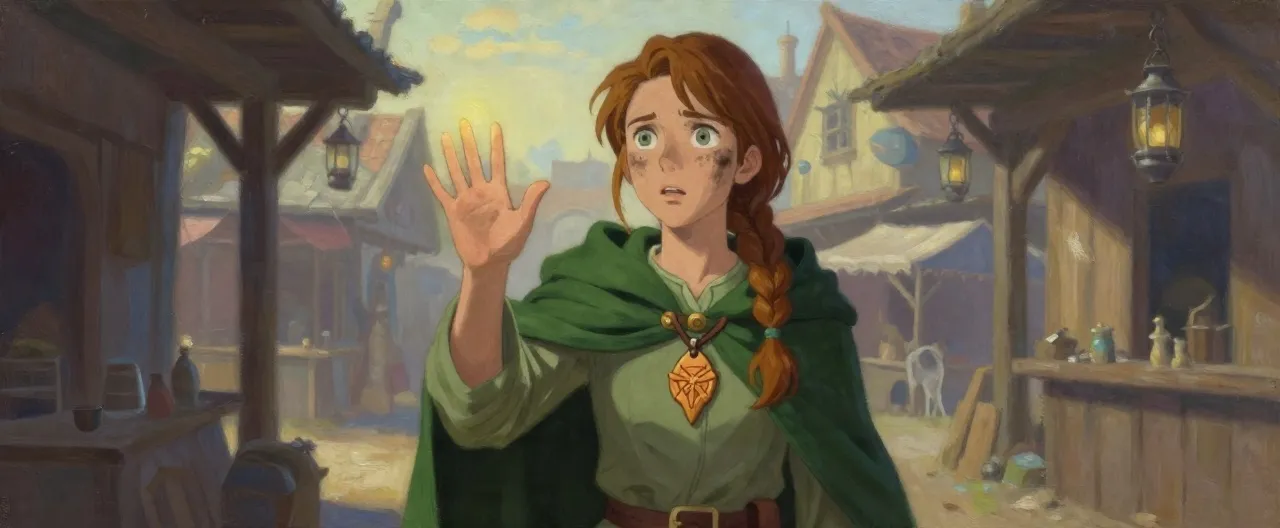
Iris Fairbank was born in the Wheatland Flats country south of the Clearwater, the middle child of a farm family whose fields answered to Chauntea long before she knew the Great Mother's name. She learned early that faith on a farm is not sung in grand temples — it is the rhythm of sowing and harvest, the first warm loaf from the oven, the small mercy of a neighbor's help when a barn burns.
When a fever took her younger brother and an itinerant priestess of Chauntea could only ease his passing, Iris made a quiet promise at the graveside: she would learn to keep people alive. Her parents, practical people, saw no future in it, but they let her go when a rural shrine took her in as a novice.
She spent her novitiate at a small shrine in the farming country, where an aging keeper taught her the practical catechism of the harvest goddess: how to set a broken arm, how to bless seed grain before spring planting, how to pray over a hearth so the fire holds through a cold night. She learned the cantrips of her faith — Sacred Flame to drive off wolves at the lambing pens, Guidance whispered over a farmer's weathered hands, Thaumaturgy to make a sermon carry across a muddy yard.
She learned the Healer's Kit the way farm children learn knots: by doing it badly a hundred times, then doing it right. She also learned that she was no warrior. The mace they pressed into her hands felt wrong in her grip, and her trainer told her bluntly that her gifts lay in light and steadiness, not in breaking skulls. She took the mace anyway, out of stubbornness, and has been quietly learning to swing it at a practice post ever since.
Two years ago, the elderly shrine-keeper Agnes Harper sent word that Valleyford needed a younger pair of hands at its little stone shrine, and Iris went. The town suited her — warm, ordinary, full of small devotions. She swept the shrine steps each morning, filled the offering bowl with wheat sheaves, and took over the pre-dawn rounds of the ward-stones, the old boundary markers set into the bridge arch and the ridge path that Agnes swore 'keep the dark out.' It was ritual maintenance, nothing more — a prayer to Chauntea, a spark of true light, a check of the old abjuration carvings. Or it was, until this autumn.
The shrine's glow has been dimming. The ward-stones have gone cold and cracked, one by one. The town's lanterns are failing, hearth-fires gutter for no reason, and even Oscar Reed's oven won't hold its heat. Iris has told no one how afraid she is, because she believes — with the fierce, unfair responsibility of the very devout — that the light is failing because she is failing. She has been rising earlier each morning, walking the stones in the dark, reciting her little litany about dawn returning.
This morning, in the market square before first light, a wolf came at her from between the darkened houses. She did not run. She raised an empty hand with a faint golden glow around her fingers and tried to calm it with light and a steady voice — and when that failed, she stood her ground anyway, because whatever is wrong with Valleyford, she intends to fix it. She is only beginning to understand that the failing stones, the stolen lanterns, and the frightened beast in the square might all be threads of the same thing: a creeping dark on Stony Ridge that the old stories call the Gloam, and that Agnes Harper, if asked with respect, can name.