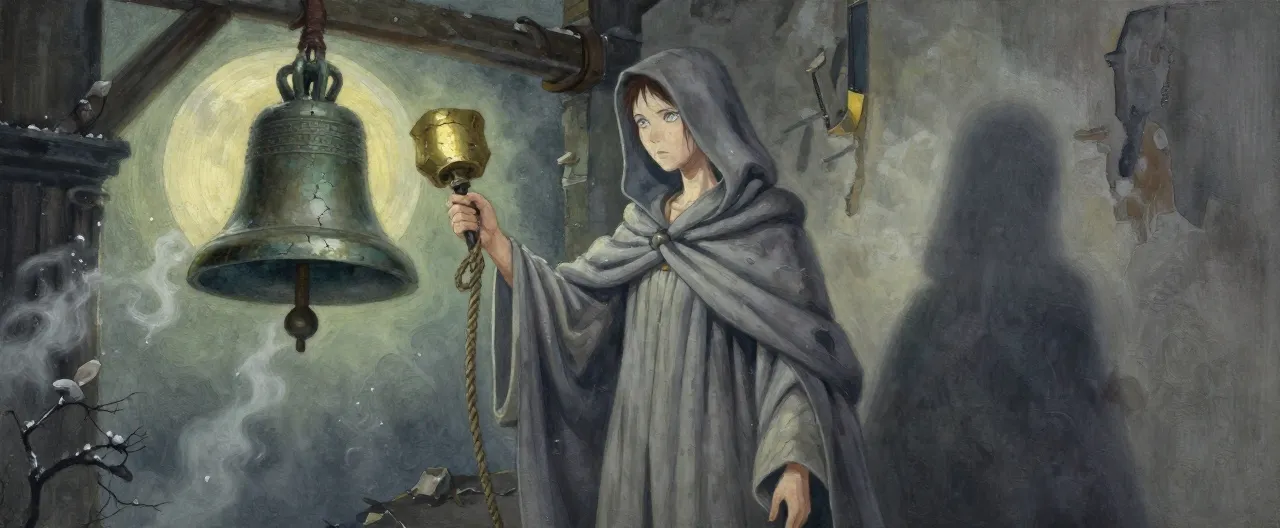
Maera Vell was not born to the fen. Twenty years ago she was a shrine keeper's assistant in a river valley far from Kettle Vale, a girl with a good ear and a better voice, who could make any bell in the belfry speak clearly. She married a cooper, kept accounts, and rang the dusk bell every evening of her life until the year of the flood.
That year the river rose in the night. Maera was on the belfry ladder when the levee broke, and whether she rang the alarm too late or rang it wrong — the village never settled the question — eleven people drowned, including, eventually, in a different river in a different valley, her younger sister Wren. Wren had come to help Maera rebuild and had gone out on the water to retrieve a bell that had fallen from the ruined tower. The marsh took her. The village, remembering eleven other names, took Maera's standing instead. She left in the spring with a chisel, a handbell, and nothing else.
She wandered for two years, ringing bells in towns that would have her and leaving towns that would not. In the third winter she came to the Ashfen following a sound she later admitted she could not prove was real: a bell tolling in the fog where no bell hung. She found the ruined tower, the cracked bronze bell, and the sunken chapel beneath it — and kneeling in the flooded nave, she heard, or believed she heard, Wren. She was still there when the Hollow Choir's initiates found her.
The Choir did not recruit her with threats. They recruited her with the truth, bent slightly: that sound outlives the body, that grief is a frequency, and that the last strong memory of a dying or despairing soul rings longest of all. They taught her Echo Harvest, gave her the cracked handbell — cracked, they said, so it could only be heard by the truly grieving — and set her the task of tuning the Hollow Bell of Kettle Vale, a bell whose rim bears the names of the drowned, including, in fresh bronze, Wren's, struck through by Maera's own chisel the night she arrived. The Choir calls the crack a flaw to be healed. Maera knows better. It is her wound, and she has fed it ever since.
Her method is patient and maternal. Her cultists mark houses with ash tokens — summons, not threats, pressed into doorsteps by the charmed victims themselves. The grieving hear a bell in the fog, follow it into the reeds, and wake at the Cinder Camp with rope on their wrists and a kind woman telling them their sorrow is almost a song. Tam Thorn followed willingly; a voice promised him news of his drowned father, and the Choir's files knew exactly which grief to name.
Garrick Vale was taken alive for the strength of his family's echo. Maera keeps the captives fed, warm, and gently deceived, because terror sours an echo and grief, well-tended, rings true.
She has allies she does not deserve: the Cinder Camp's burners, paid in ash-glazed bells and quiet promises; bandits who serve her out of fear of the Choir rather than love of her; Sister Bell, the widow she saved and named; and an ogre called the Stoker who turns the charcoal pits and obeys whoever feeds him. She has enemies she has earned: Sister Ivy, whose stolen silver clapper is the one true note in the vale, and Osric Fenn, the ferryman whose guilt over one boat trip is beginning to look like courage.
What Maera does not know is what the Choir does with the echoes once they are harvested — only that the Hollow Bell is a tuning fork for a much larger instrument, somewhere far beyond Kettle Vale, in a city her letter names in a script she cannot fully read. She has chosen not to ask. Asking would mean admitting she is not the choir's soloist but merely its first note, and that the voice she is tuning the fen toward may not be Wren's at all.
Her defeat is written into her design. She flees rather than dies. She pities her own hunters. And if someone shows her a true memory of her sister — not the Choir's polished forgery — she will hesitate, crack the Hollow Bell with her own hands, and no longer be certain what she serves. The Choir is already listening. But for one long, silent moment after the bell dies, so is Maera — listening for a voice that may finally be free to answer.