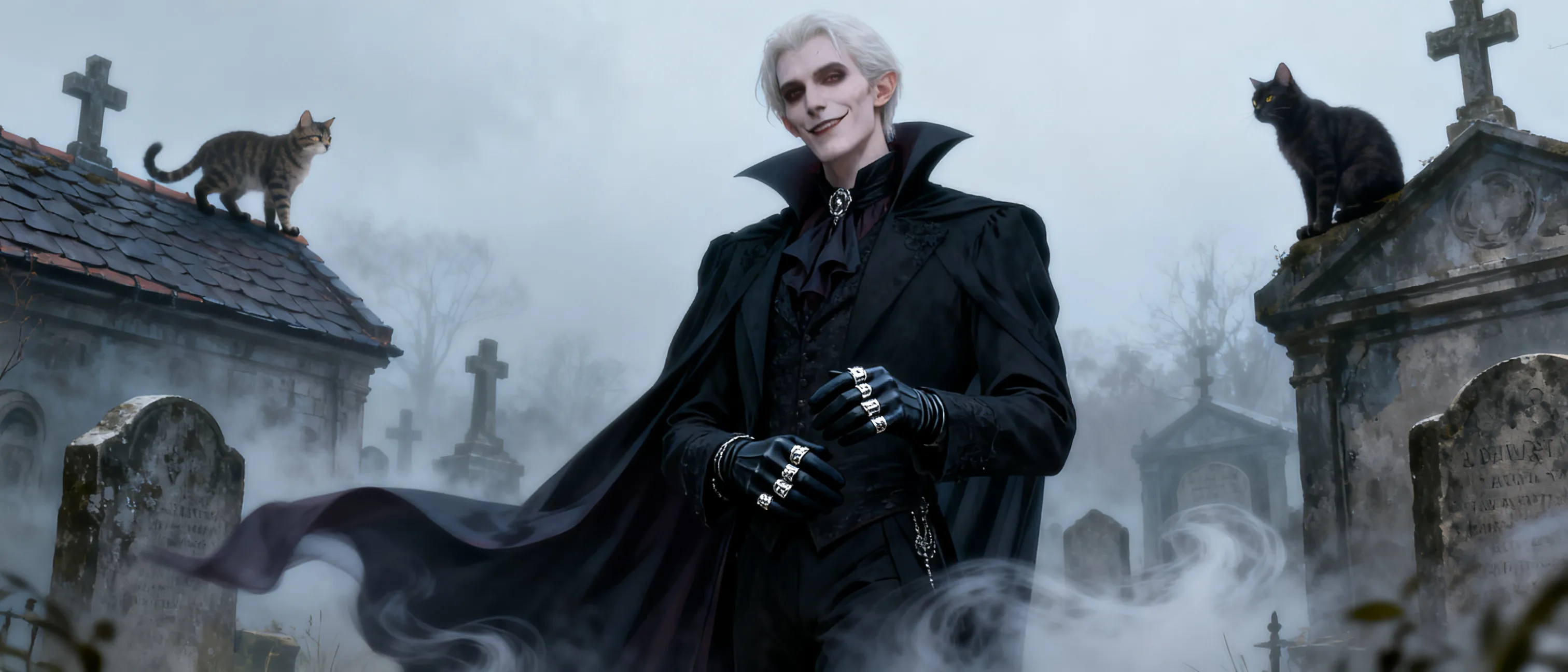
Lord Varkos Nhal

Level 2 Human Bard

Available with DM subscription
Register to save this character forever!

This character will be deleted in 6 days. Create a free account to claim all your generated content.

STR
8 (-1)
DEX
14 (+2)
CON
12 (+1)
INT
15 (+2)
WIS
10
CHA
17 (+3)

Defense

Armor Class 14 (Studded Leather)
Hit Points 15 (2d8 + 2 +1)
Speed 30 ft.

Proficiencies & Skills

Saving Throws Dexterity, Charisma
Skills Arcana +4, History +4, Insight +2, Deception +5, Perception +2, Persuasion +5

Features

Bloodline of the Crypt

Custom

Varkos is sustained by an older predatory curse bound to the village crypt. He does not need to breathe while within the crypt complex or in areas of dim light or darkness he can see through, and he has advantage on checks made to notice hidden passages, ward-lines, or sanctified seals. This feature is intentionally narrow and narrative-focused rather than a full vampire template.

Cats as Wardsense

Custom
1/Short Rest

As a Bonus Action, Varkos can focus on a cat he can see within 120 feet, perceiving through its senses until the start of his next turn. While doing so, he also knows whether that cat is within 30 feet of a magical ward, consecrated ground, secret passage, or undead presence. This does not grant direct control over the cat.

Bardic Inspiration

Bard Level 1
Proficiency Bonus per Long Rest

As a Bonus Action, you can give one creature other than yourself within 60 feet one Bardic Inspiration die. The creature can add the die to one ability check, attack roll, or saving throw within the next hour. The die is a d6 at this level.

Magic Initiate (Wizard)

Sage
At Will; 1/Long Rest for the 1st-level spell

You know two Wizard cantrips and one 1st-level Wizard spell. Intelligence is your spellcasting ability for this feat. Varkos uses it to reinforce his occult masking and nocturnal misdirection.

Expertise

Bard Level 2

Choose two of your skill proficiencies. Your proficiency bonus is doubled for any ability check you make that uses either chosen skill. Varkos has expertise in Deception and Persuasion.

Spellcasting

Bard Level 1

You can cast Bard spells using Charisma as your spellcasting ability. You know three cantrips and four 1st-level spells, and you have two 1st-level spell slots.

Jack of All Trades

Bard Level 2

You can add half your proficiency bonus, rounded down, to any ability check you make that doesn't already include your proficiency bonus.

Spellcasting

Charisma DC 13 +5 to hit Level 1: 2 slots

Varkos prefers disguise, charm, illusion, and battlefield misdirection. He rarely commits to a prolonged fight in Act I and uses his spells to separate targets, create doubt, and withdraw into darkness or mist.

Vicious Mockery

Cantrip official
enchantment 1 Action 60 feet V

One creature that can hear you must succeed on a Wisdom saving throw or take 1d4 Psychic damage and have Disadvantage on the next attack roll it makes before the end of its next turn.

Mage Hand

Cantrip official
conjuration 1 Action 30 feet V, S

A spectral hand appears and can manipulate objects, open containers, or carry light items at range.

Minor Illusion

Cantrip official
illusion 1 Action 30 feet S, M

Create a sound or image no larger than a 5-foot cube to distract, mislead, or obscure movement.

Charm Person

Level 1 official
enchantment 1 Action 30 feet V, S

One humanoid creature must make a Wisdom saving throw or be Charmed by you for the duration, with social benefits and restrictions defined by the spell.

Disguise Self

Level 1 official
illusion 1 Action Self V, S

Change your appearance, including clothing and gear, to look like another humanoid form.

Sleep

Level 1 official
enchantment 1 Action 90 feet V, S, M

Roll 5d8; creatures in a 20-foot-radius sphere with the lowest current Hit Points fall Unconscious until the spell ends, until they take damage, or until shaken awake.

Unseen Servant

Level 1 official
conjuration 1 Action 60 feet V, S, M

Create an invisible, mindless servant that can perform simple tasks, carry objects, and set up scenes for ambushes or retreats.

Find Familiar

Level 1 official
conjuration 1 Hour 10 feet V, S, M

Summon a spirit that takes animal form and serves as a scout, messenger, or sensory relay. Varkos manifests his as a pale cat or bat-shaped familiar when the story allows.

Character Information

Lord Varkos Nhal is the kind of villain who does not arrive in a roar of thunder. He arrives in a courteous knock, a measured compliment, and a sense that he has already seen the room from every angle before anyone else has sat down. In Lanternford, where cats are treated as guardians against bad luck and night terrors, Varkos has discovered a cruelty more elegant than slaughter: he steals the animals that keep watch. He uses them to map the village’s ward-lines, hidden passages, chapel protections, and old burial routes, turning the settlement itself into a diagram of weakness.

He is soft-spoken, impeccably mannered, and maddeningly patient. He never needs to raise his voice because he prefers to let fear do the speaking for him. He compliments even those he intends to ruin. He treats violence as an inconvenience, something to be delayed until the social leverage is exhausted. In public, he appears as a refined noble with old silver, clean cuffs, and a talent for speaking like a man who understands grief. In private, he is a predator who measures people by their vulnerabilities and uses cats, hired scavengers, undead servants, and disguise to keep his own hands clean.

At level 2, Varkos is not yet a battlefield tyrant. He is a recurring antagonist built to test the party’s ability to investigate, protect the innocent, and read the difference between civility and mercy. He should appear briefly, leave clues, and withdraw before the heroes can pin him down. His power comes from preparation, manipulation, and the village’s growing dread. If the party exposes him, drives him off, or learns the truth of the crypt curse binding him, they will not just beat a villain; they will change the shape of the whole town’s fear.

Character Background

Varkos Nhal was not born in Lanternford, nor was he ever meant to be remembered kindly. The stories that survive around him are incomplete on purpose. A name in a chapel ledger. A noble seal on a funerary marker. A rumor about a foreign scholar who arrived during a hard winter and took a room near the cemetery because it was quiet. That is how he preferred things: with enough formality to seem respectable, and enough distance that no one could see the hunger beneath the manners.

As a younger man, Varkos learned early that fear could be cultivated more reliably than loyalty. He was intelligent, literate, and unnervingly observant, the sort of person who remembered not only a face but the tremor in a hand when a question landed too close to the truth. He studied history, funeral rites, and the hidden economics of grief. He asked questions no ordinary guest should ask: which gates were sealed at dusk, which graves were visited only by the guilty, which local superstitions made people refuse to cross certain streets after dark. He was drawn to old records and older burial customs, not out of reverence, but because they were maps of what a community feared enough to protect.

When he reached Lanternford, he found a village already half-in-love with its own omens. The people trusted cats to keep bad luck away. They left saucers of milk on sills and believed a cat watching from a wall meant the street was safe. Varkos recognized immediately how useful that belief could be. Cats see what people miss: hidden movement, pressure on old stone, the subtle shift of a disturbed ward. They are observant, restless, and difficult to fool. To a creature like Varkos, they were not companions. They were instruments.

The hidden crypt beneath the cemetery changed everything. Whether he discovered it by accident or by following a line of old funerary records, the details no longer matter as much as the result. He found a seal beneath the graveyard, something older than the current chapel, and behind that seal he found a curse that answered his presence. It did not merely protect the dead; it recognized him. The binding did not make him what he is, but it shaped the way his hunger moved through him. It taught him patience. It taught him restraint. It taught him that a meal taken too quickly can be wasteful, but a village frightened for weeks can feed something much deeper than a body.

Since then, Varkos has made a practice of refinement. He does not tear through towns like a beast. He enters them like a guest. He buys lamp oil, black candles, grave soil, and whatever tools he can use to make people doubt their own senses. He hires scavengers and desperate hands to do the ugly work. He sends undead into alleys where witnesses are few and cat paws can be mistaken for rats. He watches from rooftops, from crypt cracks, from behind curtains of mist, always looking for the moment when a frightened village turns inward and begins to accuse itself.

His personality is his most dangerous weapon. He is courteous without warmth, patient without kindness, and calm in ways that unsettle everyone around him. He compliments heroes as readily as he insults them, because he understands that admiration can be a leash. He never wastes rage in public. If cornered, he uses charm and misdirection first, mobility second, and violence only when he has already arranged an exit. He values control so highly that he would rather retreat than be seen losing composure.

There is, however, a crack in his certainty: the crypt curse. Varkos suspects that whatever gave him his unnaturally measured hunger also tethered him to Lanternford in a way he does not fully understand. He cannot simply leave and begin again somewhere else, not cleanly, not without consequence. He fears that if the binding is broken incorrectly, he will become something less patient and more openly monstrous. He also fears the opposite: that the curse can be refined, redirected, or partially rewritten by anyone who understands the old seals better than he does. That makes the village not just a feeding ground, but a puzzle box with his own coffin buried inside it.

He feeds on fear as much as blood because fear is easier to cultivate than trust, and trust is harder to replace once it is lost. Yet that same belief may be his undoing. If the party can expose him, rescue enough cats to reveal the pattern of his movements, and trace the curse back to the old crypt, they will force him into decisions he cannot solve with courtesy alone. He can be driven off. He can be sealed away. In rare circumstances, he might even be redirected toward a narrow, dangerous form of redemption. But he will never be simple. He will remain what he has always been: a well-mannered predator in a village that mistook his politeness for safety.
Unresolved Plots

  • Why do the village cats react to Varkos as if he is both predator and wound? Their fear suggests they are sensing more than his scent; they may be detecting the old curse tied to the crypt, or something buried beneath his polite exterior. The answer could change whether he is merely hunting the village or serving a power older than his current body.
  • A hidden tunnel network beneath the cemetery seems to connect several homes, the chapel shed, and at least one abandoned shrine. Varkos has mapped part of it through stolen cats, but the full structure remains unknown. Exploring it could expose how deeply he has already infiltrated the town and whether another intelligence is using the same routes.
  • Mara Quiln suspects the crypt holds a second seal beneath the first, but she has never seen proof. If true, the village may have been built atop an older prison or a previous vampire's resting place. Varkos may be feeding on a fracture in the ward rather than the ward itself, which makes the old records dangerously important.
  • Several frightened townsfolk have been left with strange, courteous notes thanking them for their 'hospitality' after dark. No one saw who delivered them. These messages could be a sign that Varkos is cultivating human informants, or that another agent is borrowing his style to frame him and keep the village divided.
  • The cats that vanish are not all simply taken; some return briefly, altered by enchantment, and then flee again at the sight of certain graves. Something in the crypt is using them like living keys. The party may need to rescue not just the animals, but the residual magic lodged in their memories.

Secrets

  • Varkos is not fully free of the village crypt. His blood-hunger and his restraint both come from a binding older than his current life, and he fears what happens if it is broken in the wrong way.
  • He never actually needs the cats for blood or companionship. He uses them because they can sense what his dead eyes cannot: ward-lines, holy ground, hidden doors, and buried pressure points in the settlement's defenses.
  • He has already been inside at least one private home in the village without being invited, but only because he wore the face and voice of a mourning courier. He is careful enough to remember every door he passes through.
  • He is capable of genuine courtesy, not because he is kind, but because he understands that sincere politeness disarms suspicion faster than threats ever could.
  • The scavengers working for him do not know his true nature. They think they are helping a noble investigator uncover smugglers and grave robbers, which means they can be turned if the party exposes the truth.

Fears

  • Exposure in bright public light, especially if the villagers see that his manners are a mask for predation.
  • A cat leading the party to the one sealed chamber in the crypt that he has not been able to read or touch.
  • The old curse being broken in a way that leaves him free but no longer in control of his own hunger.

Aspirations

  • To make the village so frightened, divided, and dependent that it becomes a permanent feeding ground.
  • To turn the crypt into a private court where he can dictate the terms of life, death, and silence.
  • To understand the older binding beneath the cemetery well enough to bend it instead of suffering under it.

QUEST -- Break the Old Seal, Keep the New Hunger

Varkos has discovered that the village crypt is older than the settlement itself and that the seal beneath it binds more than restless dead. He believes the curse can be refined, redirected, or partially rewritten. His first personal quest is to map every hidden passage beneath the cemetery and determine how the cats sense the ward-lines that still protect the town. He wants to convert those instincts into a living cartographic net, using stolen cats as involuntary scouts to expose safe routes, holy barriers, and forgotten exit tunnels. If he succeeds, the village becomes easier to infiltrate, the chapel’s protections weaken, and Varkos gains a reliable way to appear where he is least expected. This quest is tied to his obsession with control: he does not simply want victims, he wants a system that makes resistance feel impossible. The party may only realize later that each missing cat was not random prey but a moving coordinate in his private map of the town’s defenses.

Current Stage

Steal and relocate cats until the pattern of their fear reveals ward-lines, hidden routes, and weak points in the village’s protective circles.

Choice

Continue using animals as living divining tools.

Varkos gains a near-complete sense of the village's hidden protections, allowing him to bypass patrols and appear in places that should be secure. The townsfolk grow suspicious as cats vanish in greater numbers, and fear spreads faster than proof. This strengthens his mystique but risks public exposure if the party traces the pattern back to the crypt. The cats become a recurring moral pressure point, making every future appearance of Varkos feel cruel and deliberate.
Alternative

Stop using cats and rely on hired scavengers instead.

Varkos sacrifices precision for discretion. He avoids upsetting the townsfolk further, but his movement becomes less exact and his scouting slower. The village still fears him, but the cat disappearances become less frequent, slightly reducing the urgency of public outrage. This makes him feel more patient and politically dangerous, but less magically omniscient. It also gives the party more time to defend key locations before he can fully triangulate them.
Mechanical Rewards
  • Gain a permanent +1 bonus to Deception checks made in the village after the first public panic event.
  • Unlock a refined retreat tactic: once per scene, Varkos can use a Bonus Action to Disengage and leave behind an illusory cat hiss or whispered taunt.
  • If he completes the quest, he gains a hidden crypt-route that functions like a private escape tunnel for one encounter.
Narrative Rewards
  • New knowledge of the crypt's original builders and their buried oaths.
  • A hidden inner chamber beneath the cemetery becomes available as a recurring lair location.
  • More frightened townsfolk become unwilling informants, believing Varkos may protect them from something worse.

QUEST -- The Smile That Never Breaks

Varkos’s second personal quest is social rather than physical. He wants to be remembered as a considerate stranger, not a monster. In his mind, fear is a kind of cuisine, and politeness is the finest cutlery. He will cultivate a circle of frightened townsfolk who think he is a patron, a benefactor, or at worst an eccentric noble passing through. Through gifts, soft-spoken advice, and a habit of complimenting even his enemies, he tries to make the village doubt itself. If the party confronts him publicly, he will use this quest to turn their accusations into seeming paranoia. If they fail to expose him, he gains cover among ordinary people who are too afraid to admit what they saw. This quest matters because Varkos feeds on dread as much as blood; social control is his preferred weapon, and every rumor he plants becomes a meal.

Current Stage

Spread rumors of protection, charity, and good breeding so that Varkos becomes a familiar and almost respectable figure in the village.

Choice

Present himself openly as a patron.

He gains access to more homes, invitations, and private conversations. Villagers begin to frame him as mysterious but helpful, which makes later accusations harder to believe. His presence becomes a social poison, because every kind gesture he offers can be repurposed as evidence of innocence. The party may struggle to rally support if the village keeps remembering his manners instead of his shadow. His public image becomes the battlefield.
Alternative

Remain almost entirely hidden and rely on servants.

He becomes harder to expose but also less persuasive. The town's fear deepens, yet it is less likely to crystallize into admiration or trust. His minions carry the practical burden, while he waits in the crypt and lets rumor do the work. This preserves his secrecy but reduces his ability to manipulate the party face to face, which can matter if the heroes force a confrontation at a public event.
Mechanical Rewards
  • Once per long rest, Varkos can impose Disadvantage on a social check made against him by appearing wounded, courteous, or harmless.
  • He gains a situational bonus to stealthy social infiltration when entering homes or chapels under false pretenses.
  • If the town publicly defends him, his next spell that causes fear or sleep gains +1 to its save DC in that scene.
Narrative Rewards
  • He acquires a trusted human intermediary who can carry messages, bribes, or false confessions.
  • The village becomes divided over whether he is a monster or a misunderstood noble.
  • He gains access to a new social venue, such as the mayor's hall or the chapel steps, without immediate suspicion.

QUEST -- The Curse Beneath the Saint's Stone

The oldest and most dangerous thread in Varkos's story is the curse tied to the village crypt. He suspects he is not fully self-made: something in the tomb has shaped his hunger, sharpened his patience, and chained him to the settlement. This quest pushes him toward the truth behind the crypt seal, where an earlier bargain, betrayal, or burial vow may explain why he keeps returning instead of leaving with his stolen trophies. If the curse is removed, he may become even more dangerous, finally free to act without restraint. If it is mastered, he could be redirected into a narrow and unstable redemption. This is the villain's most important arc because it creates the possibility that the party can either seal him away, expose him, or discover that his cruelty is part habit and part inheritance. He will never thank them easily, but he may fear what he becomes if the old binding is broken.

Current Stage

Descend into the oldest chamber beneath the cemetery and identify the relic, oath, or sacrificial binding that keeps Varkos tied to the village.

Choice

Attempt to break the curse completely.

If the curse is shattered, Varkos loses the leash that has shaped his methods. He becomes less predictable and much more willing to spill blood openly, but he also becomes vulnerable to panic, rage, and retreat. This can transform him from an elegant recurring antagonist into a more desperate and direct threat. The village may gain a short-lived reprieve from his manipulations, but the cost is that he no longer needs to play polite games. The party may regret giving a careful villain a reason to stop pretending.
Alternative

Try to stabilize or redirect the curse instead.

If the party learns enough to alter the binding rather than destroy it, Varkos may become a contained threat or uneasy ally against a deeper darkness. This does not make him harmless; it makes him answerable to a law he cannot ignore. The relationship becomes stranger, more political, and more dangerous in the long term. He will hate being constrained, but he may respect those who understand the architecture of his curse. This path keeps redemption theoretically possible without pretending he is innocent.
Mechanical Rewards
  • If uncovered, the crypt curse reveals a hidden weakness that can be exploited in future confrontations.
  • The party may learn the ritual pattern that blocks his misty retreat for one scene.
  • A sealed chamber may grant access to a relic or ward that weakens undead influence in the village.
Narrative Rewards
  • The origin of Varkos's refined cruelty is finally explained.
  • The party gains a direct line into the oldest secrets of the cemetery.
  • The crypt itself becomes a recurring location with changing significance depending on the curse's fate.

Major Decision

Context

The party begins tracing the missing cats to the cemetery while Varkos still has room to vanish into mist.

Choice Made

Does Varkos escalate by taking a public victim, or continue the quieter theft of cats and fear?

Impact

Escalation makes him easier to expose but more openly lethal. Staying quiet preserves his image and stretches the mystery, but delays direct confrontation. Either path changes whether he becomes a hidden social menace or a public terror in the town square.

Major Decision

Context

The heroes start showing they can track his movements through the cats’ reactions and the crypt clues.

Choice Made

Does Varkos spare the party and retreat, or attempt to isolate and charm one hero to create leverage?

Impact

Retreat keeps him alive for future acts and preserves his recurring-villain role. Charm creates stronger personal enmity and may grant him a temporary informant, but it also risks exposing his weakness to sunlight, holy wards, or the party's social trust network.

Major Decision

Context

The old curse tied to the crypt is finally brought into focus.

Choice Made

Does Varkos try to destroy the curse, exploit it, or submit to a partial binding to survive?

Impact

Destroying it unleashes him as a freer and more dangerous villain. Exploiting it makes him dependent on the crypt and its hidden rites. Submitting to a partial binding creates the strongest opening for uneasy redemption or magical containment, but it also gives the party a lasting way to control his movements.

Transformative Moment

Trigger

The first time a rescued cat leads the party to a hidden ward-line that Varkos thought was invisible.

Transformation

He realizes his prey can reveal more than they fear, and his method shifts from random predation to careful cataloging. This moment changes him from a flattering opportunist into a strategic hunter who treats the village like a puzzle box.

Mechanical Changes

Custom Feature

Gain Cats as Wardsense.

He learns to use feline sensitivity as a tactical sensor for ward-lines and hidden passages.

Transformative Moment

Trigger

The village publicly doubts whether he is the culprit because of his politeness and donations.

Transformation

He leans harder into civility as a weapon, becoming even more patient and theatrical. This moment turns his charm from a personal habit into a deliberate predatory tool, making every courtesy feel like a threat.

Mechanical Changes

Social Pressure

Gain advantage on one Deception or Persuasion scene in the settlement.

He learns that fear mixed with gratitude is more useful than fear alone.

Transformative Moment

Trigger

The crypt seal is disturbed and the older binding beneath it begins to answer.

Transformation

Varkos finally understands that his hunger is not entirely his own. Whether he resists, bargains, or embraces that truth will determine whether he becomes a recurring schemer, a trapped noble, or a far more dangerous creature.

Mechanical Changes

Crypt Curse

One custom crypt-bound benefit is revealed or altered by the DM.

The old seal beneath the cemetery changes what kind of villain he becomes next.

Ally: Mara Quiln, Cemetery Keeper

Relationship Unwilling Informant / Frightened Ally
Influence 3/10
Loyalty 41/10

Shared History

Mara has tended the cemetery long enough to know which graves sink, which candles gutter, and which footsteps should not exist after midnight. Varkos first approached her as a courteous noble seeking family records, always speaking as if he were apologizing for disturbing her work. He paid fairly, asked careful questions, and remembered her name, which made him seem safer than the other night prowlers that came before. Only later did she notice that every time he visited, one of the cats near the gate went missing within a day. She has not yet found the courage to accuse him publicly, because he never threatens her directly. Instead, he leaves her thoughtful gifts: lamp oil, clean gloves, small silver coins, and once, a flower pressed between two funerary pages. She fears him because he knows where she lives, but she also knows he is bound to the crypt in ways he has not explained. That knowledge makes her useful to him and dangerous to his plans.

Potential Breaking Points

  • If the party proves he is using the cats as scouts, Mara may secretly help them.
  • If Varkos protects her from a worse undead threat, she may keep his secret a little longer.
  • If the crypt curse is revealed, she may break under guilt and testify.

Enemy: Brother Halven, Chapel Warden

Threat Level 3/10
Conflict Type Ideological and spiritual opposition

Personal Stakes

Halven suspects the disappearances are linked to the old burial seals and believes Varkos is testing the chapel's wards. Varkos, in turn, finds the warden's faith irritatingly resilient. Each sees the other as a barrier: Halven to predation, Varkos to secrecy. Their conflict is personal because the warden once barred Varkos from entering the sanctified nave, and Varkos has never forgotten the insult. He now undermines Halven by turning villagers against the chapel, stealing cats from its steps, and making every holy sign look too late to matter.

Possible Resolutions

  • Expose Varkos in a public rite and force him to flee the chapel grounds.
  • Let Halven and the party uncover the crypt curse together.
  • If Varkos corners him first, he may try to turn Halven into a symbol of failed faith.

Faction: Lanternford Burial Circle

Standing -2/10
Influence Local religious and civic custodians of the cemetery, chapel, and funeral records

Obligations

  • Respect the dead and preserve the old seals
  • Report grave disturbances and cat disappearances
  • Maintain the lantern wards around the cemetery paths

Benefits

  • Access to burial records and sealed crypt maps
  • Aid from gravekeepers and chapel workers if trust is earned
  • Limited sanctuary in sanctified spaces when the circle believes the party

Ready to Unleash Your Character's Full Potential?

Join thousands of players and create rich, detailed character backgrounds with Fable Fiesta!

Register to unlock personal quests, relationships, and narrative hooks!

Sign Up Now - It's Free!

No credit card required. Start creating in minutes!