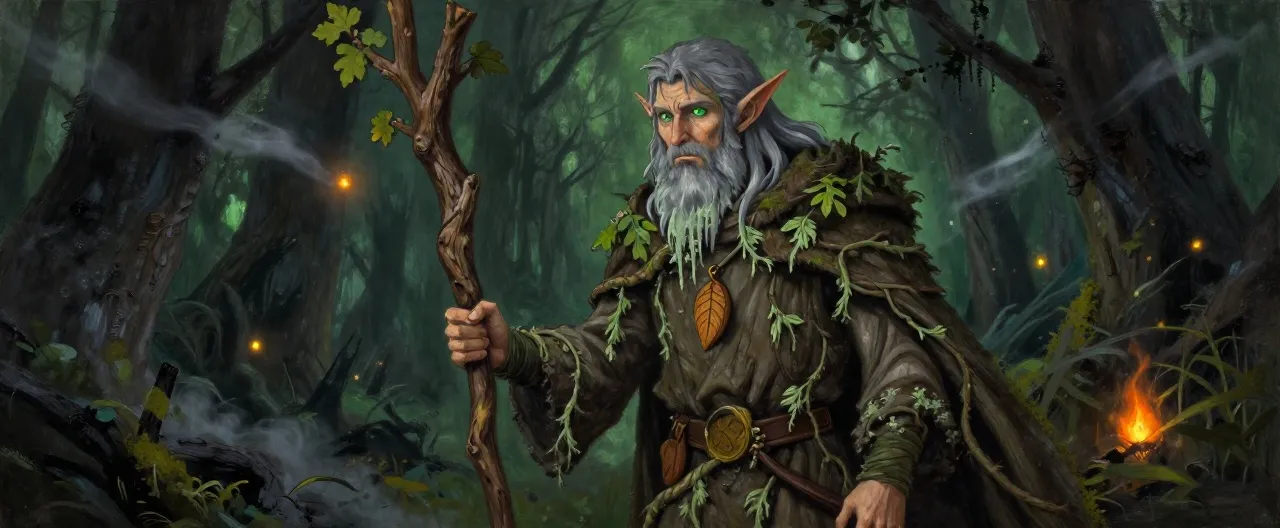
Theris was born under the eaves of the Thornwood when the eldest grove was already old, and he was chosen by the druidic rings before his hundredth winter. He trained in the old ways — patience, planting, the slow reading of root and rain — and rose to become the Concord's voice in matters of the forest's health. For two centuries his life was measured in seasons: groves tended, students taught, borders walked.
Malrec Thorn was his finest student, a boy who could coax dead branches to bloom, and Theris believed the old ways were safe in such hands. Then the orc war came, and with it human soldiers, and fire. The eldest grove burned with Malrec's family inside its sanctuary ring, and Theris arrived too late to do anything but carry bodies and speak rites over ash. In the years since, he has walked every burned acre of the Thornwood, recording each fire's age, cause, and direction of travel in a bark-bound ledger — the work that earned him his title, Keeper of the Burned Acres.
He argued against the Concord's retaliatory raids and was outvoted three times; each raid cost him a grove and a friend, and each defeat hardened the young rangers against his patience. He watched his finest student curdle into the forest's most dangerous extremist, and he blames his own silence as much as the torches. Now, with the Ashen Choir manipulating both humans and elves toward a war that would make the orc invasion look small, Theris has done something he has not done in decades: he has asked outsiders for help.
He knows Malrec's ritual will corrupt the Forest Heart — the stone at the Thornwood's center, where the forest's oldest memories live — and he knows he cannot stop his student alone. He will guide the party through the deep paths, vouch for them before the Concord, and teach them what the forest needs them to know. But he carries his own secrets: the fire-marks in the eldest grove's ashes that no human torch could have left, the bone whistle from a farm his own people burned, and a corruption growing in his own body through the living wood of his staff.
He has perhaps three winters left. He intends to spend them making sure the forest outlives its mourners — and he will hold every outsider, every elder, and every student to the same standard: the forest does not ask who lit the fire. It asks who will plant.