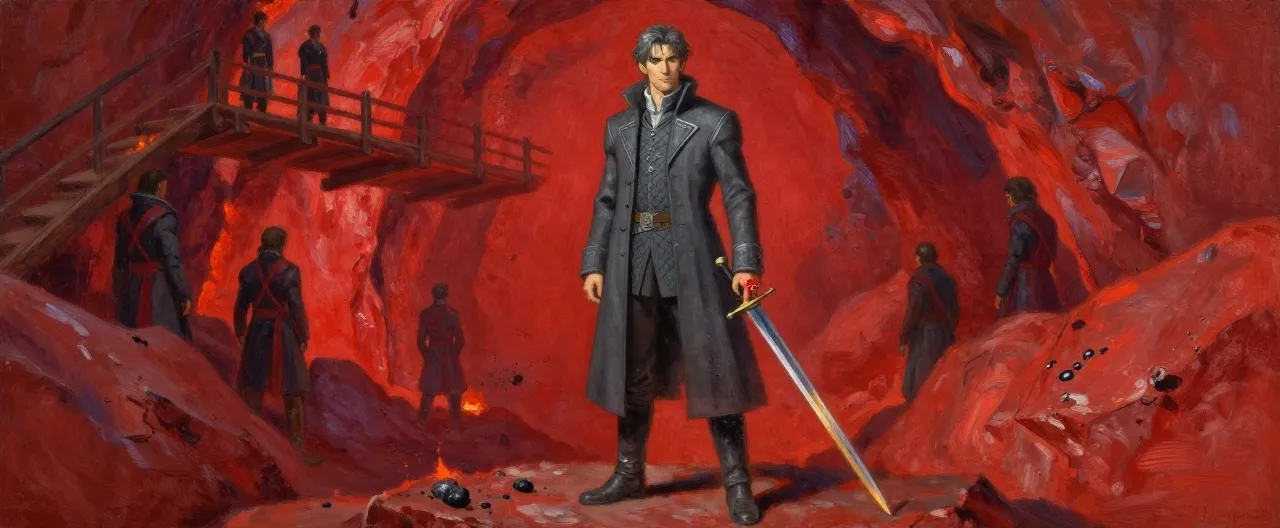
Edric Vane was born in Moonharbor, third child of a shipping clerk named Aldous Vane, a meticulous, honest man who stamped every bill of lading with a small red hand — his own private mark of a job done properly. Aldous was prosperous in the modest way clerks are prosperous: a rented house above the chandlery rows, a wife who took in sewing, children who ate well. Then the Council passed the Harbor Tariff of the year Edric turned fourteen, a levy aimed at the independent consigners, and Aldous — who had never once padded a manifest — was the sort of man who paid what he was assessed rather than what he could hide.
He paid until there was nothing. He borrowed until the creditors circled. He went into the debtor's cell beneath the customs house in the winter Edric was fifteen, and he died there in the spring, of fever and of the particular shame of an honest man ruined by rules he had obeyed.
Edric visited the cell twice. The second time, he took his father's stamping hand from the effects — a carved red hand on a wooden handle — and he did not cry, because he had already done the arithmetic: the tariff was legal, the seizure was legal, the cell was legal, and therefore legality was simply the name the strong gave to their appetite. He was fifteen. He did not go home.
He signed onto a coastal brig as a purser's boy and spent the next ten years learning, with a clerk's patience, exactly how the Reach's money moved: which guilds forged which manifests, which magistrates drank where, which harbor officials could be bought for less than the cost of a crate. He kept books for smugglers out of Saltmarch, ran numbers for a Moonharbor moneylender, and was once, briefly, a legitimate junior factor for a shipping house — fired for finding the owner's embezzlement and refusing to unfind it.
At twenty-five he went inland to the Ashen Reach, and for two winters he lived in Cinderfall Hamlet under the name Edric Marsh, fixing roofs, mending fences, and reading the old miners' tally-marks that Gran Odda's husband taught him over cheap wine. He was liked. He has never forgiven himself for how easily he was liked. In his third year he moved to the Skullgate Bazaar and began collecting the discarded: a Warden's sergeant with gambling debts, a deserter from the coast garrison, an orphaned dockhand, a ruined miner.
He fed them, armed them, gave them a sash and a word — brother — and the Redband Brotherhood was born in a bazaar back room with seven men and a ledger.
The brotherhood grew the way debt grows. Protection money became tribute; tribute became companies; companies became three thousand men across the Reach and the coast. Vane never led a raid. He signed letters. He learned of the blackfire seam two years ago when a prospector's report crossed his desk — ore that burns without smoke, forges a blade that never dulls — and he understood in one reading that the Deadvein Deep was not a mine but an anvil, and that the world he intended to forge on it was already half-made: a bought councilor here, a blackmailed guildmaster there, a privateer in his debt, a poisoned well testing a weapon, and an army digging in the dark beneath a mountain while the Council insisted nothing was wrong.
He is not a madman and not a zealot. He is a bookkeeper of grievances, and his ledger is nearly balanced. What he wants — more than Moonharbor, more than the chain, more than the fire — is for the city that killed his father to say aloud what it did. He has drafted the brotherhood's charter eleven times and burned it eleven times. He keeps two framed letters from Gruma Ashfang refusing his truce.
He pays his sister's rent through a cutout. And in the deepest gallery of the Deadvein Deep, under a red light that never quite goes out, he waits with a rapier, a war chest, and the calm of a man who believes the accounts have already been settled — and who has never once checked his own.