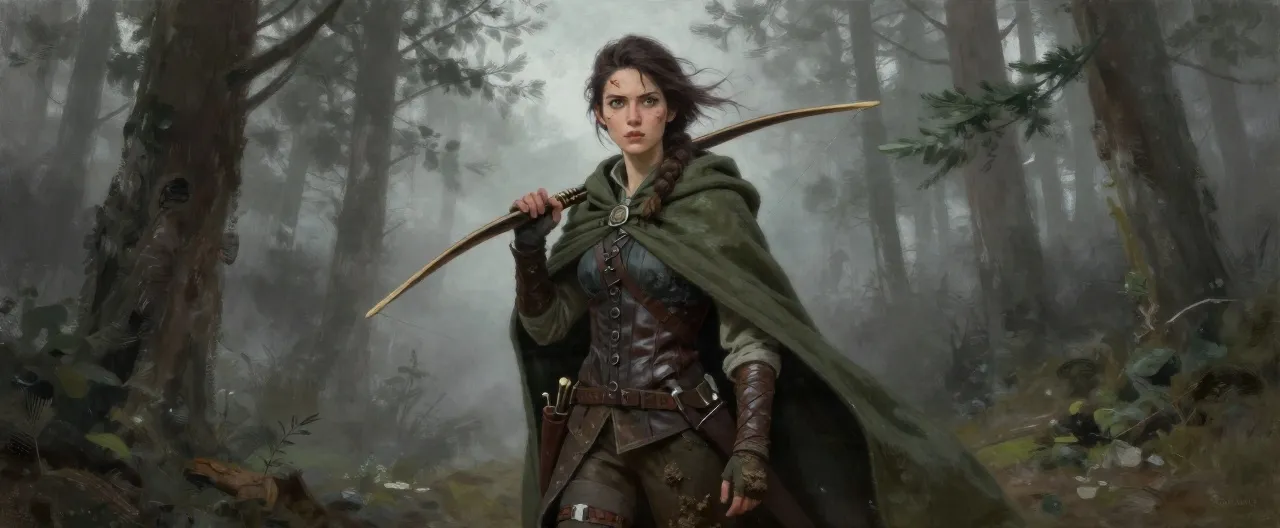
Maris Rowe was born in Vallaki, the walled town west of the Svalich Woods, the middle child of a cooper and a woman who laid out the dead. Neither trade was hers. She left home at sixteen with a borrowed hunting bow, a week of bread, and the belief that the road east to the village of Barovia was just a road. It took her three days to learn otherwise. The mists turned her back twice. The third time she made it through the woods by following the milestones, and she arrived in the village of Barovia thin, chilled, and wiser about what the valley was.
She never really stopped walking it. Scouting was the only trade in Barovia that suited her — watching a treeline for a farmer who couldn't spare a man, tracking lost livestock, walking the Svalich Road between the valley's settlements for merchants too frightened to make the trip with fewer than four guards. She was paid in copper and silver, sometimes in a hot meal and a bed behind a barred door, and she learned to take all three without caring which came.
Over the years she became one of the few people in the valley who knew the whole road rather than one stretch of it: where the birches give way to pine, where the streams run shallow enough to cross, which milestones still stand and which have fallen into the moss.
Most importantly, she learned the wolves. Every child in Barovia knows the Svalich Woods are thick with wolves; Maris knows the difference that matters. Wolves hunting for food move with hunger — sloppy, bold, whining to each other. Wolves being directed move like soldiers: silent, spread out, herding rather than chasing, and always driving their quarry somewhere. She has watched them push travelers east toward the village and west toward the mists, and she has never once seen a directed pack fail its purpose. She doesn't say the Count's name after dark. She doesn't need to. She knows who the dogs belong to.
Her scar came in her second winter, from a she-wolf that was neither hunting nor herding but simply mad — the valley breeds those too. A trapper named Kolar stitched her brow by firelight and taught her the yew bow she still carries, cut and seasoned from a deadfall above the Old Svalich Road. Kolar is gone now, the way most people in the valley eventually go, and Maris doesn't talk about it.
She knows a little of the old ways — not a druid, nothing so grand, but the small practical craft of someone who lives in the woods: calling birds quiet, reading weather in the canopy, asking the land for guidance. She speaks a few words of Sylvan, learned from an old woman near Tser Pool in exchange for a season of firewood, and the Vistani mostly leave her alone, which she counts as a fair arrangement. She distrusts them the way she distrusts anyone who moves freely through the mists.
She has no faith left in the Morninglord's church — she watched Father Donavich bury too many neighbors without rites and decided the gods keep the same office hours as everyone else in Barovia. What she believes in is the road, the bowstring, and the difference between a wolf that's hungry and a wolf that's working. She met the party the way she meets everyone worth knowing: by being the one still standing when the wolves came, and by asking the only question that mattered — which way were they driving you?