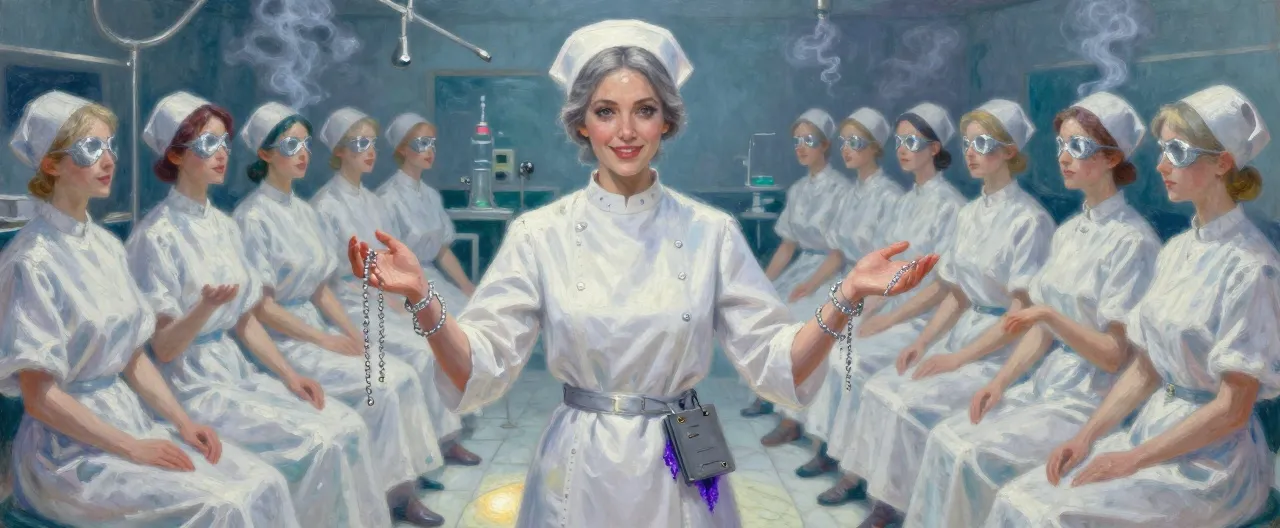
Vela Ashgrove — she abandoned the surname when she took her wimple — was born in Highwatch to a tanner and a midwife, and medicine was her inheritance in both blood and temperament. She apprenticed at fourteen, married a chandler at twenty-two, and by thirty she was the parish physician of the Chapel of the Dawn, delivering half the children in the poor quarter and setting the bones of the other half. Father Alden, then a young deacon, read the vesper hymns while she worked; she hummed along. It was, by every account, a happy life of the ordinary kind.
The Weeping Fever came in the winter of her thirty-eighth year. It arrived in the grain shipments from the bog country and burned through Highwatch's poor like fire through thatch. Vela worked nineteen-hour days for six weeks. She bled fevers, packed wounds with salt, prayed at bedsides between patients. Her husband sickened first; she treated him with her own hands and lost him on the ninth day. Her daughters — seven and four — followed within the fortnight.
She held the younger one while she died and hummed the girl's favorite lullaby because it was the only medicine she had left. The chapel's congregation prayed. The fever carts came anyway. By spring, one in three of Highwatch's poor was in the ground, and Vela Ashgrove stopped praying mid-verse during a funeral service and never finished the line.
She did not stop working. That was the horror of it. She worked harder, colder, better — and it changed nothing. Two years after the plague, an escaped asylum patient's ravings led her to a fragment of the Codex hidden in a dead cultist's boot, and the fragment did not tempt her with power. It offered her a question: what is pain? She spent a night with the page and came out the other side with an answer that felt like grace.
Pain is information. Suffering is the mind's insistence on being a self. Remove the self, and the suffering has nowhere to live. The Void Beyond was not a devil; it was anesthesia, vast and patient, and the Choir were its surgeons.
She came to the Gilded Asylum a year later, when the Choir bought its debts through Councilor Harwin's nephew. She rebuilt it in marble. She trained the staff, hired Captain Thorne, and instituted the 'silver treatment' for the weeping sickness — a condition she invented, whose symptoms are the ordinary dreams of ordinary people. The stitching quiets the mind's noise; the harvested psychic energy flows through the asylum's basement, through the wards around the Solar Sigil (captured by the Choir in a raid on a Dawn chapel, and stored in the one place no one would look for it: beneath a saint's hospital), and out to the Fane in sealed lead canisters on the monthly wagon.
The Codex granted her the Hollow Warden's rites in exchange: a domain without a god, magic drawn from the space between thoughts. She learned to charm with a hum, to harvest pain from the restrained, to see through her own silver thread. The Choir named her a living saint. Mor himself knelt in her surgical theater. And Vela, who had once knelt in a chapel and been answered with fever carts, found that being knelt to felt like nothing at all.
The crack in her — the thing Nira smells and Alden prays on and Kaelen bets his life on — is the lowest ward. Forty patients, terminal cases the Choir's quota demanded she harvest to extinction. She told the Fane they had died. She moved them below, behind a door only she and Kaelen can open, and she has been skimming the quota ever since to keep them breathing. She tells herself it is a strategic reserve, a hedge against future need.
She tells herself a great many things. At night, when the Sigil glows through the floorboards and the patients above it sleep without nightmares, she sits on the basement stairs with her ledger open to the scratched-out names and does not hum, because the lullaby has recently begun humming back.