Character Background
Veyra Blackwake was born where the harbor meets the alleyways, in a district where salt crusted the wood faster than paint could preserve it. Her mother mended nets for merchant crews, and her father unloaded cargo until a broken back pushed him into debt and drink. Veyra learned early that the sea brought food, wages, and stories, but it also brought hunger, broken promises, and men who decided who got paid by deciding who could be afraid enough to keep quiet. As a child she was not especially strong, but she was quick-handed, quick-eyed, and quick to notice what people left unattended. She stole small things at first: buttons, line, coins dropped in rainwater, and little scraps of folded paper from dock offices where nobody expected a girl with brine in her hair to linger. The first lesson the harbor taught her was simple: if you want to live, you learn what everyone else values before you learn what they say they believe.
Her earliest years were shaped by scarcity and motion. Dock work came and went with the tide, and the authorities who claimed to protect the town were often too slow, too lazy, or too compromised to stop the worst abuses. Veyra watched stronger people take from weaker people and call it law. She watched sailors get cheated by merchants, merchants get extorted by smugglers, and smugglers get hunted by the very constables who took bribes from the same ships. To her, there was no clean difference between legal commerce and criminal trade. There were only winners, losers, and the stories winners used to justify themselves. That idea hardened during a storm season when a cargo dispute turned violent and her family was caught in the middle. Her father was badly injured trying to protect a shipment that never belonged to him, and the compensation that followed was a cruel joke. Veyra never forgot the lesson: the people who talk most about order are often the first to let someone else drown.
As a teenager she ran messages, stole keys, and learned the routes by which contraband moved through the harbor. She became a useful nuisance, then a liability, then a problem worth paying attention to. The first time she was truly punished, it was not by the law, but by the people who feared she knew too much. That humiliation shaped her more than the pain. She decided then that being harmless was a form of death. If the world insisted on calling her a thief, she would become the sort of thief people remembered. If it wanted a monster, she would learn how monsters were fed.
Her rise into piracy did not begin with a glorious mutiny or a legendary duel. It began with survival. She fled a dockside betrayal on a stolen skiff, carrying only a knife, a hand-drawn route, and the names of two men who had sold her out. One of them drowned in a squall. The other lived long enough to teach her that fear can be as valuable as coin if you know how to spend it. Veyra spent years turning that lesson into a career. She learned how to bribe pilots, how to hire rough men before someone else did, how to keep a crew fed enough to stay loyal, and how to retreat without shame so she could return with better odds. She was never the strongest fighter in any room, but she became the most prepared. That is what made her rise.
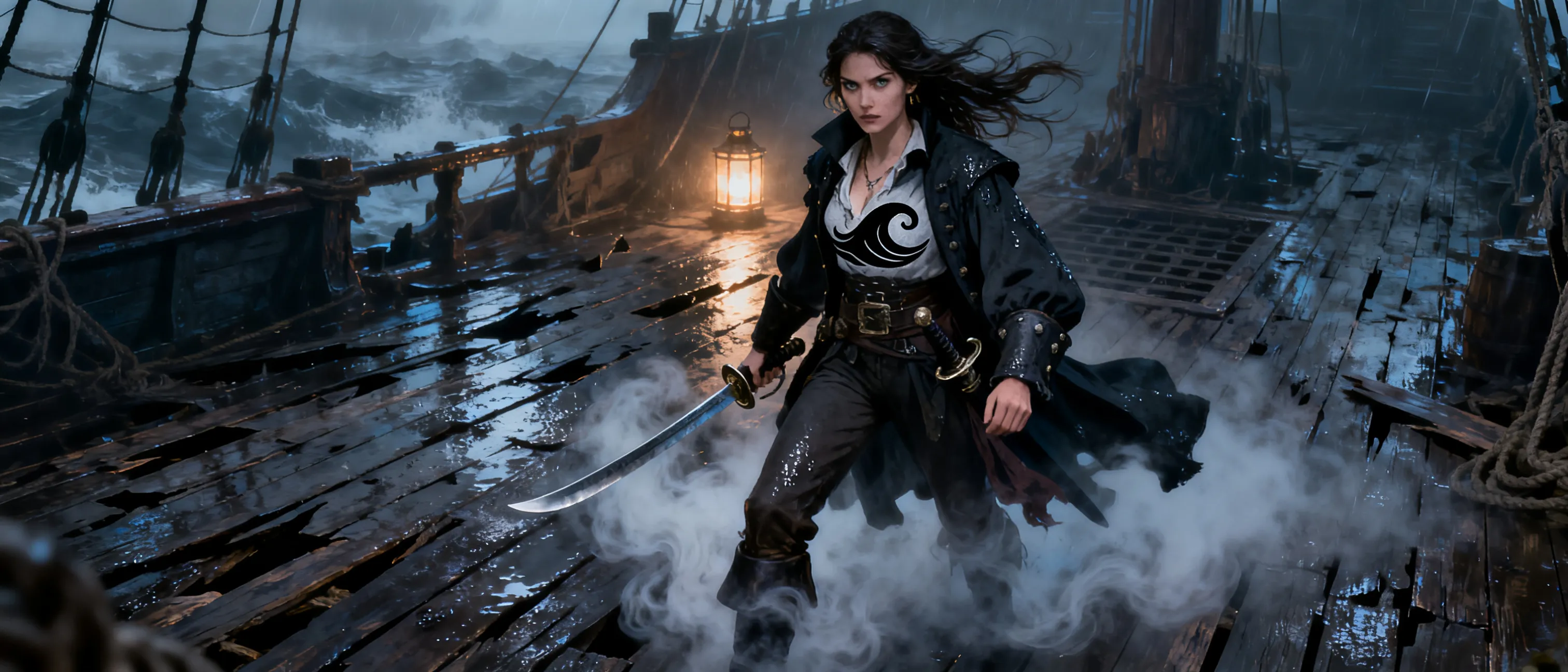
The black wave token that marks her operations is not merely a symbol. It is a promise of arrival, an assertion that her crew has already mapped the cost of resistance. Her launch boats are fast because she believes hesitation is a luxury belonging to people with better lives than hers. Her smuggler contacts, hidden coves, and stolen logs are all part of the same philosophy: power is not won in a single battle, but in controlling what happens before and after it. If a vessel survives her first attack, she expects it to be softer, slower, and more afraid the next time she strikes.
Yet beneath the confidence there is a wound she keeps hidden. Veyra does not believe in mercy because mercy once failed her. Someone she trusted chose caution over loyalty when the harbor turned ugly, and the consequences cost her more than she ever admitted. She learned then to assume betrayal before disappointment could become weakness. This is why she can appear charismatic in one moment and vicious the next. Her theatricality is not an act, exactly; it is armor. If she performs control loudly enough, maybe nobody notices how much effort it takes to maintain it. If she laughs while others panic, maybe no one sees the hand that is already checking for escape routes.
By the time the campaign begins, Veyra has become a captain who can read a tide line, spot a lie in a ledger, and turn a dockside insult into a battlefield advantage. She is ruthless, but not mindless. She believes she is building a future in which her crew will never be at the mercy of better-dressed predators. That belief is what makes her dangerous and, for the right table, strangely usable as a temporary ally later in the story. If the heroes confront her only as a cutthroat, they will miss the fact that she is also a planner, a survivor, and a woman trying to turn old wounds into a kingdom of fear. If they break her, they may only prove her right. If they redirect her, they may gain a knife that knows how to point toward a greater enemy.