Character Background
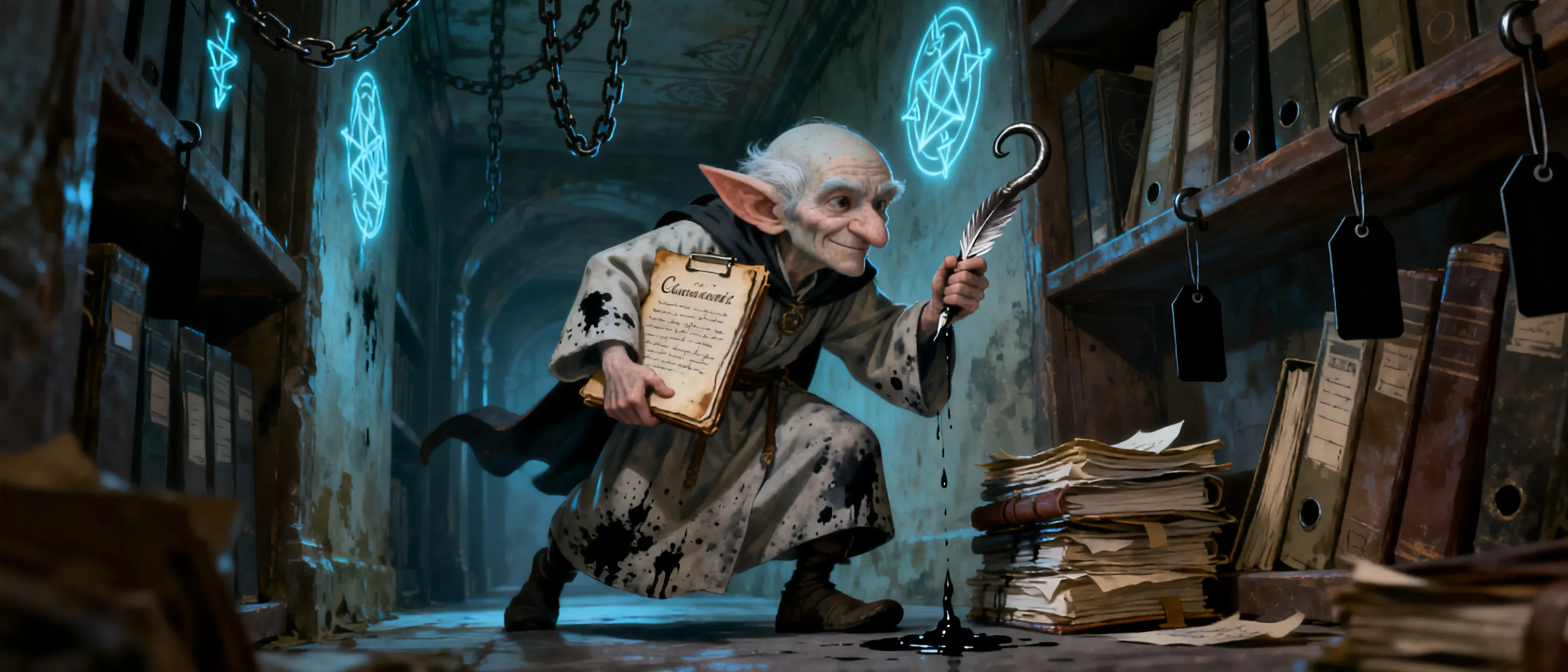
Mournix was born in the back room of a records hall where old contracts were stored in chain-hung cabinets and the air always smelled of dust, wax, and iron. They were small even for a gnome, quick-fingered, sharp-eyed, and too quiet for the other apprentices who preferred jokes, shortcuts, and gossip. While other children learned letters by copying children’s primers, Mournix learned by tracing the edges of real agreements: delivery contracts, binding oaths, repair claims, inheritance disputes, and notices of debt. The adults who supervised the archive discovered early that the child had a gift for noticing what others skipped. A smudged date. A missing witness. A clause that contradicted itself if read aloud. A seal pressed in the wrong color. Mournix saw these things not as details but as breaches in the world.
That talent earned praise, then responsibility, then expectation. By the time Mournix was old enough to work independently, they had become the sort of clerk people went to when they wanted a document checked twice and a lie punished quietly. They were never beloved, but they were useful, and usefulness became the closest thing they had to affection. Their social life narrowed into routines of copying, auditing, and filing. They became an expert with calligrapher’s supplies, an obsessive reader of old legal formulations, and a collector of marginal notes. Where other scribes took pride in elegance, Mournix took pride in precision. They believed that the law was not a social convenience but a kind of machinery: imperfect when poorly maintained, devastating when fed false input, and sacred when preserved correctly.
Their worldview hardened during a long apprenticeship in which they watched a noble house, a merchant family, and several minor vendors all use the same contract language to evade responsibility for the same failed shipment. The paperwork was technically valid, the blame passed in circles, and no one paid the cost except the workers and couriers who had trusted the written promises. Mournix did not react with grief. They reacted with outrage. Not because the people had suffered, but because the records had been made to lie while appearing clean. The lesson they took from it was not that authority was corrupt, but that authority required stricter accounting. A bad bargain was not a moral accident. It was evidence that someone had not been precise enough.
That belief made Mournix vulnerable to Marrow Quill. Marrow did not recruit them with charisma or cruelty. Marrow recruited them with a proposition: a hidden market, a bound fiend, a price-setting engine, and a ritual that required someone competent enough to keep the ledger exact. To Mournix, the work sounded almost holy. A giant machine that could assign value to objects, promises, and names? A binding whose success depended on wording? An archive where one person could protect the truth from being lazily rewritten? It was everything Mournix had ever believed, made larger and more consequential. They accepted quickly, and in doing so stepped into a world where their talents were finally indispensable.
At first they were grateful. The underworks, archive keys, and contract tablets gave them access to systems bigger than the local record hall ever had. They learned the hidden route between the Chain Archive and the Engine Chamber. They became the person who checked every clause before the ritual advanced, the one who kept cultists in line by making them recite the terms correctly, the one who could identify a corrupted seal at a glance. People began to fear their soft voice because it meant correction, and correction usually meant pain. Mournix did not mind. Fear, unlike respect, was reliable.
But the market changed them in ways they did not expect. The Gnome Depot and Kobold Swap Meet were not clean institutions. They were a living compromise held together by trust, barter, repairs, and a thousand overlapping favors. Gnomes and kobolds both believed they were the only ones keeping the place from collapsing, and both were right in different ways. Mournix saw that the market ran on imperfect human habits: quick deals, verbal understandings, emotional loyalties, and useful lies. They hated how effective that mess could be. They hated even more that the market survived because of it.
So Mournix doubled down. They began using the ritual not just to keep a demon bound, but to keep everyone else legible. They corrected sloppy records, re-tagged dangerous goods, and punished mistakes with a cold precision that made underworkers shake. They convinced themselves they were preserving the market from incompetence and corruption. In reality, they were building a private theology around control. Every clause had to matter. Every promise had to be witnessed. Every shortage had to have a cause. If reality contradicted the ledger, reality was the thing that should be suspected.
The fatal crack in that worldview came when Mournix noticed that Marrow Quill’s promise did not balance. The reward was too vague, too delayed, too dependent on undefined authority. It looked like a clean bargain from a distance, but up close it had the stink of an empty correction. Mournix became quietly obsessed. They started auditing the ritual texts and cross-checking every promise against the true ledger. Their suspicion grew when they saw black iron inventory tags reroute cursed goods toward the vault and when they realized the demon was being fed not just by power, but by debt itself. The market was not merely being used. It was being appraised as a soul-backed commodity.
That discovery did not make Mournix heroic. It made them offended. If Marrow intended to void the promised reward, then the contract was not merely immoral; it was shoddy work. And Mournix can forgive many things, but not shoddy work. From that point on, they became a colder, sharper version of themselves. They still believe all bargains are sacred, but sacred now means enforceable, and enforceable means dangerous. They will weaken intruders with curses and webs while preserving the ritual, destroy evidence if they must, and flee with fragments of the true ledger if that is the only way to keep the record from being erased.
In the end, Mournix’s tragedy is simple: they are not trying to bring chaos into the world. They are trying to make the world impossible to cheat. They have mistaken precision for justice, and the market beneath the bazaar is about to teach them how expensive that mistake can be.