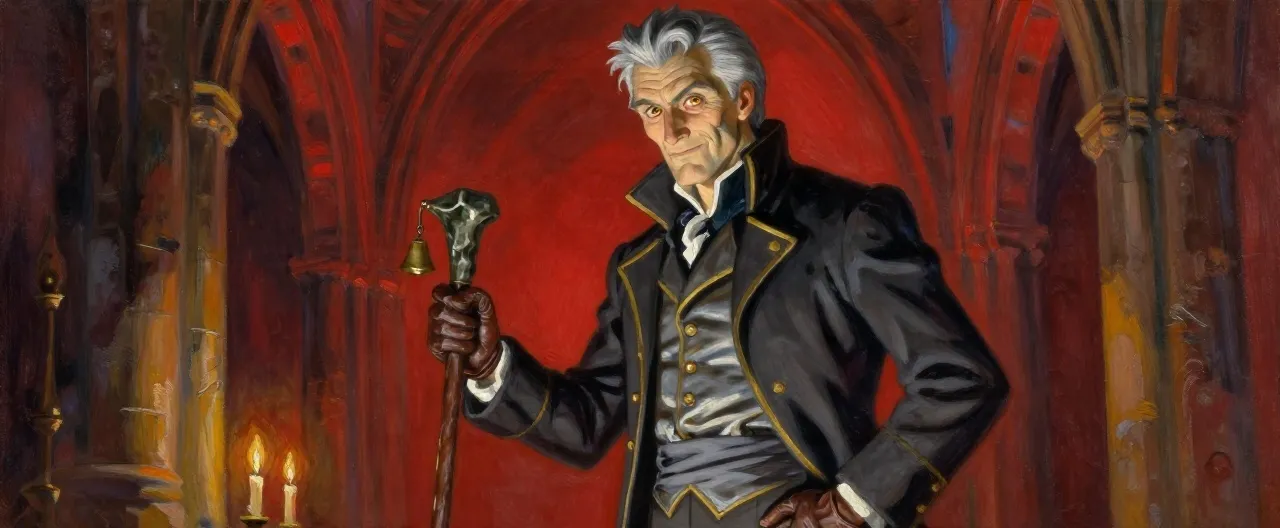
Hart was born in the Lowward of Castillo forty years before the campaign begins, the second child of a debt-collector and a hedge-witch's daughter, and he learned early that a name is the only thing a poor person owns that cannot be taken by force. His sister Ashlyne was the elder by two years and the better of the two by every measure that mattered: she joined the Order of the Weeping Saint at fourteen, took her vows at sixteen, and founded a wayside chapel in the badlands called Ashlyne's Well, where the Chain's leavings were fed and mended and asked for nothing.
Hart went into the family business. He collected debts from hedges rather than ledgers — took names as surety, in the old badlands way, and a man who lost his name lost his luck and usually his life within the year. He was very good at it and he hated himself thoroughly and told nobody either thing.
The Chain burned Ashlyne's Well in the eleventh year, on a convoy order signed by a young officer of the Kindly Chain named Maris Draper. Hart dug his sister out of the ash alive and she lived three days, and he then walked to Castillo, down into the undercroft nobody else could open, and gave the Red Gate a name freely given — not his own. Hers. He believed, then, that he was spending a dead woman's name because a dead woman cannot be bankrupted by it, and that the Gate would honour her consent the way it had honoured the founders' blood.
The Gate did something else: it accepted the name and kept the debt open, and Hart has spent thirty years paying interest on a promise that was never his to make.
In those thirty years, Hart has built the Ember Choir from a heresy in a cellar into the most dangerous institution in the badlands. His insight — the one nobody else in Castillo's history has had — is that the seal under the holy city is not a wall but a ledger, and that it is paid in names freely given rather than in blood. The Choir's rank and file believe the Gate wants blood and that the Deacon has found a gentler way.
This is the lie Hart permits because it recruits: the truth is that blood is worthless to the Gate and always was, and every drop spilled by the Chain and the Choir has been waste, and the only currency that has ever worked is a person who says their own name out loud, in front of the Gate, because they want to. Hart has spent four decades learning how to make people want to.
The soup kitchens, the hospital wing, the orphanages, the Gilded Procession — none of it is a performance. Every bowl of soup is real, the medicine works, the children are fed and taught to read, and Hart remembers the name of every person he has ever been kind to and asks after their mothers by name. He believes, with total sincerity, that he is saving the badlands, and the horror is that he is right about the arithmetic and wrong about everything else.
What Hart wants is not to open the Gate and loose what is behind it. He wants to walk through it himself and come back as the thing that decides what comes through — a god with a city's worth of worshippers who have already given him their names. He does not think of this as ambition. He thinks of it as the only honest settlement of a forty-year debt, and he will weep genuine tears while he explains it to you, and he will mean every word.
His relationship with the Chain Mistress is the wound he keeps best-hidden. He has known for thirty years that Maris Draper signed the order that burned his sister's chapel. He takes her calls. He pays her rates. He defends her to Warden-Captain Cedric Warren when Warren suggests she is disposable, because the Choir needs the Chain and because Hart has told himself, every day for three decades, that Draper is the only person in the badlands who understands what a name is truly worth — that she is, in her obscene way, a colleague.
He has never forgiven her. He has also never told her that he knows, because the day he tells her is the day he has to admit what he did with his sister's name, and he would rather walk through the Gate than say it out loud. Both of those things are going to happen in the final act, and only one of them can be undone.