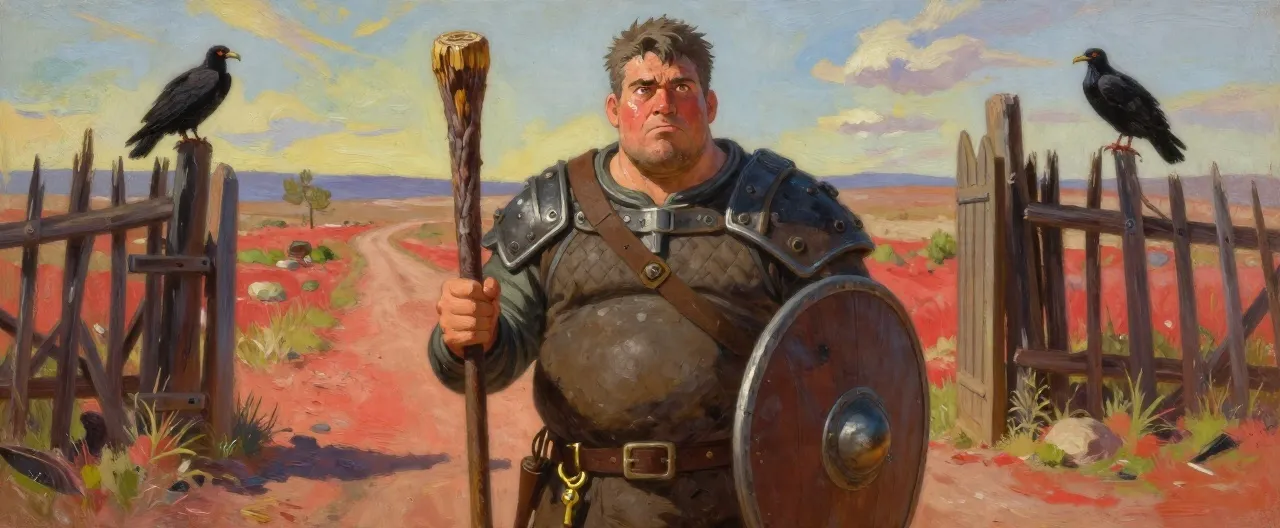
Philip Kingsford was born in a badlands waystation, the son of a carter, and he never wanted to be anything else. Twenty years on the Old Turnpike: grain to Malvern, wool to Northbridge, pilgrims' trunks from the South Downs to the foot of Castillo's mesa. He knew every ford, every water hole, every waystation that fed a man honest portions. He married once, badly; she left for Malvern and he let her go without argument, which is the kind of decision he has been making his whole life — the one that avoids a scene.
The trouble started with coin. A mining camp outside Malvern paid him in silver that turned out to be Ledger-stamped, and he spent it before he knew. The Ledger's factor found him, forgave the 'clerical error', and kept the account open — a leash disguised as a favor. And here is the thing Philip will not say out loud: he took a second payment. Willingly. To buy a team of horses. He never asked what the wagons carried, and by the time he did ask, the wagons were his, and the freight was people, and the factor's smile had not changed at all.
He gave up the wagon rather than keep hauling it. The Ledger, patient as paper, simply bought his debt from a Malvern moneylender and offered him a guard's contract at the stockade behind Shepherd's Rest — good wages, honest work, a fence to stand at. He took it. He tells himself a fence is a fence. He has been telling himself that for a year, and every night he counts forty gold in his pocket and comes up short, and every morning he stands at the pen gate and looks at the road.
The yard boss let him set the night watch rotation a year ago — a 'trust' gesture, the Ledger's kind of trust. Philip designed it himself, and he has never told anyone that every captive taken on a night he scheduled was taken on his watch. The Ledger's ghouls in the brick cellar behind the office sing at night, and the tune is one his mother sang, a badlands lullaby older than the road, and he is afraid of what that means.
He is not a monster. He is what the Ledger makes out of ordinary men: a big strong man with a debt and a shame, told that looking away is a survival skill, until looking away becomes a way of life. He leaves water by the pens. He picks up the small tokens the captives leave near the fence — a carved wooden horse, a knot of blue thread — and keeps them in his pocket with the forty gold, and he does not know what to do with them.
He is waiting, without knowing it, for someone to give him permission to stop. Twenty gold and a promise of honest work would do it. So would a private word, man to man, that does not shame him in front of the people behind the fence. What would break him — publicly, in front of the captives — is the one thing he cannot survive: being made into the story the Ledger tells about him, the fence, the coward, the drunk who lost his wagon.
If that happens, he will fight, because a man with nothing left will defend the last thing he has, and the last thing Philip has is the story that he is not what they say he is. Give him a better story, and he will hand you the key off his own belt and open the gate himself.