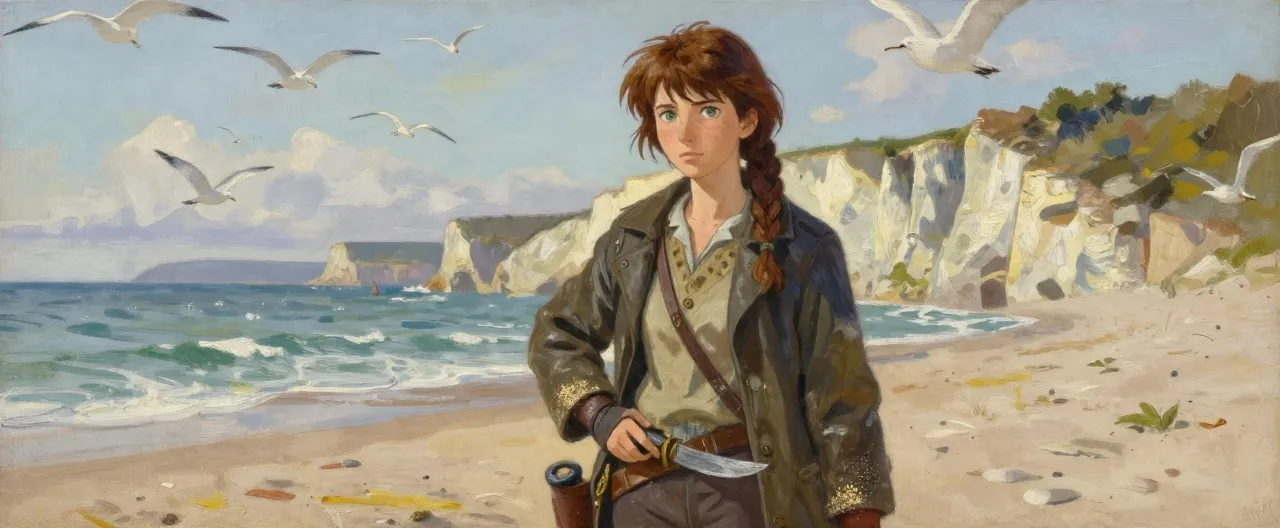
Willa Hargrave was born in Saltport, a fishing village of some two hundred souls tucked into a curve of pale beach on the coast, where timber houses lean together along one main street and paper lanterns hang from every eave. Her father mends nets out of the Salty Biscuit, Dean Wade's blue fishing boat, and her mother was one of the shore-women — the older fisherwives who mutter charms over the nets before each launch, small workings in the old way.
Willa grew up half in the water: mending nets by lamplight, gutting fish before dawn, and running the whole length of the beach on errands until she knew every tide pool, gull colony, cave mouth, and safe path along the Chalk Coast better than the gulls themselves. She learned to read weather the way town children learn their letters, and to throw a sling stone by practicing on tin cans balanced on the harbor wall.
The little shrine to Tymora by the harbor is where she leaves a copper piece before any risky climb — sailors' luck, plain and simple — though her real devotion, if she has one, is to the shore itself and the old net-mender's charms her mother taught her. Those charms turned out to be genuine: under the shore-women's casual instruction she picked up the druidic cantrips Guidance and Druidcraft, and a borrowed version of Speak with Animals that works famously well on gulls.
Pip the talking gull pretends not to understand a word she says, which both of them enjoy. When the sea broke into the old tin mine years ago and it was sealed, Willa was a child; she still remembers the sound the water made, and she knows the tide times around the flooded workings by heart. Lately she has been quietly hunting for Dean Wade's missing oar along the harbor — she found drag marks in the wet sand under the steps that don't match anything with legs, more like something dragged by hand — and when she followed the gull calls north one evening, she was cornered on the sand by two mean-tempered strangers asking questions about the cliffs.
She gave them nothing but a sore shin apiece and a sling stone apiece, and she has been watching the north cliff path ever since. She has heard the talk around town: lanterns vanishing three nights running, Mayor Hurst fretting over the festival, and a grey-hooded stranger seen asking about the old mine — which nobody with any sense goes near at high tide. Willa doesn't like fog that won't lift, and that stranger is exactly that.
She'll walk the cliffs with anyone who gives her a reason, and she'd rather bring the thief back fed and sorry than strung up — she was young and hungry once herself, and someone left bread out for her. She expects the same kindness passed along, fair sailing all round.