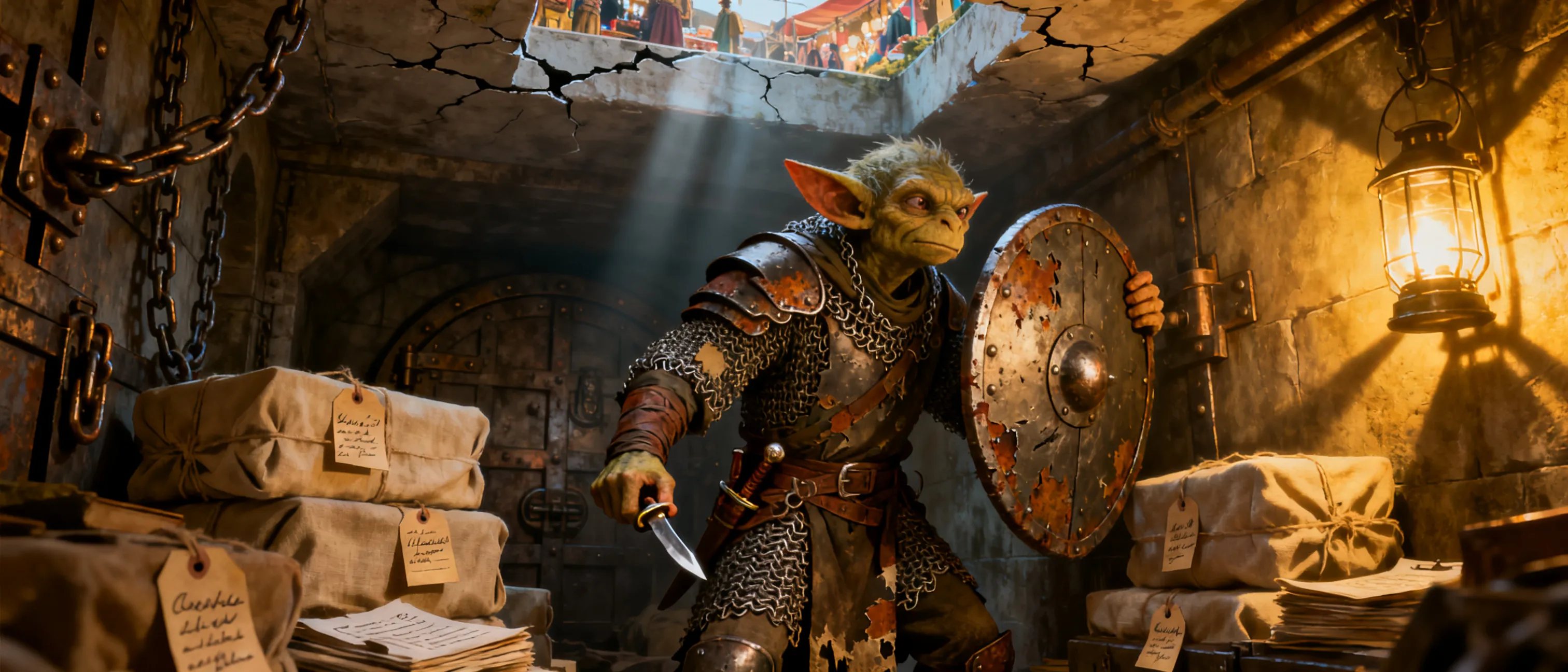
Character Background
Skarn Threadscale was hatched in the underworks of the market, in a warm little niche between a steam pipe and a storage wall where the light was always dim and the floor always dusty. He grew up among runners, tally-keepers, and maintenance crews who treated survival as a craft. In the kobold tunnels, every label mattered. Every key had a home. Every corridor had a purpose. If something moved without being logged, it was either a problem or a predator. That was the world Skarn learned first: not the marketplace above, all lantern glow and cheerful bargains, but the strict, practical order that kept the whole place from eating itself.
As a hatchling, Skarn was small even for a kobold and too serious for his own good. While other young workers ran messages or played among the cart lanes, he watched the older wardens maintain the vault seals and asked why each bell was tied to a different lock. He had a patience for repetition that made him useful, and an instinct for noticing what was wrong that made him trusted. A cracked rune, a mismatched seal, a ledger line written in the wrong hand—he noticed all of it. He did not become a scholar in the academic sense, but he learned enough to read old diagrams, seal-cant, and archive notes. The market’s history became his own private map of what had gone wrong before and how it might go wrong again.
The first time Skarn was posted to the Basement Vault of Final Price, he expected a glorified storage room. Instead, he found a living machine of seals, chains, wards, and old promises. The vault did not merely hold objects; it held consequences. Dangerous returns, irredeemable bargains, and objects too odd or too cursed to remain in the public market all passed through its iron doors. Skarn took to the work with grim determination. He patched armor with his own hands, memorized the bell sequence, and learned which old lock needed grease before it needed force. Over time, he became one of the few wardens who could tell the difference between a routine rattle and a warning in the walls.
The gnomes above learned to respect him, if not always to like him. He was too direct for their tastes, too suspicious of improvisation, and too likely to ask for a receipt when they asked him to ignore procedure. But he always showed up when a breach alarm sounded, and he always tried to keep the workers safe before thinking about paperwork. The kobolds beneath the market trusted him because he was one of them: practical, tired, and unwilling to pretend that a bad system becomes good just because it is old. He served as a bridge between the warring instincts of the market—innovation and caution, clutter and order, sale and salvage.
Then the black tags began appearing. Goods that should have gone to quarantine instead drifted downward. Lamps went missing. Cages were relabeled. A few records disappeared and returned with the edges neatly trimmed, as if somebody had edited reality with a ledger knife. Skarn at first blamed incompetence. Then he blamed lazy workers. Then he started blaming himself. He had the authority to open the vault routes and the knowledge to recognize tampering, yet he could not catch the culprit. Every correction he made seemed to be answered by another quiet adjustment elsewhere. The market did not break all at once. It frayed. That was worse.
Skarn’s bluntness sharpened as the pressure rose. He began snapping at people who spoke too loosely, not because he enjoyed cruelty but because panic felt like a fire that would spread faster than any thief. He learned to keep his fear hidden behind impatience. The vault had become his whole life, and now it was beginning to feel like a trap disguised as a job. He had to confront the unpleasant possibility that the old seals he had devoted himself to were not sacred protections, but temporary solutions that only worked while enough people believed in them. That realization did not break him. It made him angry, which for Skarn was often the first stage of courage.
He does have ideals, though he would deny it if asked. He believes people should know the truth about the dangers they live beside. He believes labor deserves respect, and that workers should not be sacrificed to preserve appearances. He believes a lock is only as honorable as the reason it exists. His flaw is that he can mistake endurance for wisdom. He can keep going long after a better person would ask for help. He also carries a private shame: when panic seems imminent, his first instinct is to lock everything down, even if that means others lose freedom they need. He worries that under stress he becomes exactly what he hates—a gatekeeper who values control over people.
That is why the party matters to him. Outsiders are dangerous, yes, but they are not already trapped in the market’s habits. They can ask the rude questions, follow the ugly clues, and challenge the assumptions Skarn has lived with for years. If they swear to keep the market from collapsing into panic, he will help them. Not because he is soft, but because he understands the cost of a controlled disaster versus a public one. He wants the vault safe, but he is starting to understand that safety without trust is just a prettier cage.
If Skarn survives the sabotage and the final descent into the Price Engine, he may become something more than a warden. He may become the person who decides that a seal is not holy simply because it is old, and that loyalty means protecting the living market, not the paperwork that used to define it. For a kobold raised beneath a trading labyrinth of gnomes and runners, that is as close to revolution as he can imagine.