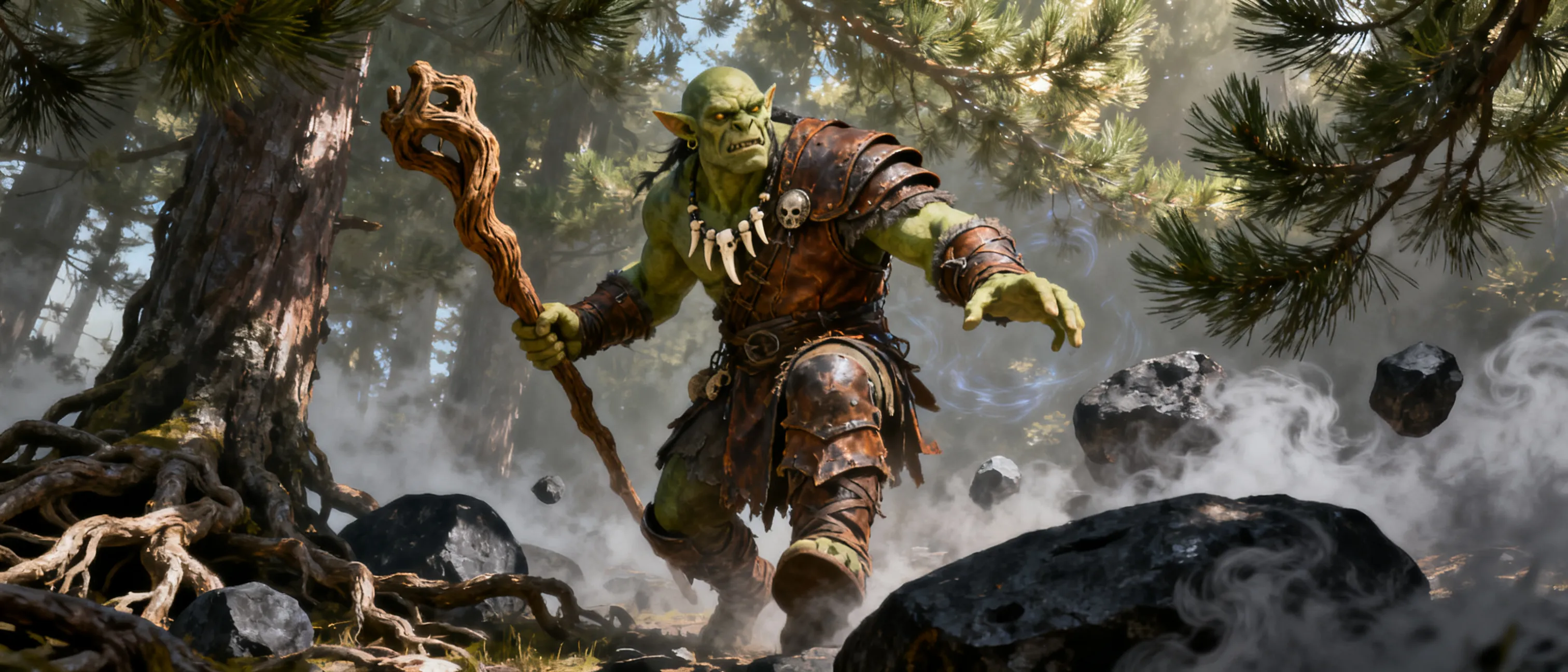
Character Background
Ragnarök was born on the edge of a hard country where the wind never seemed to rest and the soil was often too thin to promise much of anything. His people measured worth by grit, persistence, and the willingness to endure pain without complaint. Children were expected to prove themselves early, whether by hunting, guarding, or working beside the elders until their hands blistered. Ragnarök did not fail these trials, but neither did he excel in the way the strongest or loudest did. He was broad-shouldered even as a child, with an orcish frame built for labor and battle, yet he spent much of his free time watching ravens circle above the camp, kneeling beside creek beds to study how reeds bent in the current, or tracing lichen patterns across old stones half-swallowed by the forest.
Most adults saw this as peculiar. A few saw it as a weakness. Ragnarök saw it as a kind of strength no one else in his clan had bothered to name.
His childhood changed when a wandering scholar arrived during a season of floods. This traveler was no warrior and carried no trophies of conquest, only parchment, inks, and a calm expression that made even the fiercest hunters lower their voices. The elder of Ragnarök’s clan welcomed the stranger, and in exchange for shelter, the scholar shared stories of old kingdoms, forgotten rites, and the hidden laws that governed weather, growth, and decay. Ragnarök was transfixed. He followed the scholar everywhere, asking questions that most people would never think to ask: Why do some trees survive lightning? How can fire be a destroyer and a purifier? Why do certain birds always arrive before rain?
The scholar recognized in him a rare hunger for understanding and began teaching him to read signs in the living world. Ragnarök learned that knowledge could be practical without being cold, and reverent without being submissive. He learned how to identify medicinal herbs, how to predict a storm by the smell of the air, and how to quiet his breathing until even skittish creatures stopped fearing him. He also learned that the world was larger, older, and stranger than the stories told around the clan fires.
Then came the winter that took his mentor.
A blizzard struck the region with such force that paths vanished and roofs groaned under drifts of snow. When a hunting party failed to return, Ragnarök and the scholar set out together to find them. They found the missing hunters in a ravine, pinned down by a landslide and injured but alive. The rescue should have been simple, but the storm worsened. The scholar, already weakened by age and travel, gave Ragnarök instructions for sheltering the wounded and went to help reinforce the path behind them. He never returned. By the time Ragnarök found him, the scholar had collapsed in the snow, sacrificing his strength so others might live.
That death marked Ragnarök forever. He inherited the scholar’s notes, staff, and ritual tools, but more importantly, he inherited a purpose. He left his homeland after the thaw, not in shame, but in devotion. He had seen enough of how fragile life could be, and enough of how stubbornly it persisted, to understand that the world needed people willing to defend balance instead of merely taking from it.
Since then, Ragnarök has traveled from vale to valley, learning druidic secrets from groves, ruins, and solitary hermits. He is not a romantic about the wild. He knows it can kill without warning. He also knows it can heal, rebuild, and remember. His personality is shaped by that truth: patient but uncompromising, quiet but not passive, severe in judgment yet capable of deep mercy when the situation demands it. He prefers simple food, well-worn tools, and direct speech. He respects people who work for what they believe in, even when he disagrees with them. He distrusts those who treat living things as disposable.
Ragnarök’s bonds are to the land, to the memory of his mentor, and to the unspoken promise that he will not let the places he passes through be left worse than he found them. His ideals center on balance, responsibility, and earned survival. His flaw is that he can become almost ritualistically stubborn when he believes he is acting in service of nature’s greater good, even if others can see a better compromise. He is learning, slowly, that wisdom is not only knowing when to act, but also knowing when to bend.
Now, with staff in hand and stormlight in his eyes, Ragnarök walks the world as both witness and wound-healer. He is not yet the druid he intends to become. But the roots are already there, reaching deeper every day.