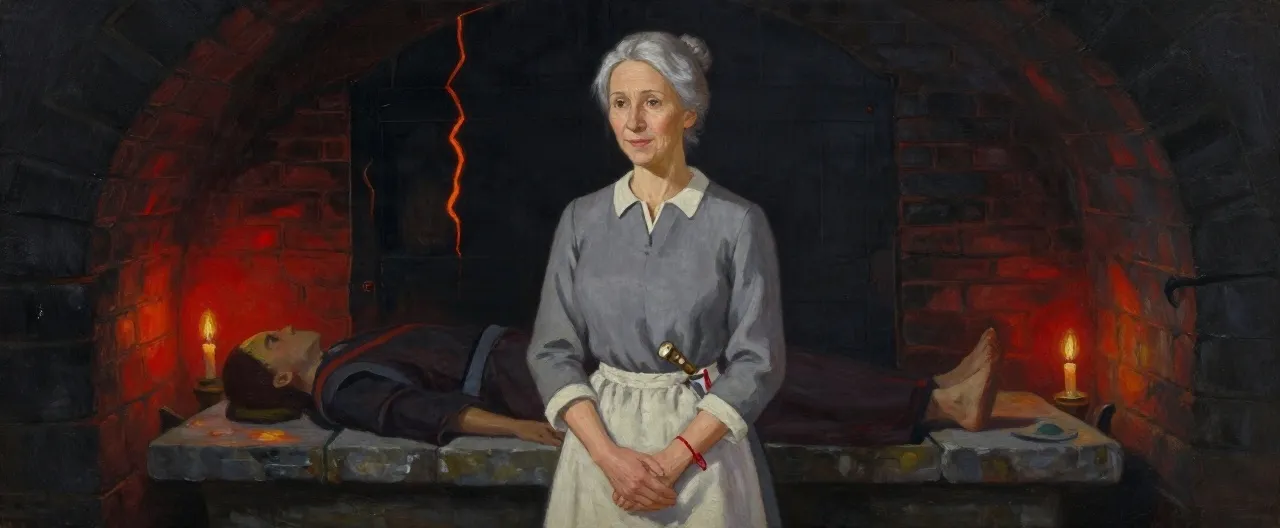
Margaret Copperfield was born in a dry-wash village that no longer exists, the fourth of six children of a well-digger who drank and a mother who died of the fourth. At nine years old she was sold — not taken, sold, with paperwork, by a man her father owed — to a badlands cult that kept children in a cellar beneath a ruined assize station and used them in rituals that never quite worked.
She spent four years down there. She learned to read from a stolen liturgy. She learned that adults who smile are worse than adults who beat you, because at least the beating is honest. She learned the sound the cellar made when the ritual was about to start: a low seam-hum in the stone, like a held breath.
She was thirteen when the cult finally got it right. They opened a seam in the cellar wall — not a door, a wound — and something looked through. It looked at every child in that cellar. And it did not take her. The others went. The cult's leaders went. The cellar went dark and stayed dark, and a thirteen-year-old girl sat alone in it for two days before she found the strength to stand, and she took a bone-handled knife from a dead man's belt, and she walked out into the badlands, and she has been deciding what that night meant ever since.
Her conclusion, reached over decades and never once revisited: the world is a botched draft. A world in which children are sold and the only mercy on offer is a demon's unexplained whim is not a world to be repaired — it is a world to be replaced. The thing behind the seam looked at the worst place in the world and, in the middle of it, spared one child. That is not cruelty. That is discernment. That is something that saw what the world was worth and chose, precisely, what to keep. Margaret has spent forty years proving herself worthy of being kept.
She built the Red Ledger in her thirties, three wagons and a stolen ledger-book, and she built it as a business because she understood, from the inside, that chaos is loud and paperwork is silent. She built the Choir of the Open Gate out of the old cult's wreckage — keeping the ones who had seen the seam, culling the ones who had seen only a trick — and she has spent two decades feeding it the desperate and the bereaved, one tenth of every sale, singing over what it buys.
The tithe-rituals in the Buried Cistern and the Singing Camp send stolen strength up the chain to her, and she spends it the way she spends everything: on bread, on bandages, on the slow patient purchase of a city's love.
Castillo was the last piece. She came a year ago under a clean name with clean money, and in twelve months she has become the most beloved woman in the city — bread lines, orphanages, a wing of the cathedral hospital, a kind word for everyone and a real memory of every name. She bought the Old Mint's vault leases through a straw buyer. She found a broken Watch sergeant and gave him a purpose.
She dug, all spring and summer, toward a dome of white stone outside the east wall, and in its black-brick basement she found the gate-stone: a slab of black rock with a seam in it that is not a crack, and behind the seam, something that is not air.
The ritual is prepared. It has been prepared, in pieces, for forty years. At the new moon she will open the shrine's sealed door, bind a willing servant of the dawn to the stone table, and give her own blood freely — because the gate, the founding ledgers say, opens only to what is given, never taken, and Margaret Copperfield has never in her life taken anything she could get given.
She will open the wound in the world and let the thing that kept her step through, and it will remake the draft, and there will be no more cellars anywhere, and she will not be sorry, and she is not sorry now.
She is not a monster. That is the trap the whole campaign is set in. She is a woman who was destroyed at nine years old, who met the void at thirteen and mistook its indifference for mercy, and who has spent her entire life being kind — genuinely, expensively, memorably kind — as a down payment on an apocalypse. She thinks she is the only adult in the room. She has never once considered that the thing in the cellar did not spare her. It simply did not want her. And the crack in her certainty, when the party finally finds it, is that single unbearable word: kept.