Acolyte Background
Shelter of the Faithful: members of her faith and affiliated temples provide free healing and care in Temple Row; +2 Wisdom, +1 Constitution from background ability score adjustments (already reflected).
Trained in martial arms and heavy armor: proficiency with all armor and martial weapons; can cast and hold Concentration spells in melee wearing chain mail and shield.
While on stone surfaces, Ysolde can treat stone as difficult terrain-free and gains Tremorsense-like benefits per SRD 5. 2 Dwarf trait (see DMG rules text).
Whenever Ysolde uses a spell of 1st level or higher to restore hit points, the target regains extra HP equal to 2 + the spell's level.
Advantage on saving throws against poison, and resistance to poison damage. Well suited to the sweet rot of the plague wards.
Ysolde can channel divine power once between rests; subclass options unlock at level 3 (Preserve Life for Life Domain).
Cleric spellcasting using Wisdom. Spell save DC 13, spell attack +5. Prepares 6 spells after a Long Rest.
60 feet of darkvision, useful in the temple crypt and the undercity tunnels.
+1 Hit Point per character level.
Prepared spells = 3 + Wis modifier (3) = 6, plus Life Domain's always-prepared Bless and Cure Wounds (counted above). Cantrips are separate.
Dex save or 1d8 radiant damage; no cover benefit. Ysolde's judgment light against restless dead.
Touch a creature; add 1d4 to one ability check within 10 feet, before the check.
Minor divine manifestation: booming voice, flickering lantern flame, trembling doors — useful for calming a ward or commanding the dead's attention.
Up to 3 creatures add 1d4 to attack rolls and saving throws for 1 minute (Concentration).
Restore 1d8 + 3 HP (plus 2 from Disciple of Life).
Restore 1d4 + 3 HP to a creature you can see (plus 2 from Disciple of Life).
Ward a creature; attackers must make a Wis save or lose the attack. Perfect for guarding the dying in the ward.
One-word command to a creature; Wis save negates. 'Halt' or 'Flee' for shambling plague dead.
Behind the character
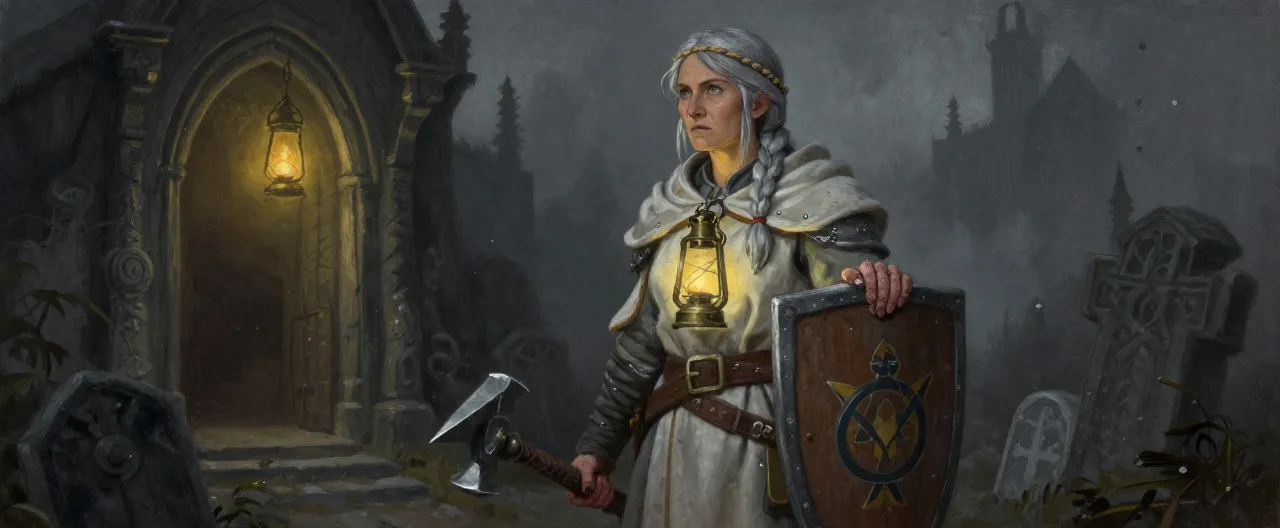
Ysolde Bram, called the Lantern of Mercy, is a weathered dwarf woman in her sixties, broad-shouldered and iron-grey, with braided silver hair bound in a temple cord. Thirty years in Nostramus have bent her back and cracked her hands with lye and grave-dirt, but they have not bent her will. She wears a dented but well-kept suit of chain mail over a white-and-grey habit, carries a mace at her belt and a wooden shield painted with a lantern sigil, and a brass holy symbol shaped like an open lantern hangs at her throat, glowing faintly in the dark.
Before the adventure
Ysolde came to Nostramus thirty years ago as a wandering acolyte of the faith of the open lantern, a creed that holds that a light left burning in a doorway is a promise made to every stranger in the dark. She was meant to stay a season. She stayed because temple row was poor, then because it was needy, then because there was no one left to leave it to. She has buried three generations of parishioners in the ground behind the Temple of Mercy, and she knows the names on every stone, because she carved half of them herself.
In the last three weeks she has buried more than in the thirty years before. The weeping plague came off the docks like a tide, and the temple's nave is now a hall of coughing and prayers, rows of cots where pews used to stand. Ysolde has noticed something that frightens her more than the dying: the prayers she says over the dead have become the same words she says over the dying, and she cannot remember when the two rites merged.
She keeps a lantern burning in the temple doorway all night, every night, because the one thing she will not do is let the doors close. Twenty years ago, during a fever scare, she turned away a dying man at that door, and he died in the street. No one knows. It is the reason for everything since.
She is patient, unsentimental about death, and stubbornly kind. She has no patience for sermons and will hand a dying stranger a cup of water before she hands them a blessing. She believes faith is a discipline of the hands first and the heart second: change the linen, dig the grave, keep the light. Her faith has been tested by Brother Aldous's failing conviction and by the plague's resistance to every prayer she knows, and it has held, but it has changed. She is quieter now, and harder in a way that worries her.
Her secret is older than the plague: she arrived in this city carrying a grey cough she has never named, and she has dosed herself with temple remedies for thirty years in quiet expectation that the sickness will one day finish what it started in her lungs. Now the cough has returned, and she does not know if it is her old sickness, the weeping plague, or something worse. She also keeps a private list of graves she dug with her own hands, and on the back, in handwriting she does not remember writing, is a single line: 'The lantern goes out on the last night.'
Her driving goal is simple and impossible: find a cure for the weeping plague, and keep the Temple of Mercy open to anyone who knocks, sick or not. She carries Sister Neris's ledger because the dead of Nostramus deserve to be counted for a reason, and she carries her mace because some doors must be held open against the things that want them shut.
Threads to follow
Beneath the surface
What haunts them
What drives them
Personal quest · 1
Sister Neris has found a pattern in her ledger of plague victims: three dead on one street in a single night, none near the docks. Ysolde must help finish the ledger, walk the three houses in temple row, and follow the thread down into the crypt beneath her own temple, where Doctor Fesk kills the people he swore to save. The ledger is the only proof the city will accept, and Neris trusts no one else to carry it.
Complete the ledger with Neris and identify the three plague houses.
Personal quest · 2
The Temple of Mercy's doorway lantern has burned every night for thirty years, and Ysolde swore it would never go out. Now the temple's oil is gone, the tallow yard is a corpse staging ground, and refugees whisper that a dark lantern means the temple has closed and no one need knock again. Ysolde must find oil, wick and hands to keep the flame alive through the worst nights of the plague, while deciding how many dying strangers she can shelter before the doors cannot hold them all.
Secure oil and supplies from Quartermaster Bree, the tallow yard, or the Harbor Kin.
Personal quest · 3
Ysolde has buried three generations of parishioners, and she keeps a private list of graves she dug with her own hands. Among the names is her own: thirty years ago she arrived in Nostramus carrying a sickness she never named, and she has quietly dosed herself with temple remedies ever since, certain the weeping plague will one day finish what started in her lungs. Now her old cough has returned. She must find out what she has been carrying all these years, whether it is connected to the plague, and whether she has unknowingly been a carrier in temple row.
Consult Brother Aldous and Archivist Mora's records about the sickness Ysolde brought to the city thirty years ago.
In the Crypt of Mercy, Ysolde finds Doctor Fesk's caged first subject, Vessel Thirteen, a plague-swollen ghast that still wears a hospital shift and moans fragments of temple hymns. She recognizes the hymns: the creature was one of her own parishioners, a woman whose name is in Neris's ledger.
The rite of mercy succeeds only if she holds concentration through the creature's attacks; success grants her the permanent boon 'Last Rites' (her healing spells can stabilize a dying creature at 0 HP automatically once per day) and closes the creature's story with peace. Destroying it grants a permanent +1 to her mace attack rolls as her resolve hardens, but Neris is haunted by the death. Capturing it alive yields the strongest evidence for Captain Vey but risks it breaking loose in the temple, and if it escapes it infects the ward.
Captain Vey's son is hidden, plague-sick, in temple row, and the Inquisitor's spies are counting the sick. If Ysolde heals the boy, the Watch's supplies are strained and the Inquisitor may learn a captain's son was concealed from quarantine rolls.
Quiet healing spends both spell slots and a use of Channel Divinity, leaving Ysolde drained, but earns Vey's unconditional loyalty and a permanent writ of passage. Refusing costs Vey's trust (disadvantage on checks with the Watch) but preserves spell resources and pressures Vey into open defiance, which accelerates the campaign's clock. The bargain route grants the writ and a squad of four Guards as allies, but if the Inquisitor learns of the deal, Quill marks Ysolde as a blackmailer and hunts her through Act III.
At the Sunken Shrine, the ritual can be broken by the counter-words or by destroying the ratbone staff. Ysolde, attuned to the staff's whispering, realizes the staff's plague magic could theoretically be inverted: the same ley energy that spreads the plague could channel a mass healing, but only by someone willing to bind themselves to the ley line.
The inversion requires a DC 16 Constitution save; on a success, Ysolde permanently gains 'Lantern of the Ley' (her Cure Wounds and Healing Word target one additional creature and she can sense plague magic within 60 feet), but on a failure she gains a permanent level of exhaustion that cannot be removed until the plague focus is destroyed, and the staff's whispering haunts her dreams. Shattering the staff is the safe, costly choice; keeping it intact for the inversion risks everything but could change the shape of the final battle aboard the Weeping Sister.
Completing The Ledger of the Dead
Ysolde stops repeating the same prayer over the dead and the dying and writes a new one of her own, gaining +1 Wisdom and a permanent +2 to Medicine checks as her faith becomes her own rather than inherited.
+1 (max 18)
Ally
Neris came to the Temple of Mercy nine years ago as a novice who could not stand the sight of blood, and Ysolde was the one who put a basin in her hands and told her that nausea was not the same as weakness. Ysolde trained her to change dressings, to hold the hands of the dying, and above all to write everything down, because a name recorded is a name that cannot be erased.
When Neris's younger brother died in the first week of the plague, it was Ysolde who dug the grave and stood with her through the night, saying nothing, because there was nothing to say. Neris now keeps her ledger the way Ysolde keeps her lantern: as a vow. She trusts Ysolde more than any priest, more than Captain Vey, more than the temple's own hierarchy, and she has said that if Ysolde ever tells her to burn the ledger, she will ask why before she refuses.
Enemy
Fesk was, thirty years ago, the young physician who first examined the grey cough Ysolde carried into Nostramus, and he treated her kindly and free of charge, a memory she has treasured without knowing how much it would one day cost. When his own family died in a plague a decade later, something in him inverted: he decided that mercy was the disease and culling the cure. He returned to temple row deliberately, knowing the temple's wards, its routines and its ledger-keeping, and he has been infecting Ysolde's own patients one cot at a time while she prays over them.
He considers Ysolde the finest example of everything wrong with the city's mercy: thirty years of tending the dying and not one of them saved. He wants her to watch the temple fall and understand that he was right. Ysolde, for her part, remembers the kind young doctor and cannot decide which grieves her more: what he does, or what was done to him.
Faction
Ysolde is not the temple's ranking priest, but after thirty years she is its spine. She arrived as a wandering acolyte with a grey cough and stayed when the older clergy retired or died, and she has personally buried more of the temple's congregation than any priest in its history. The poor of temple row do not come to the temple for the hierarchy's sermons; they come because Ysolde's lantern burns in the doorway and the doors do not close.
This gives her a moral authority the temple's official leadership cannot match, and it also gives her obligations: the temple's stores, its crypt, its nurses and its reputation all answer to her in practice. The Ash Watch tolerates the temple because of her; the Inquisitor watches it because of her; the Ratbound Choir chose to hollow it out from beneath because of her. If the temple falls, whether to plague, fire or Quill's purge, Ysolde loses not just a building but the proof that her thirty years meant something.
Join thousands of players and create rich, detailed character backgrounds with Fable Fiesta!
Register to unlock personal quests, relationships, and narrative hooks!
Sign Up Now - It's Free!No credit card required. Start creating in minutes!