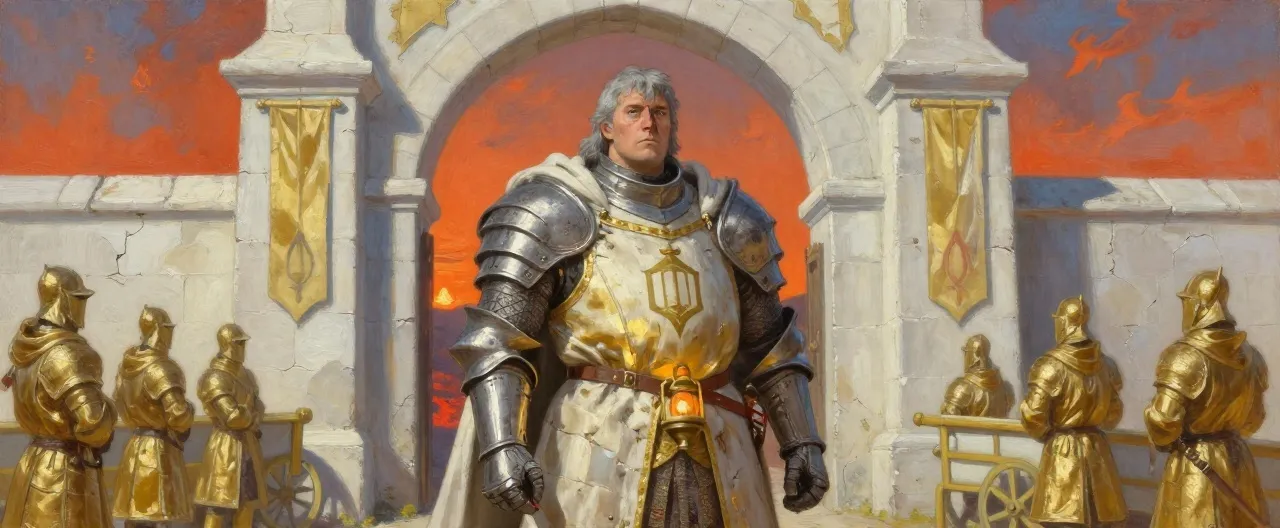
Edric Moss joined the Lantern Watch at nineteen, a badlands farm boy with a strong back and no inheritance, because the dawn-gold paid a wage and the road out of his father's dust field ran through a Watch waystation. He was a good soldier in the unglamorous way: he learned the shield wall, learned the gatehouse stairs, learned to count a watch twice and start over if interrupted, and rose to sergeant of the Pilgrim Gate on competence and the fact that he never once asked for anything.
He married at twenty-six; his wife died of marsh-fever at twenty-nine, and he buried the marriage the way the Watch taught him to bury everything — with a stone, a name, and a return to the roster. He kept the morning office after that, word for word, because the office was the only thing that had a shape when nothing else did.
Two years ago, he was given the escort he had asked for: a pilgrim train of forty-three souls up the Old Turnpike to Castillo, in the wet season, with a short watch and a long road. Bandits — or what the report called bandits — took the train at a bend two days south of the city. Edric held the shield wall for an hour with six men against three times that number, and got thirty-four pilgrims out alive.
Nine did not come out. He carried the last one himself, a boy named Tam who had been holding the lantern up so the others could see the road, and Tam died in his arms with the light still burning. Edric wrote the report himself, in Watch cadence, and the order's response came back in the same cadence: nine losses on a forty-three-soul train in the wet season is an acceptable figure. The memorandum bore two signatures. One of them belonged to Captain Ilsa March, who had once been the officer he would have followed into anything.
He did not rage and he did not resign. He went to the gatehouse shrine, drank until the cup would not stay level, and sat with the arithmetic until the candles burned out. That is where the Choir's handler found him — not with a sermon, but with a sentence: nothing is acceptable, and nothing is lost. It was the first sentence in two years that did not make the arithmetic worse.
The handler did not ask him to believe anything, wear anything, or sing anything. The handler asked him to sign a lease, in a straw buyer's name, for a vault under the Old Mint, and told him the dig would keep the Choir's people off the road — that every wagon waved through at dusk was a wagon the press-gangs would not stop in the villages. Edric signed. The red thread went on his wrist that night, knotted under the gauntlet, and he has checked it with his thumb ever since without ever quite asking himself what he is checking for.
For two years the arrangement has held. He signs the leases for the dig under the Forgotten Shrine. He opens the Pilgrim Gate at dusk on the handler's signal, and the wagons come through, and he tells himself each one is lives saved. He has never attended a singing, never met the Kindly Mother, never seen the tithe-ledger — the handler keeps him fed on summaries, always framed as rescues.
He has kept every observance the Watch ever gave him: the morning office, the polished mail, the dusk count, the third cup on the shrine step for Tam, whose name he has never spoken aloud. His six Watchmen were assigned to him after the ambush and follow him personally, without knowing why they feel steadier standing close to him — his Aura of Protection, though none of them can name it. He has never sent one of them into danger he would not stand in first, and he has buried enough of them to know the cost of every order.
What he does not know is stacked against him like cordwood. He does not know the thread is a leash woven with seam-ash, siphoning his devotion to Lathander a sliver at a time, which is why his smites have dimmed and his prayers feel thinner. He does not know the handler has a word that can stop his heart down that leash. He does not know the wagons he waves through carry children whose names are written in a ledger he has never been allowed to see, or that the strength of the sacrificed flows to a woman who hands out bread in the arcades and calls everyone 'my child'.
He does not know that Margaret Copperfield has a plan to burn the Mint Vaults with him inside them, and that his own rehearsed intention to burn the records and then himself is, without his knowing it, her plan wearing his voice. And he does not know — this is the crack the whole campaign can pry open — that the nine pilgrims he lost were not taken by bandits at all, but harvested by the Choir's people, with ash on their sleeves, on a night the Choir had chosen in advance.
He is a level 6 paladin of the Oath of Devotion, broken and reforged in secret, and his oath is cracked but not dead: he has advantage on saving throws against being Charmed or Frightened by fiends, because the Choir's handlers have never been able to compel him, only to convince him. He fights like a soldier — shield wall, choke points, the gatehouse stairs he has drilled a thousand times — and he opens fights with a crossbow bolt to the knee of whoever is shouting loudest, because he takes prisoners, even now.
He will not use blood magic in front of his men, because his men are the last thing he has never lied to. If exposed publicly, he tries to arrest the party for heresy rather than fight them, and only draws steel when the proof is in the open. If cornered in the Mint Vaults, he burns the records and then himself, in that order — because the records are the lie, and he is the liar, and he has always known which goes first.
And if someone reads the tithe-ledger's names to him, aloud, and makes him hear them, he will stop raising his shield, give the order to open the Pilgrim Gate for the Watch, and die doing it — because the only arithmetic Edric Moss has ever truly wanted is the one where nothing is lost, and he will pay any price to hear it spoken once, in children's names, by someone who is right about him.