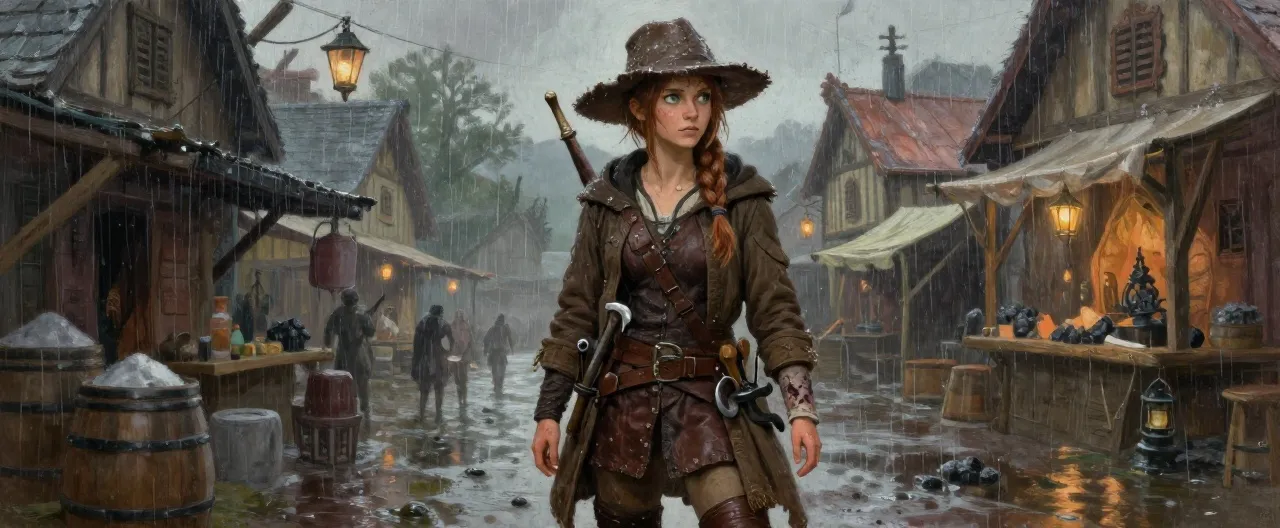
Cora Vintner was born in Burrow's End, the halfling quarter of a river town two weeks down the Merchant's Road from Twinford, where the Vintner family had kept the tally-books for the salt barges for three generations. Her mother counted barrels for the wharf-masters; her father wrote out letters of credit for small traders who couldn't afford a proper counting-house. Cora learned her letters on ledger paper and her arithmetic on other people's debts, and by twelve she could spot a falsified column faster than the town's paid clerk.
She also learned early what a debt really is. When she was fourteen, a debt-runner chalked a mark on her family's doorpost — the thieves' cant sign that a collector was coming, though nobody in Burrow's End could read it then. Her father owed nine gold to a factor in the coast trade, and the factor had sold the debt to someone worse. Cora watched a polite man in a grey coat take the family's good table, her mother's ring, and her father's dignity, all with receipts signed proper.
The family survived. Cora never forgot the shape of that transaction: who held the paper, who sold the name, who did the collecting. She decided that the shape of a debt tells you who really holds it, and she has been reading shapes ever since.
She ran numbers for the Burrow's End stallholders as a girl — keeping honest tallies for people the factor's clerks overcharged — and picked up Thieves' Cant from a dockside fence named Old Tam, who traded in rumours as much as goods. Tam taught her the chalk-marks, the hand-signals, and the first rule of the trade: never be the last one to notice trouble. She keeps a copper of Tymora on her belt loop for luck and drops a coin at any shrine of Waukeen she passes — not out of deep devotion, but because in her experience the goddess of trade keeps the best-ledgered accounts of anyone, and it pays to stay on good terms with the one power in Faerûn who never loses track of what's owed.
By her twenties Cora was working the river towns as what the trade calls a ledger-walker: she audits accounts for traders too small to hire a clerk, traces debts that have been sold on and resold until the paper is three towns away from the original loan, and — when the shape of a debt turns rotten — she finds out who is really holding it. She has broken two loan-shark rings this way, quietly, by putting the right figures in front of the right watch-captains. She's made enemies, but they are the kind of enemies who sue rather than stab, which suits her fine.
Three weeks ago, a salt-factor she'd done honest work for told her something strange was moving up the Merchant's Road. Debts in the river towns were disappearing — not collected, not forgiven, just vanishing from the ledgers overnight, and the people who owed them vanishing with them. He'd bought a second-hand receipt from a carter, and the seal on it bothered him: too clean. Cora looked at it once and agreed. Seals that clean are pressed from a mould, and moulds cost money, and money means someone is buying.
She came up the road to Twinford on the eve of the Salt Fair, following the smell of bad arithmetic. Her plan was simple: walk the fair, read the chalk-marks on the doorposts, count the grey coats, and find out who is settling other people's debts without their consent. Then word ran through the market that Margaret Butcher's stall had shut and not opened, and a girl named Willa Garrett was standing in the rain holding a receipt she couldn't read, asking anyone with a sword and a spare hour.
Cora has no sword. She has something better — she can read the receipt. And she knows, in the marrow of her, exactly what it means when the person holding the paper is the one who disappears. The last time she saw a debt vanish cleanly, a family lost everything. This time she intends to count every name on every ledger until the shape of the debt gives up whoever holds it — and then she intends, in her own dry way, to call in the collection.