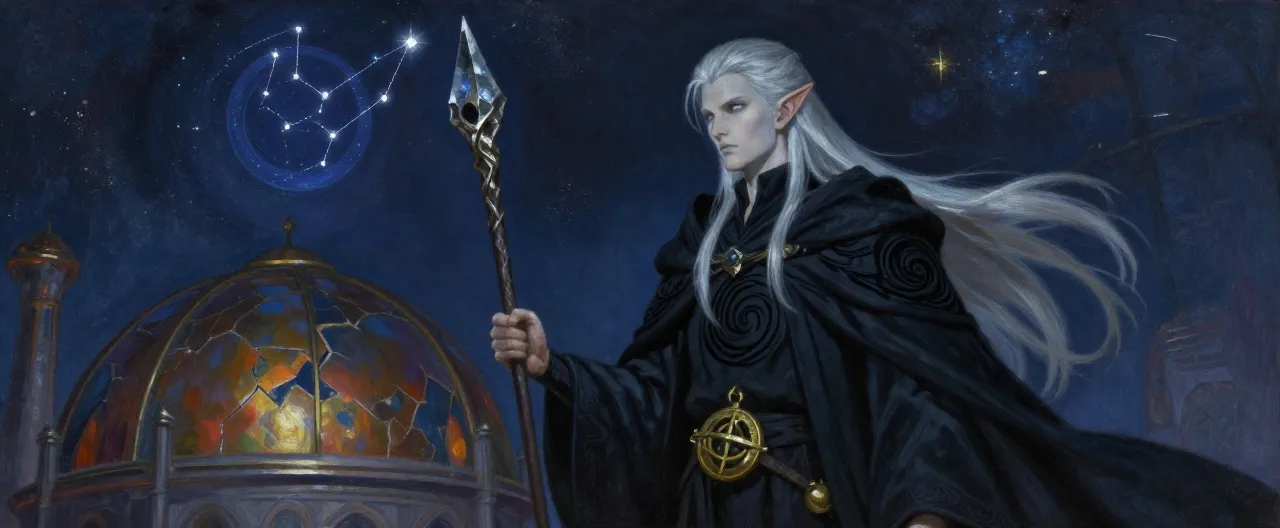
Kaelen was born in Starfall three centuries ago, the second son of a minor elven family of instrument-makers who crafted astrolabes and orreries for the city's merchant-scholars. His childhood was spent in workshops smelling of brass filings and lamp oil, assembling mechanisms whose purposes he understood before his parents explained them. He was clever in the way that isolates: he corrected his father's gearing before he was sixty, and by ninety he had exhausted the family library and begun stealing time in the Grand Library under a false patron's seal. The librarians caught him twice. The second time, an aging archivist named Lyra of the Astral Cartographers' remnant circle paid his fine—and offered him apprenticeship.
He refused her. Publicly. At a symposium, after she corrected a flaw in his spatial-geometry proof in front of forty scholars, he stood, thanked her with glacial courtesy, and declared that the Cartographers' caution was 'the cowardice of fossils,' that the multiverse's secrets belonged to whoever was bold enough to take them. It was pride dressed as philosophy, and it cost him everything he might have been. Lyra sealed the Far Realm texts he craved behind Cartographer wards, and Kaelen spent the next decade and a half cracking them with two fellow researchers—Ambra and Dossel—who shared his hunger.
When the wards finally failed, the three of them performed a joint scrying into the Far Realm's shallows. Ambra and Dossel were caught by the Cartographers' remnant council on Lyra's testimony and sentenced to planar banishment. Kaelen escaped detection, alone, having—though he has never admitted this—let his friends take the risk of the final ritual while he kept the notes.
For two hundred years he worked alone: excavating drowned Cartographer stations, decoding mirror-crypts, mapping planar seams in stolen fragments. He became very good and very hollow. Nine years ago, mid-ritual in a sealed vault beneath the Observatory of Falling Stars, with spiral energy coiling up his arms and something vast turning its attention toward him, Lord Veyron walked in. Instead of killing the intruder—or being killed—Veyron offered partnership: every sealed text, every seam, every secret, in exchange for service. Kaelen accepted, and the black spiral sigil was stitched into his robes and, he slowly realized, into something deeper.
For nine years he has been Veyron's arcane lieutenant: recruiting the twin scouts Sarn and Merrit, running the cult's Starfall spy network, leading the search for the Horizon Needle. He believes he is a partner. Three months ago, the entity behind the spiral began making demands in his dreams—demands Veyron knows nothing of—and Kaelen began, very quietly, to stockpile components for a severing ritual. He has also begun slowing the Needle search by feeding Veyron false progress, buying himself solitary time with the Vault of Stars.
He tells himself he is positioning for leverage. The truth, which surfaces only in the four-hour stillness of his trance, is that the great scholar of his generation has spent three centuries being owned—by pride first, then by fear, now by a thing from outside—and that the Horizon Needle, folding space like a page, is the first thing he has ever wanted for himself alone.
He is, in the end, a cautionary tale with excellent handwriting: brilliant, precise, and built entirely out of decisions he made to avoid being small—each one making him smaller.