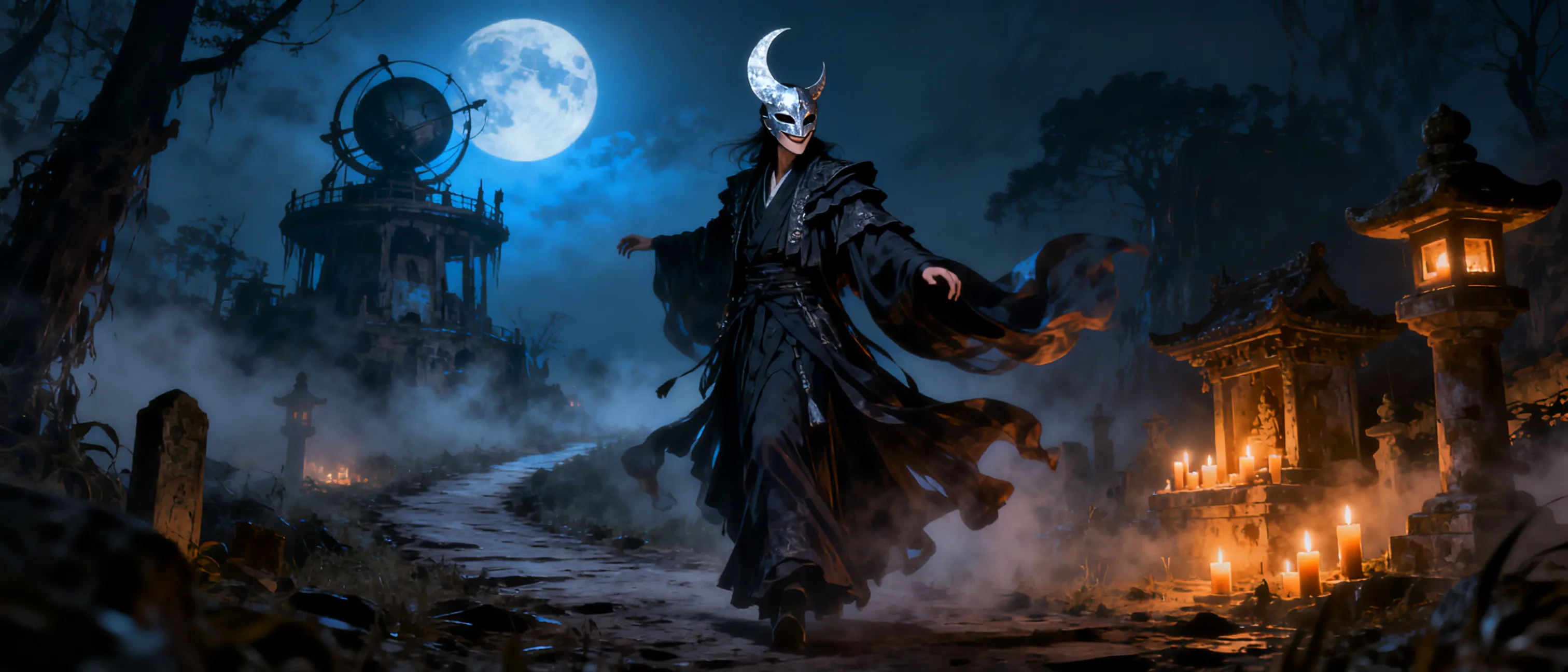
Kurozane, Mask of the Dimming Sky

Level 3 Oni-Blooded Human Rogue (Thief)

Available with DM subscription
STR
8 (-1)
DEX
17 (+3)
CON
13 (+1)
INT
12 (+1)
WIS
10
CHA
15 (+2)

Defense

Armor Class 15 (Studded leather armor)
Hit Points 21 (3d8 + 3 +1)
Speed 30 ft.

Proficiencies & Skills

Saving Throws Dexterity, Intelligence
Skills Insight +2, Stealth +5, Deception +4, Intimidation +4, Investigation +3, Sleight of hand +5

Features

Mask of the Dimming Sky

Custom
At will, while not incapacitated

Kurozane can alter his face, voice, posture, and minor features to pass as a different humanoid of similar size. This is not true transformation into another creature type, but it is convincing enough to bypass casual scrutiny and support his infiltration operations.

Sneak Attack

Class Level 1
Once per turn

Once per turn, Kurozane deals an extra 2d6 damage when he hits a target with a Finesse or Ranged weapon attack and has Advantage on the attack roll, or when another enemy of the target is within 5 feet of it and Kurozane doesn't have Disadvantage.

Second-Story Work

Subclass Level 3

Kurozane's climbing doesn't cost him extra movement, and he can make long jumps with a running start using extra distance from his Dexterity modifier. He uses this to exploit broken roofs, observatory catwalks, and vertical terrain.

Oni-Blooded Dread

Custom

Kurozane carries a supernatural chill that unsettles the weak-willed. When he speaks calmly after a threat or ambush, frightened witnesses often hesitate before fleeing, giving him time to slip away or sow more fear.

Rogue Features

Class Level 1

Rogue features at this level include Expertise, Sneak Attack, Thieves' Cant, and Cunning Action. Kurozane fights from concealment, relies on precision strikes, and uses his Bonus Action to Dash, Disengage, or Hide.

Roguish Archetype: Thief

Subclass Level 3

Kurozane’s training favors infiltration, climbing, quick theft, and battlefield opportunism. He is comfortable in ruins, rooftops, and collapsing spaces where he can vanish and strike from above.

Fast Hands

Subclass Level 3
Bonus Action

Kurozane can use the Bonus Action granted by Cunning Action to make a Dexterity (Sleight of Hand) check, use thieves' tools to disarm a trap or open a lock, or take the Utilize action.

Expertise

Class Level 1

Kurozane has Expertise in Deception and Stealth. His proficiency bonus is doubled for those checks, allowing him to manipulate witnesses and disappear with unnerving ease.

Thieves' Cant

Class Level 1

Kurozane knows a secret rogue cant of hidden warnings, coded threats, and criminal shorthand. He uses it to coordinate with cult collaborators without exposing himself.

Criminal Contact: Night Raiders

Background

Kurozane maintains a hidden web of smugglers, cult helpers, and masked raiders who move messages, contraband, and stolen ritual charts between safehouses.

Cunning Action

Class Level 2
Bonus Action

On each of his turns, Kurozane can take the Dash, Disengage, or Hide action as a Bonus Action.

Character Information

Kurozane, Mask of the Dimming Sky, is the kind of villain who makes people feel as though they have already lost before the first blade is drawn. He speaks with perfect courtesy, bows at the right angle, and offers just enough truth to seem reasonable. Then he watches. He measures fear, counts exits, and decides whether a witness should die, flee, or survive with a story too strange to be believed. In the Shadow Eclipse campaign, Kurozane is not merely a battlefield threat; he is the face of a conspiracy designed to make communities collapse from within.

He is a master of disguise and manipulation, the visible hand behind the first infiltration cell, and a careful student of how fear spreads from one frightened household to a whole settlement. He does not simply replace leaders. He erodes trust until replacement feels like relief. His goal is to prepare the world for a celestial ritual that will bind permanent darkness to ancient sky-sites and observatories. He wants the heroes to feel the scope of the threat only after they have already spent themselves chasing false leads.

In combat, Kurozane is a predator of terrain. He opens from cover, uses deception to split the party, and retreats the moment the battle turns against him. He is savage when cornered, but never stupid. If escape serves the ritual, he will flee. If witnesses can be left alive to deepen dread, he will spare them. If a minion must be sacrificed, he will do it without hesitation.

What makes Kurozane memorable is not just his cruelty, but his discipline. He is calm, polite, mocking, and always one step away from vanishing into a false identity. He is the kind of villain the party may see in a crowd three times before they realize they have seen the same smile on three different faces.

Character Background

Kurozane was not born in a palace, though he learned to walk and speak like someone who had been. He came from a life in the margins: a child of border roads, servant yards, and winter markets where everyone had a second story and nobody could afford to ask too many questions. In his earliest years, he learned that survival belonged to the observant. A hungry child who listened well could predict when a guard would look away, when a merchant would underweigh grain, and when a household was about to sell its secrets for a warm fire. Kurozane grew up among those small negotiations. He was not the strongest child, nor the fastest, but he was the one who noticed who was afraid and who was pretending not to be.

There was always something slightly wrong about him, though no one could name it at first. His eyes lingered too long on lantern light. His voice, even as a child, could sound eerily measured when he wanted something. Some said he was simply clever. Others said he had been touched by old blood or that a spirit had marked him at birth. The truth is more practical and more frightening: Kurozane learned early that people treat you according to the mask you wear, and he became very, very good at making the right face.

He first understood power in a counting house, where records could be altered, debts moved, and names erased without drawing a blade. A clerk with the right seal could ruin a merchant, shelter a thief, or feed a district through a hard winter. Kurozane loved that kind of power because it was invisible. It left no heroic scars. It created no dramatic duel. It simply changed what was possible. He studied ledgers, codes, and the habits of frightened administrators until he could tell which lies would survive a casual inspection and which ones needed a little blood to hold.

That aptitude eventually brought him into contact with people who were worse than he was, or perhaps merely more honest about it. The Shadow Eclipse cabal recognized in him the perfect tool for their opening moves. They did not ask him to become a butcher. They asked him to become an architect of dread. Replace one leader. Seed one rumor. Steal one chart. Move one frightened town a step closer to surrender. Kurozane accepted because he saw elegance in the design. A world that could be darkened by ritual was a world that had already proven it would kneel if enough of its own people whispered the right fear into the right ears.

He has since become the visible hand behind the first infiltration cell, the one who ensures that the campaign begins with uncertainty rather than certainty, with suspicion rather than open war. He prefers ruined observatories, roadside shrines, and settlement offices because those places carry symbolic weight. A shrine is where people go to ask that the world remain ordered. An observatory is where they look for meaning in the sky. A town hall is where they decide whether to trust one another. Kurozane likes to corrupt those places first.

His personality is a refined performance wrapped around a very practical cruelty. He is polite because politeness lets him be close. He is mocking because mockery makes others unsure of their footing. He is unsettlingly calm because panic belongs to his victims, not to him. He often leaves witnesses alive, but never by kindness. He leaves them because fear spreads better when it has a mouth to speak. He knows that a terrified witness is more useful than a corpse if the witness can be made to question their own memory. He knows that a village with no confidence in its own senses will open its gates to almost anyone who appears calm.

Kurozane’s body-shifting disguise is one of his greatest assets, but it is also a confession. He does not trust any face to hold power for long, including his own. He changes names, posture, and voice with practiced ease, yet the same pattern remains underneath: he wants to see whether other people will believe what they are told when the telling is done in a pleasant tone. He has turned that curiosity into a strategy and a religion. The Shadow Eclipse is not merely a ritual to him; it is proof that the world can be made to accept night as a form of order.

And yet, for all his composure, Kurozane is not invulnerable. He fears exposure more than injury, because being unmasked strips away the very theater that makes him dangerous. He fears failure before his superiors, because his identity is tied to usefulness. He fears a witness who survives long enough to remember him clearly. These fears shape the way he fights. He will withdraw when cornered, abandon allies when necessary, and plant false clues if it buys him a few more hours. That makes him a villain the party can chase, but not easily pin down.

If the heroes break his cell in Act I, Kurozane will not suddenly become a different man. He will simply become more urgent. He will accelerate the timetable, tighten the network, and lean harder into the idea that fear is a tool to be sharpened, not a mood to be indulged. If captured or magically compelled, he may reveal the next ritual site, but only under pressure, and only in fragments. He will never willingly hand over the full shape of the cabal. Even in defeat, he will try to remain useful, because usefulness is the last mask he trusts.

That is what makes him dangerous: he is not a cackling tyrant waiting on destiny. He is a patient operator who believes the world is already willing to be frightened into darkness. The heroes must prove him wrong, one witness, one clue, and one shattered deception at a time.
Unresolved Plots

  • One of the town’s elders may still be an unrecognized collaborator, and Kurozane has not yet decided whether to protect or replace them.
  • A false ritual map was deliberately planted for the heroes; it may lead to a trap, or it may conceal a second, more valuable clue.
  • The observatory lens records a sky-pattern that Kurozane has not fully decoded, and he is afraid the heroes will learn what it means first.
  • A surviving witness knows the sound of Kurozane’s true voice and may be able to identify him even in disguise.
  • A hidden safehouse contains the names of future targets, but the route to it is guarded by people Kurozane once promised to spare.

Secrets

  • Kurozane’s polite courtly manner is learned, not natural; he imitates noble speech because he believes fear is easier to obey when it wears elegance.
  • He keeps at least one backup identity in every settlement he infiltrates, including a harmless-looking laborer or messenger.
  • He is more afraid of failure before the cabal than of death, because being outplayed would strip him of the control he uses to justify himself.

Fears

  • Being unmasked in front of witnesses and reduced to a mere monster rather than a strategist.
  • Losing the observatory charts before the cabal completes the next stage of the rite.
  • Becoming irrelevant to the Shadow Eclipse cabal after investing too much of himself in the first infiltration cell.

Aspirations

  • Anchor permanent darkness at a sky-site that will make his name feared for generations.
  • Build a network so thorough that a village cannot trust its own neighbor.
  • Prove that civilization is only a thin costume over the patience of night.

QUEST -- The First False Town

Kurozane has already planted one disguise-ring in a border settlement, but his control is not yet perfect. This quest centers on his attempt to replace a civic leader, merchant mediator, or shrine caretaker with one of his hidden collaborators before the party can unravel the cell. He wants the town to surrender to fear from the inside, not the outside, because that makes the Shadow Eclipse feel inevitable rather than imposed. The quest forces him to decide how much of his network he is willing to burn to preserve secrecy. If the heroes pressure him hard enough, he may abandon an ally, reveal a dead-drop route, or sacrifice a safehouse to keep the larger ritual hidden. This quest matters because Kurozane is at his most dangerous when he is not in the room; every conversation and rumor becomes a weapon. For the party, the reward should be more than coin: they can expose the impersonation method, gain a permanent advantage on one social investigation tied to disguises, and secure an enemy ledger that points toward the next ritual site. The arc also deepens his relationship to fear, because he realizes that ruling a town through dread is not the same thing as ruling it through obedience.

Current Stage

Track strange inconsistencies in a public official’s behavior, handwriting, or schedule until the disguised infiltrator is identified.

Choice

Expose the impostor publicly and risk a panic.

The town survives, but the revelation detonates fear through the streets. Kurozane loses a valuable pawn, yet the heroes gain credibility and a frightened witness who remembers where the impostor met the cult. Kurozane will mark the party as a threat and become more aggressive in later scenes, especially when speaking to crowds. If the party does not choose this, the impostor continues gathering leverage and may frame an innocent person. The public exposure also creates a hard divide: some townsfolk will thank the heroes, while others will blame them for tearing away the last illusion of safety.
Alternative

Quietly tail the impostor to the safehouse.

The party avoids panic and gets the stronger lead, but the impostor has more time to prepare an escape route or destroy records. Kurozane respects the restraint and treats the heroes as subtle hunters rather than blunt crusaders. If they fail, he may learn that they are disciplined enough to threaten his deeper cells. If they do not choose this, the town remains calm for now, but the cult network keeps breathing in the shadows, ready to strike again when the heroes are elsewhere.
Mechanical Rewards
  • Kurozane permanently gains one extra use of Cunning Action per Short Rest only if the heroes fail to corner him; if the heroes succeed, he instead loses confidence and his next escape attempt suffers disadvantage.
  • The party gains a documented clue that allows them to bypass one investigation obstacle in Act I or gain advantage on the next related Investigation check.
  • If the quest resolves through exposure rather than slaughter, Kurozane's network loses a layer of protection, reducing the number of disguised allies available in later scenes.
Narrative Rewards
  • Access to a frightened but cooperative witness who can identify future infiltrators by mannerisms.
  • A sealed ledger listing one future target and one dead-drop location.
  • A chance to create a recurring rival relationship between Kurozane and the party's investigator or face.

QUEST -- The Sky-Site Ledger

Kurozane’s next obsession is an ancient observatory or hilltop lens site that can anchor permanent darkness. He needs the site not simply to advance the ritual, but to prove that fear has a geometry: if the sky can be measured, then it can be controlled. This quest sends him to recover a stolen star chart, secret access codes, or a ward key from a ruin guarded by old mechanisms and anxious locals. The quest is important because it deepens his relationship to control. He does not just want a dark world; he wants a world where darkness obeys procedure. As a villain, that makes him useful to a campaign because every clue becomes a deadline. The heroes can intercept him, but doing so might destroy the site before it is fully understood. If they allow him to complete this stage, he gains stronger footing in the region and may be able to flee future battles through planned routes. If they stop him, they can damage the cabal’s timetable and gain a permanent edge against his future deception. The reward should reflect that impact: access to the observatory’s hidden lore, a bonus to checks involving celestial navigation or ritual disruption, and perhaps the ability to reveal one false clue planted by the cabal.

Current Stage

Reach the sky-site before Kurozane's agents can collapse or corrupt its records.

Choice

Preserve the observatory library and fight around it.

The party protects knowledge, but the battlefield becomes more dangerous and slower. Kurozane may use the added time to steal only the most important chart and retreat. If the heroes do not choose this, they may destroy the site’s lore entirely, eliminating useful information but denying the villain some of his power. This choice emphasizes the campaign’s core tension: save the place, or save the future.
Alternative

Destroy the chart vault to deny Kurozane the full sequence.

The heroes deny the villain his cleanest path, but they also destroy evidence that could have made later investigations easier. Kurozane will remember this as an insult. He becomes more vicious and less inclined to leave witnesses alive in future confrontations. If the party does not choose this, he may recover enough evidence to accelerate the larger cabal’s next phase.
Mechanical Rewards
  • A permanent +1 bonus on one type of check related to interpreting star charts, ruins, or ritual sites, chosen by the GM.
  • Kurozane's escape routes become partially compromised, reducing his ability to vanish without consequence.
  • If the party secures the observatory records, they can ignore one false lead in the act's investigation sequence.
Narrative Rewards
  • A fragment of the greater ritual pattern.
  • A named enemy lieutenant or collaborator.
  • A route to the next adventure site beyond Act I.

QUEST -- Witnesses That Survive

Kurozane has a practical fear: martyrs tell better stories than corpses. He therefore keeps some witnesses alive, but only long enough to terrorize others. This quest centers on the aftermath of a raid where survivors saw too much. He must decide whether to erase them, recruit them, or leave them behind as living warnings. The heroes, if they intervene, can turn this against him by protecting the witnesses and extracting testimony that reveals hidden names, supply lines, or the location of a ritual anchor. This quest is tied to his personality because it turns his polite cruelty into a mechanical and narrative liability. Every survivor he spares might become a problem later. Every witness the party saves becomes a candle against the darkness. The reward should be a strong one: if the heroes succeed, they gain allies in the settlement, a reputation benefit when questioning frightened folk, and perhaps a one-time advantage against fear or disguise effects in the region. For Kurozane, the consequence is worse than defeat. It is humiliation.

Current Stage

Protect a witness long enough for them to testify and recover from shock.

Choice

Use compassion to stabilize the witness and gather details slowly.

The witness trusts the party, but the scene takes time and may allow Kurozane's trail to grow cold. If the party does not choose this, the witness may speak only fragments and later collapse under fear or confusion. This path reinforces the campaign's horror tone by making kindness an active strategic choice rather than a soft interruption.
Alternative

Press the witness hard for immediate information.

The party gets faster answers, but the witness may become frightened or hostile. Kurozane would approve of that tactic because it increases panic; if the party does not choose compassion, they risk becoming part of the same cycle of terror they are trying to break. The answer may still be useful, but it will cost trust and perhaps create a moral fracture within the group.
Mechanical Rewards
  • Witness protection grants the party a standing ally in the settlement.
  • The party gains advantage on one future check to spot a disguise in the region.
  • If the witness survives, they can provide one automatic rumor or clue later without a roll.
Narrative Rewards
  • A living testimony that discredits one of Kurozane’s false stories.
  • A rescued family or friend becomes a recurring contact.
  • The town’s fear begins to shift from helplessness to resistance.

Major Decision

Context

When the first town begins resisting, Kurozane can either maintain his courteous mask or reveal enough cruelty to make a public example.

Choice Made

Remain charming and let the town fear what it cannot prove, or escalate into a visible terror strike.

Impact

Staying subtle preserves his network and makes him harder to identify, but it gives the heroes more chances to gather evidence. Escalating creates immediate panic and stronger control, but it also hardens opposition and may expose his methods sooner.

Major Decision

Context

The observatory raid leaves Kurozane with a choice between saving his own life and recovering ritual notes that are critical to the cabal.

Choice Made

Escape cleanly, or stay to protect the charts and risk defeat.

Impact

If he escapes, he remains a recurring threat and can continue to manipulate the region. If he stays, he may gain a powerful ritual advantage but can be captured, wounded, or forced to reveal the next site.

Major Decision

Context

Kurozane learns that one of his collaborators has developed genuine loyalty to him rather than fear.

Choice Made

Exploit that loyalty for harder service, or eliminate the collaborator to prevent emotional weakness.

Impact

Using loyalty may create a more resilient support network, but it binds him more closely to mortal relationships and gives the heroes more leverage. Killing the collaborator preserves secrecy and reinforces his ruthlessness, but it may alienate other agents and weaken morale.

Transformative Moment

Trigger

The first time a witness lives long enough to expose his disguise.

Transformation

Kurozane stops believing that perfect concealment is enough. He becomes more theatrical, more deliberate, and more willing to use fear as a public performance rather than a hidden tool.

Mechanical Changes

Stealth and Deception

His approach shifts from pure disguise to layered misdirection; future encounters may include false decoys or staged evidence.

He adapts after his mask is seen through.

Transformative Moment

Trigger

The party disrupts the shrine ritual and destroys one of his staging grounds.

Transformation

He begins treating the heroes as true opponents rather than obstacles, which changes how he allocates minions and escape routes.

Mechanical Changes

Battle tactics

Kurozane prioritizes ambush positions, retreat paths, and separating the party before committing to direct conflict.

He learns that open control is less reliable than battlefield denial.

Transformative Moment

Trigger

He witnesses fear turn into organized resistance in the settlement.

Transformation

The villain's calm becomes thinner. He still speaks politely, but his impatience surfaces in harsher choices, quicker betrayals, and less tolerance for failure.

Mechanical Changes

Personality expression

His intimidation becomes more focused and his bluffs more dangerous, but his willingness to abandon minions increases.

He is forced to value the ritual over the people he uses.

Ally:
Sable Thread, the Ledger-Keeper

Relationship Hidden ally and logistical fixer
Influence 6/10
Loyalty 4/10

Shared History

Sable Thread once served as a minor clerk who tracked grain, lantern oil, and shrine donations for the settlement’s travelers. Kurozane recruited them not through obvious threats, but by showing them how easily accounts could be falsified and how much power a quiet person could wield with the right seals. Over time, Sable became responsible for moving ritual notes, bribes, and disguises between safehouses while never learning the full scope of the Shadow Eclipse. Kurozane values Sable because they are disciplined, unobtrusive, and excellent at making danger look like paperwork. Sable values Kurozane because he made them feel noticed, competent, and indispensable. Their bond is practical rather than affectionate, but it is still real enough to complicate betrayal. If Kurozane is cornered, Sable is one of the few people who might know where his false trails actually lead. If Sable is threatened, they may either hold firm out of fear or break in ways that expose the larger network.

Potential Breaking Points

  • If Kurozane publicly humiliates them, they may flee with records.
  • If the party offers protection, Sable may trade one safehouse location.
  • If Kurozane abandons them in a fight, loyalty may collapse.

Enemy:
Marshal Edda Vale

Threat Level 7/10
Conflict Type Investigator and local authority

Personal Stakes

Edda has begun noticing patterns in disappearances, fake orders, and witness testimony. She represents everything Kurozane hates: an organized, stubborn, publicly trusted person who can hold a community together long enough for the lie to collapse.

Possible Resolutions

  • Frame Edda for a security failure and isolate her from the settlement.
  • Force a direct confrontation and attempt to humiliate her in public.
  • If necessary, withdraw and leave evidence that implicates a lesser pawn instead.

Faction: The Shadow Eclipse Cabal

Standing 8/10
Influence A hidden conspiracy of shapeshifting oni, cult collaborators, and frightened agents spreading darkness through fear and staged disappearances.

Obligations

  • Deliver usable ritual charts and observations from sky-sites.
  • Keep exposed agents alive long enough to misdirect investigators.
  • Preserve secrecy around the true extent of the eclipse timetable.

Benefits

  • Access to hidden safehouses and disguise support.
  • Night raiders and shadow agents available for ambushes.
  • Authority to redirect frightened townsfolk through rumor and intimidation.

Ready to Unleash Your Character's Full Potential?

Join thousands of players and create rich, detailed character backgrounds with Fable Fiesta!

Register to unlock personal quests, relationships, and narrative hooks!

Sign Up Now - It's Free!

No credit card required. Start creating in minutes!