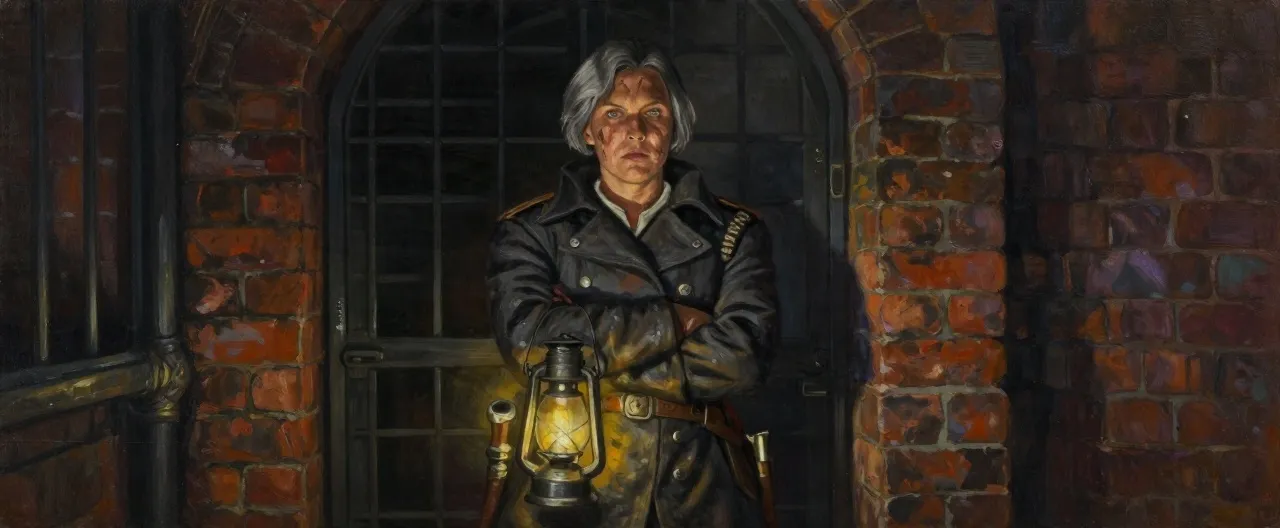
Willa Thatcher was born at the Bitterwater milepost, in the warden's quarters above the toll house, the third child and only surviving daughter of a Lantern warden named Aldous Thatcher who lit the post lantern at dusk every night of her childhood and vanished on the pilgrim road the year she turned nine. His body was never recovered from the stretch between the Dry Ford and Saltgate. The order sent a letter, a pension, and a coat that did not fit.
Willa kept the coat, grew into it, and swore to Helm at the same milepost at twenty, in a ceremony of three people and one lantern, because she could not think of a better place to make the promise.
She served the road for twelve years before transferring to the keep: mileposts, escorts, two ambushes, one hanging she still thinks about. She learned early that the badlands do not reward loud people, and she built herself out of flatness — short sentences, steady hands, a truncheon used exactly as much as needed and not a stroke more. The scar on her jaw came from a Chain toll crew at the second bridge who thought a lone woman warden was a soft mark; the two of them who survived the encounter walked with a limp for a month, and the story is still told in Bitterbridge with the details wrong.
The transfer to the keep's cells was supposed to be a quiet posting before retirement. Instead it put her inside the machinery of the road's corruption: transfer orders that moved pilgrims east in Chain wagons, manifests that came through too clean, a captain whose generosity had a ledger behind it. She found the first forged transfer order — three pilgrims, her own signature, Cedric Warren's seal — two years ago, and she has been building the case in secret ever since, a page at a time, in a private ledger kept under her bunk because she does not trust the official register and never has.
She is not a spy and does not enjoy the work. She is a jailer who believes that a cell is a promise — that the person inside it will get a fair hearing, and that the person outside it will not be able to buy the hearing — and every forged order she finds is a promise broken in her own hand. That is what drives her. Not justice in the abstract; the specific, physical outrage of a woman who booked three pilgrims into her cells in good faith and later found their names on a wagon manifest with her own signature underneath.
Her habits are all cells and night-shifts: the lantern lit at all hours, the truncheon tapped against her boot when she thinks, the doorway stance that turns her body into a barrier. She reads slowly and writes in a careful, cramped hand. She drinks one cup of bitter tea at dawn and nothing else all day. She has no family left, no partner, and one friend — Audrey Pike, at Saltgate — and she would not trade the friend for a hundred acquaintances.
She has never once lied to a prisoner, which the prisoners know, which is why they talk to her, which is why she knows more about the road's missing people than any magistrate in Castillo.
What she wants, though she would never say it in a full sentence, is for the order to be worth the coat. Her father lit a lantern every night for people who never learned his name. She has spent her whole life trying to decide whether that was devotion or waste, and the answer keeps changing depending on the day and the warden. The party, if they are honest with her, may be the first people in eighteen years who help her settle the question.