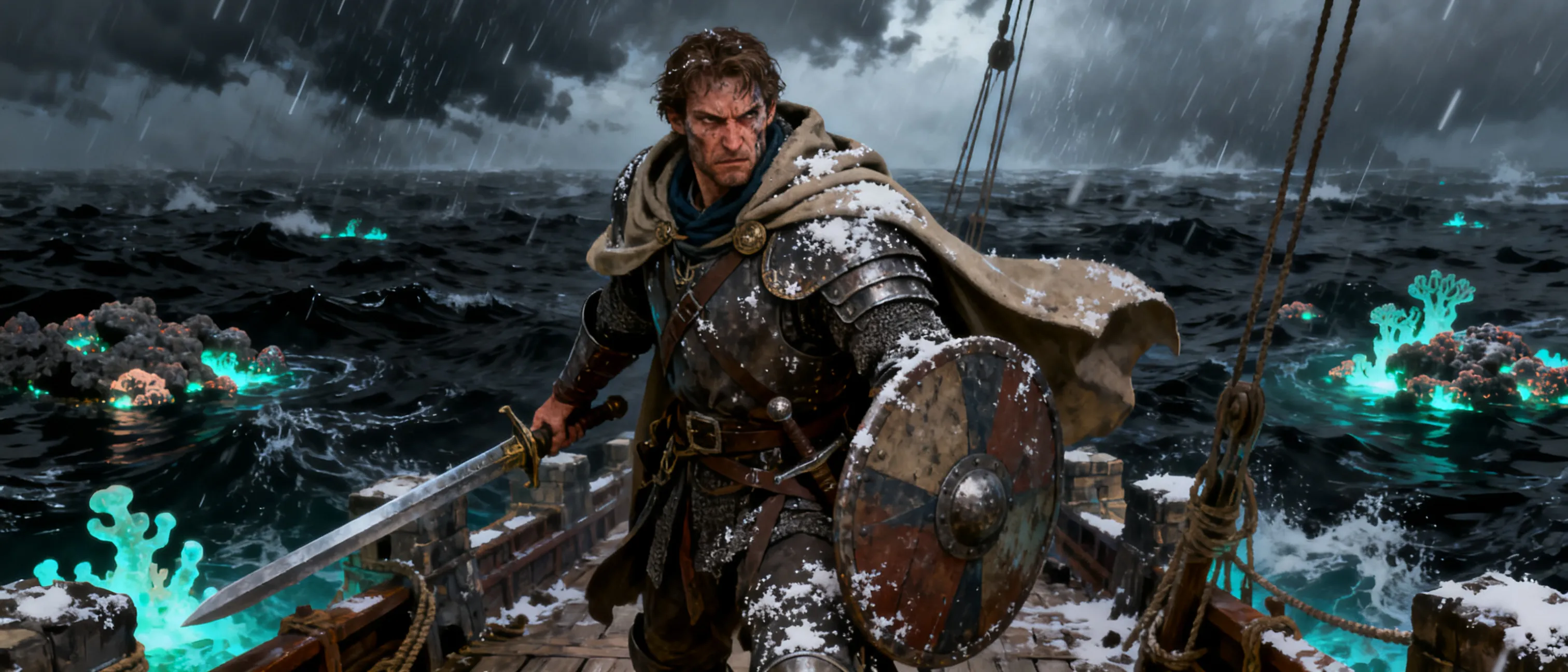
Character Background
Marshal Othren Pike was born on a coast where the sea took more than it gave. His earliest memories are of nets drying in the wind, boots full of brine, and the low, practical language of people who did not have time for poetry unless it helped them remember a weather pattern. His family was not noble, but it was stubborn. They worked ships, repaired gear, and survived by learning which warnings to trust and which captains to avoid. Othren grew up watching men with rank make choices that put ordinary people in the mud, and he learned early that authority is not the same thing as competence.
When he was old enough, he enlisted. Not because he dreamed of glory, but because the uniform offered structure, pay, and a chance to keep his home from being swallowed by the same endless coastal disputes that had starved his neighbors for generations. He was not a prodigy in the romantic sense. He was better than that: reliable. He understood formations, supply, morale, and the importance of making a decision before the moment passed. His superiors valued that, though they did not always enjoy his bluntness. He had a habit of saying what others only thought, especially when a plan was foolish. That made him enemies, but it also kept him alive.
Over time, Othren rose through command by doing the work other officers avoided. He organized evacuations when harbors burned. He held narrow channels against raiders with too few ships and too little powder. He learned that victory in maritime war is often decided before the battle begins: by charts, repair crews, weather sense, and whether your people believe you will not abandon them. Those lessons made him hard, but they also made him effective. He expects discipline because he has seen what happens without it.
His defining disgrace came during an earlier coastal campaign, long before the events of the Hundred Isles. He accepted a temporary ceasefire because it seemed the only way to save his wounded men and keep a strategic route open. The ceasefire was manipulated, then publicly twisted into a humiliation that made him look naïve and weak before his own troops. The details vary depending on who tells the story, and Othren never tells them twice the same way. What matters is the result: he learned that mercy without leverage can be weaponized, and that a commander who is made to look foolish can lose more than a battle. Since then, he has carried insult like a stone in his chest. He does not forgive public embarrassment easily, and he hates being forced into visible compromise.
That shame is why he was chosen for the Inner Starfall Sea. His kingdom needed someone who could seize the final approach, but they also needed a man too practical to waste the chance on ceremonial nonsense. Othren arrived expecting a military contest. What he found was worse: a political maze of false charts, competing fleets, pirate opportunists, islanders with their own claims, and Aurex's quiet manipulation of every side. He recognizes the pattern because he has seen it before in smaller form. Somebody is always trying to turn law into a trap and rank into a cage.
He is not a believer in destiny, though he pretends otherwise when it is useful. In private, he thinks the wish forge is the sort of object that ruins nations because everyone believes they are the exception. He would never admit that he fears the wish itself; he says only that no one should be allowed unlimited power without an army, a ledger, and a foolproof reason to deserve it. That cynicism is a shield. Beneath it is a man who has spent his whole life trying to keep other people alive without letting them see how much that burden hurts.
Othren's bonds are practical. He trusts quartermasters more than courtiers, sailors more than philosophers, and people who keep their word more than people who give beautiful speeches. His ideal is order that functions under pressure. His flaw is that he can become cruel when he feels mocked, especially if that mockery happens in front of his own command. He will tolerate almost anything if he thinks it serves the mission. He will not tolerate humiliation, because humiliation, in his mind, is how commanders become corpses and kingdoms become jokes.
If the party meets him with arrogance, he will resist them. If they meet him with competence, he may still resist them, but he will listen. That listening is the key to his entire arc. He is not meant to become a saint or soften into a kindly mentor. He is meant to confront the idea that survival sometimes requires shared authority, and that the best commanders are not the ones who never bend, but the ones who know when bending is the only way to keep the mast from snapping. In a campaign about shards, fleets, and fragile alliances, Othren Pike is the sort of man who can either become a pillar of the final siege or another shattered piece of it.