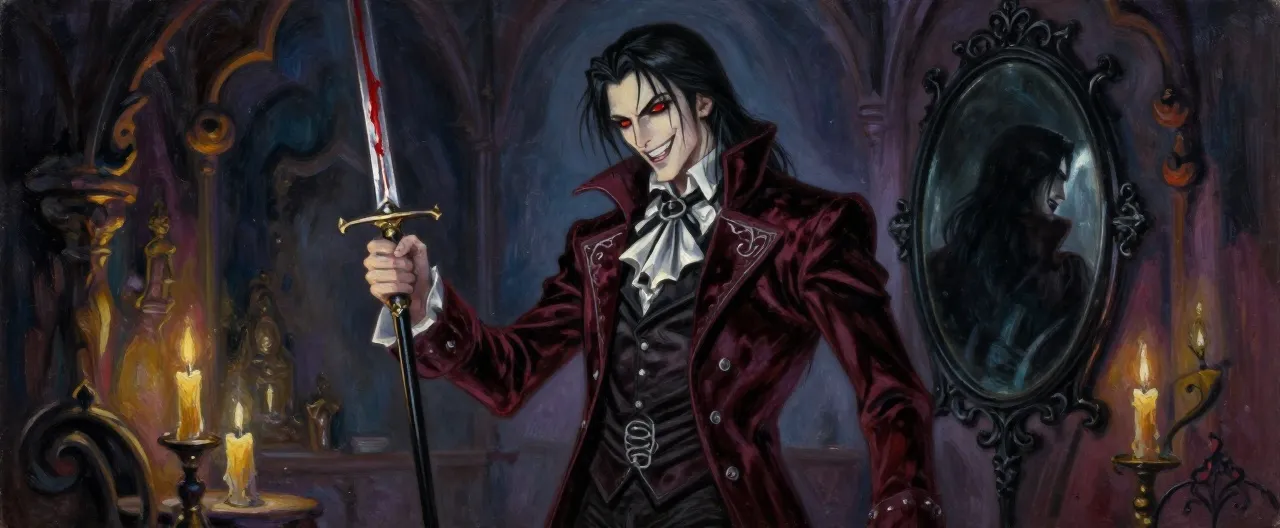
Varrick was born Aurelian Sanguine, third son of a minor noble house in the old kingdom whose ruins lie beneath Ashenmoor's foundations. Sickly, consumptive, and contemptuous of his brothers, he spent his youth in libraries and salons, cultivating wit as a weapon since his body would never be one. When consumption promised him a slow, humiliating death at thirty, he did what aristocrats do: he bought a cure. A servant of the Crimson Choir heard his desperate prayers and offered the standard contract—eternal life for eternal service. He signed in his own blood and woke as a vampire, his house's name the only inheritance he retained.
Two centuries later, Varrick has outlived his family, his fortune's original source, and every human he ever loved. He has served the Red Sovereign in three cities, each assignment more demanding than the last. He survived the Ashenmoor purges of a generation ago by sacrificing his own cell—an act the Choir's inner circle has never forgotten or forgiven, and which Madame Seraphine, his Keeper, witnessed firsthand. Their relationship is built on that shared blood: she knows what he did; he knows she knows.
He arrived in Ashenmoor twenty years ago with a single mandate: prepare a vessel worthy of the Sovereign's manifestation at the coming crimson moon. He has spent two decades building Sanguine Manor into a fortress of respectability, seeding the High District with indebted nobles, cultivating the Crimson Choir's Undercity cell, and hunting the bloodline of the knight who once staked his master—for the Sovereign's vessel must come from that line, its blood thin enough to pour and noble enough to matter. The exsanguinated bodies in the Old Quarter are not random murders; they are calibration, the Sovereign tasting the city through its envoy's hand.
Varrick's manor operates on meticulous routine: cultist-servants by day (he never sees them in daylight), ghouls in the cellars, and the black scrying mirror in his crypt where he takes his nightly counsel from a master he both worships and dreads. He maintains three indentured retainers whose families live in his cellar as insurance—the kind of arrangement he considers perfectly reasonable and which would horrify any decent person.
His vanity is legendary and poignant: with no reflection, he relies on portraits painted from memory and the flattery of his cult, and he has been known to interrogate victims for hours about how he looks. His fury when mocked is not mere pride—it is the rage of a man whose self-image exists only in others' eyes.
He knows the crimson moon is his last chance. Deliver the vessel, and the Sovereign has promised him autonomy—his own domain, his own eternity, free. Fail, and his name joins the ledger of consumed envoys. This knowledge makes him meticulous, patient, and utterly ruthless—and also, in his unguarded moments, a creature of barely contained panic. He is not the campaign's true villain. He is its most desperate man, wearing the mask of its most confident one, and the party that understands this can exploit it: his fear makes him predictable, his pride makes him baitable, and his ledger makes him legible to anyone clever enough to read it. Sister Mira has been reading him for twenty years; the Red Ledger is the first time the reading has gone both ways.