Character Background
Bramble’s earliest memories are of damp moss underfoot, rain drumming on broad leaves, and the low murmur of elders speaking in the old, patient tones of the forest. He was born in a secluded firbolg community that kept its distance from roads, settlements, and the problems of more crowded peoples. His people valued secrecy, harmony, and the slow, measured stewardship of the wild places they sheltered. Bramble was expected to grow into that same quiet rhythm, to become a guardian who could vanish into the trees, observe without being seen, and intervene only when truly necessary.
He tried. He did what was asked of him. As a child he followed the older hunters through tangled brush and learned to move softly despite his size. He learned the names of plants, the habits of deer, the warning calls of birds, and the signs that a place had been disturbed by violence. He was not stupid, only restless. While other children were content to sit beneath sheltering boughs and practice patience, Bramble always wanted to know what lay beyond the next ridge. His body was too large for stillness, his curiosity too fierce for caution. When he was reprimanded for chasing sound, or for returning from scouting with torn clothes and scraped knuckles, he was told that strength without discipline becomes disaster. He took the lesson to heart, but not in the way his elders intended.
The turning point came when outsiders began to encroach on the firbolg’s hidden borders. At first it was only tracks, cut branches, and the smoke of distant campfires. Then came poachers, boundary-breakers, and raiders who mistook the quiet woods for an unguarded prize. Bramble was still young, but old enough to understand fear when he smelled it in the air. One night, driven by anger and the desperate need to prove himself, he followed the sounds of struggle into a clearing where trespassers had trapped one of his people and were dragging away anything of value. He did not have a proper warblade, a polished staff, or any formal training for battle. He had a heavy club meant for breaking roots, and he had the wrath of a cornered forest in his chest.
He fought like something half-wild. He did not stand in the open and trade measured strikes. He lunged from shadow, used logs and stones as leverage, and hit with the kind of force that comes from fear, loyalty, and a body that has finally decided to stop yielding. The raiders fled in panic, and Bramble stood over the churned earth shaking with the aftermath of his own violence. He had saved lives, but he had also tasted the terrible clarity that comes with brutal fighting. He realized, with a strange mix of shame and exhilaration, that he was good at it. Too good. The forest had taught him how to endure; anger had taught him how to answer back.
That knowledge changed the path of his life. Though his people were grateful, they were also wary. Some admired his courage. Others feared what would happen if he kept turning that savage intensity outward. Bramble himself felt the strain of being caught between roles. He was too fierce for the quiet duties of a hidden warden and too thoughtful to become a mindless brute. So when opportunity came to leave, he took it. He set out into the wider world carrying only what he could bear: a club, a few simple supplies, a handful of memories, and the conviction that there must be a place for someone like him somewhere beyond the trees.
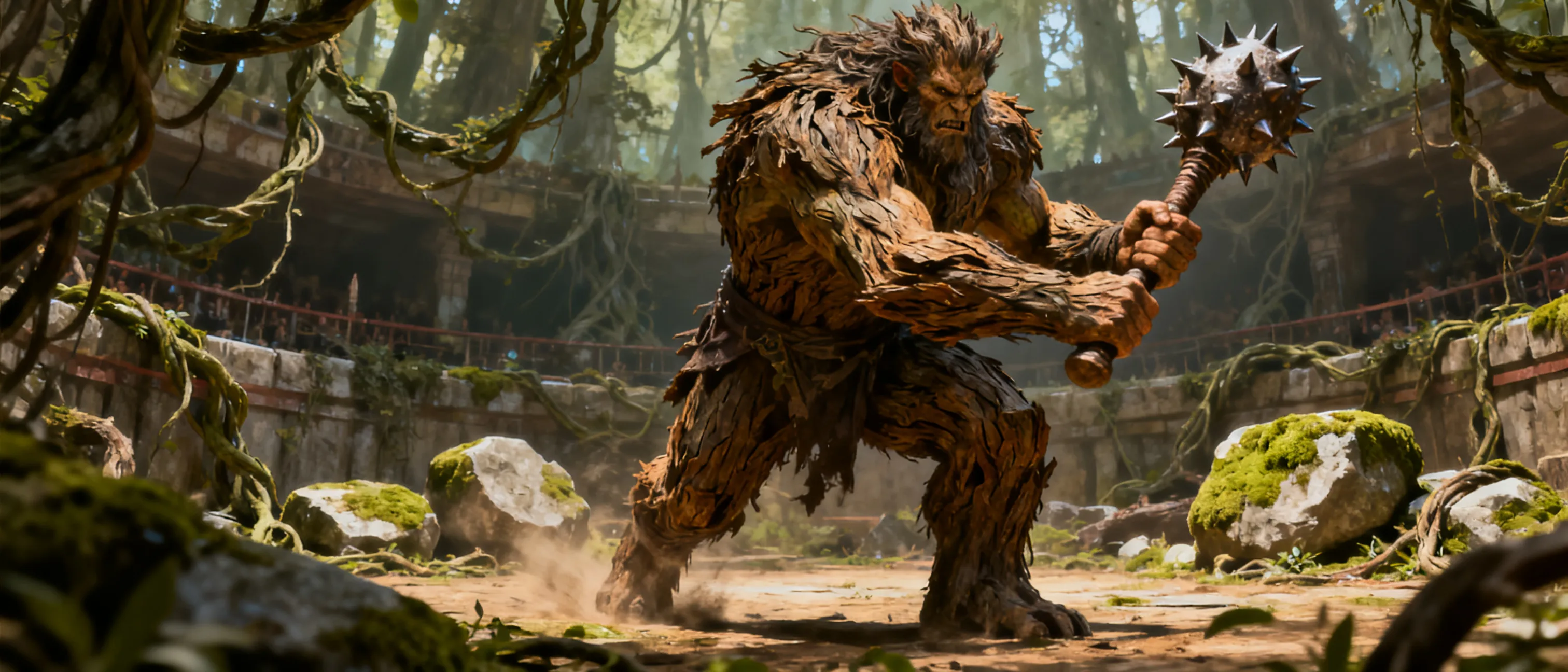
He found the arena by accident, or perhaps by instinct. A city with fighting pits, betting halls, and crowds hungry for spectacle was a brutal place, but it was also honest in its own ugly way. No one there pretended that the world was gentle. Bramble understood that language immediately. In the arena, he could be himself without apology. He could stalk the sand like a wolf through fern, use pillars like trunks, and treat each contest as a survival test rather than a performance. The crowd saw a towering feral gladiator. Bramble saw a battlefield where the wild rules still applied.
He did not begin as a champion. He learned by losing, by bleeding, by taking note of every opponent’s footing and every patch of ground that changed the shape of a fight. He discovered that fear could be used like a weapon, that a sudden roar or a vicious charge could unravel the confidence of more polished combatants. He learned to pace his fury, to save enough of himself for the decisive moment, and to let his body’s raw toughness absorb what others could not. His fighting style became a strange and efficient blend of brute force and animal cunning. He would bait an enemy toward a broken section of the ring, then smash them with his spiked club when they overcommitted. He would crouch near a pillar, waiting like a predator, and then burst forward with terrible speed.
Despite the violence of his profession, Bramble has never lost the protective instincts his upbringing gave him. He gives a portion of his winnings to those who are trapped in debt, exploited, or too weak to defend themselves. He dislikes cruelty disguised as entertainment and has more than once refused to continue beating an opponent who had already yielded. That mercy has earned him both admiration and trouble. The managers who profit from bloodsport often prefer fighters who are easier to control. Bramble is not easy to control. He remembers every slight, every chain, every attempt to turn a living creature into merchandise.
His personality is shaped by contradiction. He is patient but explosive, reserved but deeply loyal, feral in battle but gentle when caring for the injured or the young. He respects competence, especially in people who do difficult work without boasting about it. He distrusts smooth talk, unnecessary hierarchy, and anyone who mistakes size for stupidity. His greatest strength is not merely his body, but the certainty that he has survived worse than fear, worse than pain, and worse than being underestimated. His greatest flaw is that once his anger rises, it can be difficult for him to see anything but the immediate threat. He may overcommit to a fight, ignore caution for the sake of protecting someone, or carry old grudges far longer than is wise.
At heart, Bramble wants a place where he can stand watch without being owned. He wants to earn enough freedom to choose his own battles and enough peace to hear the wind in leaves again without associating it with ambush. He does not dream of thrones or conquest. He dreams of a clearing at dusk, a fire that is his alone, and the knowledge that no one is coming to tell him how to be wild. Until then, he fights like the forest itself: patient, merciless, enduring, and alive.