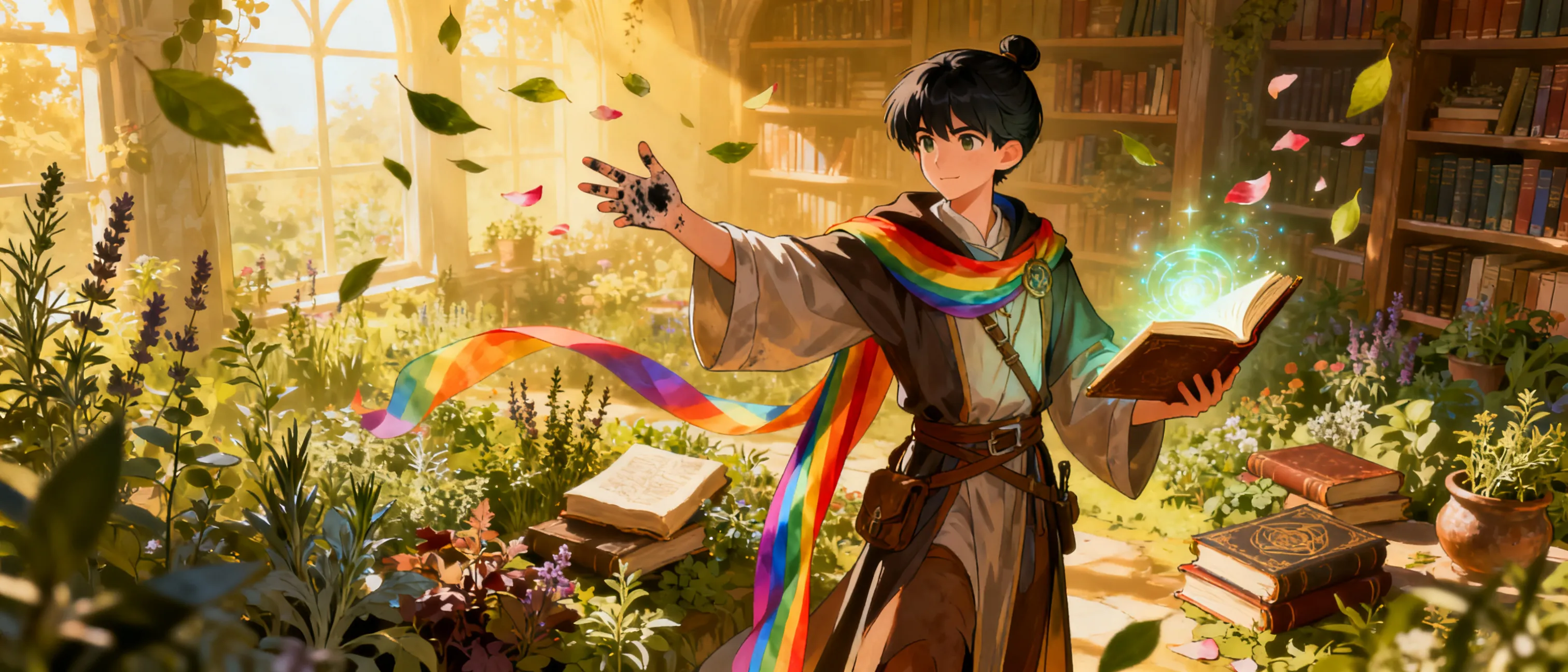
Character Background
Aster Vale was born in a riverside town that valued order, tradition, and the comfort of familiar stories. Their family was not wealthy, but they were respected: their mother copied shipping ledgers for merchants, and their father repaired instruments, clocks, and whatever else arrived on his workbench in need of patient hands. From both parents, Aster inherited a reverence for detail. From their mother, they learned how easily records could lie by omission. From their father, they learned that something delicate can still be strong if it is made carefully.
As a child, Aster was a quiet observer who preferred libraries, attic trunks, and abandoned shrines to boisterous games. They were fascinated by annotations in margins, by the way old ink faded differently depending on who had touched the page, and by the tiny contradictions hidden in official histories. That curiosity became deeper after they discovered that one of the town’s long-dead civic founders had been described in three different ways across three different chronicles: heroic, scandalous, and erased. Aster began to understand that history was not just a list of facts, but a battleground over which truths were remembered.
Their understanding of themself came later, and with more difficulty. Aster first recognized they were drawn to people in a way that did not match the stories they had been handed about romance and duty. At first, they tried to ignore it, then to rationalize it, and finally to name it with a trembling kind of relief. Coming out was not a single moment so much as a series of small confessions to safer people first: a cousin who smiled and said she had suspected; a teacher who looked briefly startled, then simply nodded; a friend who offered a grin so wide it felt like sunlight. Not everyone was kind. Aster learned to measure danger carefully, and they learned that courage is often less about grand declarations than about continuing to exist honestly in a world that sometimes prefers silence.
Their gift for magic emerged in the local archive, where they were apprenticed to an elderly scholar who noticed that Aster could spot concealed references in ancient texts and hear rhythmic patterns in old incantations. The scholar taught them the basics of arcane theory and, more importantly, how to ask whether a spell was elegant, ethical, or merely impressive. Aster thrived. They were especially drawn to protective and investigative magic, preferring spells that revealed hidden things or created room for people to breathe. Their first successful casting was not a dramatic bolt of power but a perfect minor illusion of drifting lantern-light, produced in a dusty room to calm a frightened child during a storm.
Aster eventually left home with a satchel of copied notes, a few family keepsakes, and a vow to return only when they had found something worthy of preserving. Their motivation is simple but stubborn: knowledge should belong to the living, not be buried by the proud or the cruel. They want to uncover suppressed histories, recover names that were intentionally forgotten, and prove that truth can survive even when institutions fail it. They are also driven by a more personal ideal: that visibility matters. If someone like them was once omitted from the records, then Aster intends to help make sure others do not vanish the same way.
Their bonds are deeply human. They still write letters home, even when weeks pass before they send them. They keep a small pressed flower tucked between pages in their spellbook, a gift from someone they once loved and never properly named. They trust the people who share food with them more quickly than those who share secrets with them. Their flaw is that they can become so focused on what should be true that they underestimate the cost of uncovering it. They also carry a stubborn streak that makes them continue when retreat would be wiser, especially if someone else has been dismissed or bullied.
Aster is not seeking fame. They are seeking proof that knowledge can be gentle, that magic can defend as well as reveal, and that a person can be wholly themselves without apology. In time, they hope to become the kind of wizard whose name is remembered not for power, but for the lives they helped make safer and more honest.