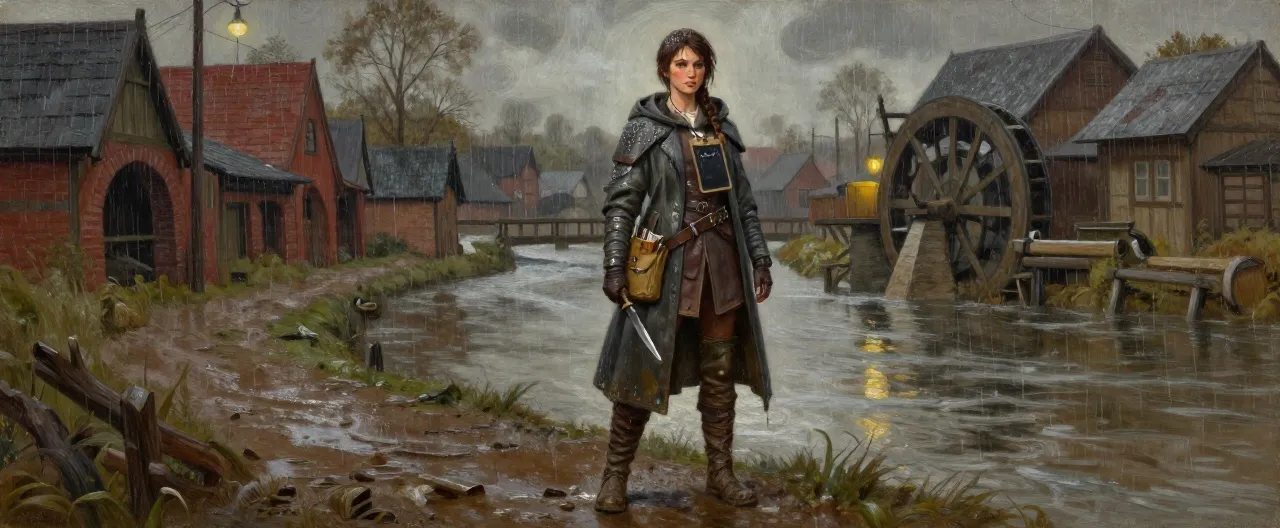
Marga Kent grew up in a carters' row outside a river town two hundred miles west of Fenwick, where her father drove salt and grain wagons and her mother took in mending. When Marga was fourteen, her father signed a note with a grain factor to replace a dead mule. The factor padded the interest, rolled penalties into principal, and within three years owned the row of rooms they lived in.
Marga watched her parents' lives shrink to a column of numbers that was never wrong in the factor's books and never right in any honest arithmetic. She taught herself to read ledgers by candlelight so she could check his figures, found the padded entries, and discovered the hard truth that a clever fraud beats a clever clerk when the magistrate holds the same pen. The law sided with the contract. The family lost the rooms. Marga lost her patience.
She left at seventeen with a slate, a knife, and a talent that turned out to be worth coin on the River Road. Honest work came first: tally-keeper for wagon caravans, counting sacks at the ford, checking manifests against weigh-house tallies at every crossing between the farms and the eastern cities. The dishonest work found her, as it always does. A fence and fixer named Elyas Flowers, who trades in paper rather than pickpockets' loot — forged toll writs, altered promissory notes, bills of sale that never were — took her on to audit the forgeries other people bought, because a bad forgery gets a buyer hanged and a good one is worth double.
Elyas taught her Thieves' Cant in a week and forgery kit work in a month, and remains her reliable contact in the underworld: she sends him a slate-rubbing of anything suspicious she finds in a town's paperwork, and he sends back names. He is the closest thing to a conscience the paper trade has, which is not saying much.
Dwarvish she learned from trade contracts, because half the salt and iron paper on the road is drafted by dwarf merchant houses and the fine print is where the money hides. She keeps a small Waukeen coin — the Merchant's Friend, patron of trade and coin — on the same cord as her slate, less from devotion than from professional respect: a goddess whose whole portfolio is fair dealing suits a tally-keeper.
Petra Hale at the Weir and Willow in Fenwick knows her better; three winters back, Marga traced a stolen promissory note through two river towns and put it back in Petra's hand, and the innkeeper has counted her a friend ever since, one of perhaps four people alive Marga would call that.
This spring she was hired by a caravan master to ride east with the salt wagons and reconcile the season's tallies, because the salt has been running light for six weeks and the discrepancy keeps pointing at one crossing: the Redwater Ford. She arrived at Fenwick's gate the same morning the melt flooded the ford and closed the road east, with a satchel of manifests that don't add up, a name she owes a favor to, and a professional certainty that somewhere in this town is a ledger with a lie in it.
She means to find it before the water drops — and if someone in a white mask has been putting people to sleep to keep their books quiet, she wants that on her slate too. Debts of that kind always come due.